## Diagram: Theoretical Model of Environment-Child Interaction
### Overview
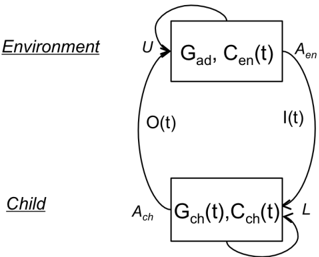
The image displays a theoretical block diagram illustrating a dynamic interaction system between two entities labeled "Environment" and "Child." The diagram uses mathematical notation to represent functions, variables, and the flow of signals or influences between these entities. It is a conceptual model, likely from fields such as developmental psychology, control theory, or systems biology.
### Components/Axes
The diagram is composed of two primary rectangular blocks connected by directional arrows, with additional self-loop arrows on each block.
**1. Top Block (Environment):**
* **Label:** `Environment` (positioned to the left of the block).
* **Block Content:** `G_ad, C_en(t)`
* **Input Arrow:** An arrow labeled `U` points into the left side of this block.
* **Output Arrow:** An arrow labeled `I(t)` exits the right side of this block and points downward to the "Child" block.
* **Self-Loop Arrow:** An arrow labeled `A_en` exits the top-right corner of the block and loops back into the top-left corner.
**2. Bottom Block (Child):**
* **Label:** `Child` (positioned to the left of the block).
* **Block Content:** `G_ch(t), C_ch(t)`
* **Input Arrow:** An arrow labeled `L` points into the right side of this block.
* **Output Arrow:** An arrow labeled `O(t)` exits the left side of this block and points upward to the "Environment" block.
* **Self-Loop Arrow:** An arrow labeled `A_ch` exits the bottom-left corner of the block and loops back into the bottom-right corner.
**3. Connecting Arrows (Flow):**
* `I(t)`: Flows from Environment (output) to Child (input).
* `O(t)`: Flows from Child (output) to Environment (input).
### Detailed Analysis
The diagram defines a closed-loop system with the following components and notations:
* **Entities:**
* **Environment:** Represented as a system with internal functions/parameters `G_ad` and `C_en(t)`.
* **Child:** Represented as a system with internal functions/parameters `G_ch(t)` and `C_ch(t)`.
* **Signals/Variables:**
* `U`: An external input to the Environment.
* `L`: An external input to the Child.
* `I(t)`: A time-dependent signal from Environment to Child.
* `O(t)`: A time-dependent signal from Child to Environment.
* `A_en`: A self-referential signal or feedback within the Environment.
* `A_ch`: A self-referential signal or feedback within the Child.
* **Notation Interpretation (Inferred):**
* `(t)`: Denotes a function or variable that changes over time.
* `G_ad`, `G_ch(t)`: Likely represent gain functions, transfer functions, or growth/adaptation mechanisms. `G_ad` is constant, while `G_ch` is time-dependent.
* `C_en(t)`, `C_ch(t)`: Likely represent state variables, capacities, or concentrations that evolve over time.
### Key Observations
1. **Bidirectional Coupling:** The core of the model is the bidirectional interaction between Environment and Child via signals `I(t)` and `O(t)`, forming a feedback loop.
2. **Asymmetry in Notation:** The Environment's gain `G_ad` is written as a constant, while the Child's gain `G_ch(t)` is explicitly time-dependent, suggesting the Child's response mechanism is modeled as changing over time.
3. **Self-Feedback Loops:** Both entities have internal feedback loops (`A_en`, `A_ch`), indicating self-regulation or memory effects within each system.
4. **External Inputs:** Both systems are subject to external influences (`U` for Environment, `L` for Child).
### Interpretation
This diagram represents a **coupled dynamical system** modeling the reciprocal influence between an environment and a developing child. It is an abstract, mathematical framework rather than a presentation of empirical data.
* **What it Demonstrates:** The model posits that child development (`C_ch(t)`) is not a passive process but an active one, shaped by (`I(t)`) and simultaneously shaping (`O(t)`) its environment. The internal functions (`G`, `C`) and self-loops (`A`) represent the child's innate or evolving capacities and the environment's persistent structures.
* **Relationships:** The arrows define causal pathways. The environment provides input (`I(t)`) to the child, whose state and output (`O(t)`) in turn modify the environment. External factors (`U`, `L`) perturb this closed loop. The self-loops suggest path-dependency or hysteresis in both systems.
* **Notable Implications:** The time-dependence of `G_ch(t)` is critical, implying that the child's ability to process environmental input and generate output changes with age or experience. The model's structure is consistent with theories of **transactional development** or **niche construction**, where organism and environment mutually shape each other over time. The lack of specific numerical values indicates this is a general schematic for formulating hypotheses or building computational models, not a report of specific findings.