## Diagram: Ax-Prover System Architecture and Workflow
### Overview
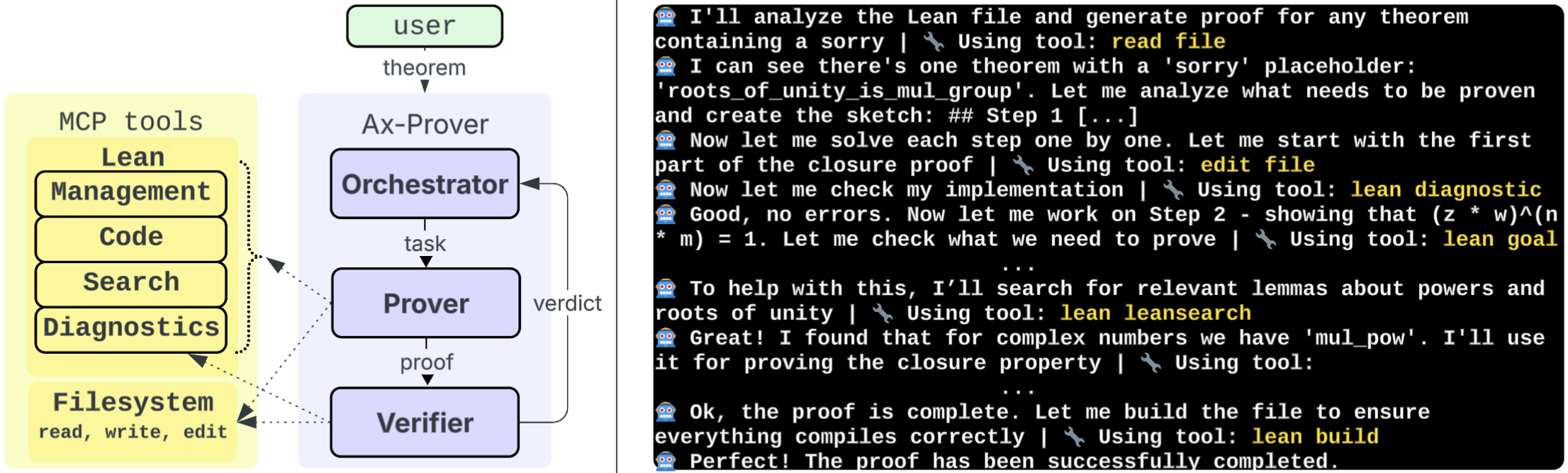
The image depicts a technical workflow diagram illustrating the integration of formal verification tools (MCP tools) with an automated proof system called Ax-Prover. The diagram is divided into two primary sections: (1) MCP tools on the left and (2) Ax-Prover components on the right, connected by bidirectional arrows indicating data flow and interaction.
---
### Components/Axes
#### Left Section: MCP Tools
- **Categories**:
- **Lean Management**: Contains sub-components labeled "Code," "Search," and "Diagnostics."
- **Filesystem**: Explicitly labeled with actions "read, write, edit."
- **Visual Structure**:
- Rectangular blocks with bold text for categories.
- Sub-components listed vertically within each category.
#### Right Section: Ax-Prover
- **Components**:
- **User**: Green box at the top, connected to "theorem" via a downward arrow.
- **Orchestrator**: Purple box below "theorem," connected to "task" via a downward arrow.
- **Prover**: Purple box below "task," connected to "proof" via a downward arrow.
- **Verifier**: Purple box below "proof," connected to "verdict" via a downward arrow.
- **Chat Log**:
- Text box on the far right containing a conversation between the user and the system, detailing steps like:
- Analyzing Lean files, generating proofs, editing files, and using tools like `lean diagnostic`, `lean search`, and `lean build`.
#### Arrows and Flow
- **Direction**:
- Left-to-right flow from MCP tools to Ax-Prover components.
- Right-to-left feedback from Verifier to Prover (via "proof" and "task").
- **Labels**:
- Arrows labeled "task," "proof," "verdict," and "theorem."
---
### Detailed Analysis
#### MCP Tools
- **Lean Management**:
- Sub-components: Code, Search, Diagnostics.
- Implies organizational and operational tools for managing Lean processes.
- **Filesystem**:
- Explicitly supports file operations (read, write, edit), critical for interacting with Lean files.
#### Ax-Prover Workflow
1. **User Input**:
- User submits a "theorem" containing a placeholder (e.g., `roots_of_unity_is_mul_group`).
2. **Orchestrator**:
- Breaks the task into steps (e.g., Step 1: closure proof).
3. **Prover**:
- Uses tools like `edit file` and `lean diagnostic` to iteratively refine proofs.
4. **Verifier**:
- Validates proofs using `lean search` and `lean build`.
5. **Verdict**:
- Final output confirms successful proof completion.
#### Chat Log Transcript
- **Key Commands/Responses**:
- `read file`: Analyzes Lean files for theorems.
- `edit file`: Modifies code to address errors (e.g., replacing `sorry` placeholders).
- `lean diagnostic`: Checks implementation correctness.
- `lean search`: Finds relevant lemmas (e.g., `mul_pow` for complex numbers).
- `lean build`: Ensures compilation correctness.
---
### Key Observations
1. **Integration of Tools**:
- MCP tools (e.g., Lean Management, Filesystem) are tightly coupled with Ax-Prover’s automated workflow.
2. **Iterative Proof Process**:
- The system uses a step-by-step approach (Step 1, Step 2) to decompose proofs, reflecting a modular verification strategy.
3. **Automation**:
- Tools like `lean build` and `lean search` automate error detection and lemma retrieval, reducing manual intervention.
4. **Bidirectional Feedback**:
- The Verifier’s verdict feeds back into the Prover, enabling iterative refinement.
---
### Interpretation
This diagram represents a formal verification pipeline designed to automate theorem proving in software development. The integration of MCP tools (e.g., Lean Management, Filesystem) with Ax-Prover’s components (Orchestrator, Prover, Verifier) suggests a system optimized for:
- **Efficiency**: Automating proof generation and verification reduces human error.
- **Scalability**: The Orchestrator’s task decomposition allows handling complex theorems incrementally.
- **Reliability**: The Verifier’s feedback loop ensures proofs meet formal standards before finalizing.
The chat log highlights the system’s ability to interact with Lean files, diagnose errors, and leverage existing mathematical lemmas (e.g., `mul_pow` for complex numbers). This indicates a focus on **closure properties** and **algebraic structures**, critical for verifying software correctness in domains like cryptography or formal methods.
The absence of explicit numerical data or trends suggests the diagram prioritizes **process visualization** over quantitative analysis. However, the structured workflow implies a systematic approach to proof automation, aligning with principles of formal verification in software engineering.