## Diagram: High Level Architecture of ClarifAI
### Overview
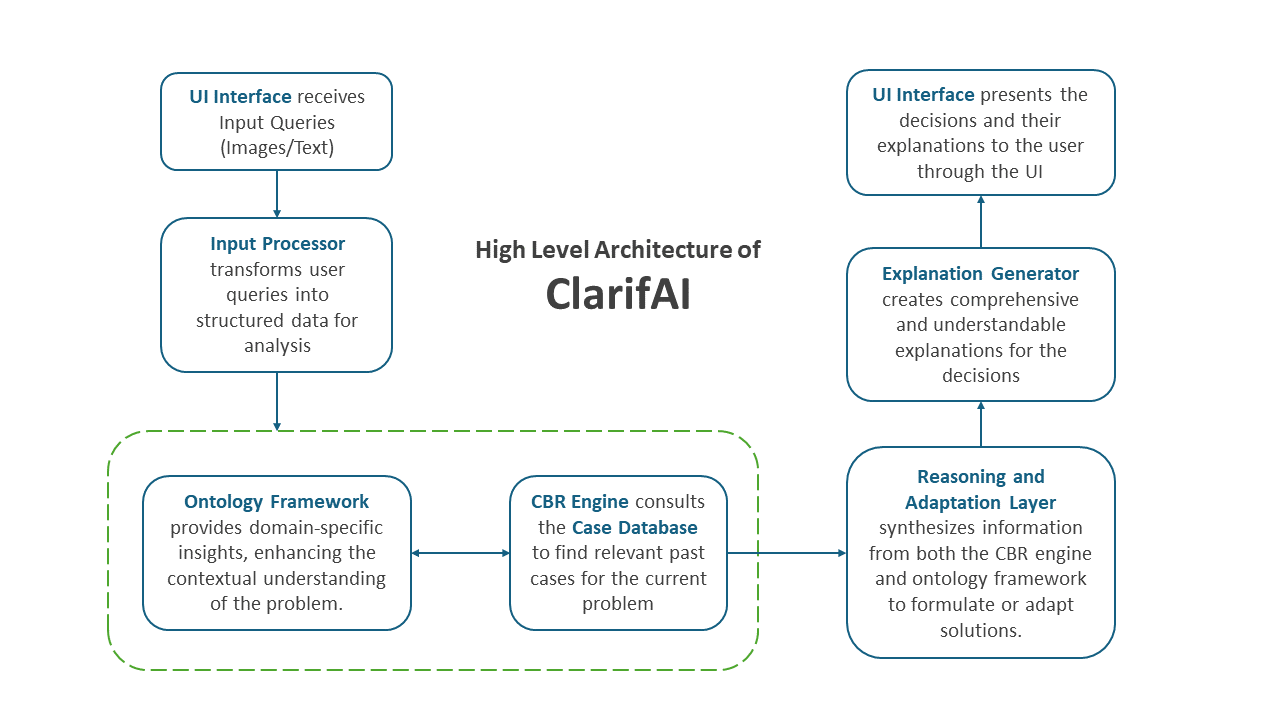
The image is a diagram illustrating the high-level architecture of ClarifAI. It depicts the flow of information and processes between different components, starting from user input and leading to explanations of decisions.
### Components/Axes
The diagram consists of several rectangular blocks representing different components, connected by arrows indicating the flow of information. The components are:
1. **UI Interface (Top-Left)**: Receives Input Queries (Images/Text)
2. **Input Processor (Mid-Left)**: Transforms user queries into structured data for analysis.
3. **Ontology Framework (Bottom-Left)**: Provides domain-specific insights, enhancing the contextual understanding of the problem.
4. **CBR Engine (Bottom-Center)**: Consults the Case Database to find relevant past cases for the current problem.
5. **Reasoning and Adaptation Layer (Bottom-Right)**: Synthesizes information from both the CBR engine and ontology framework to formulate or adapt solutions.
6. **Explanation Generator (Mid-Right)**: Creates comprehensive and understandable explanations for the decisions.
7. **UI Interface (Top-Right)**: Presents the decisions and their explanations to the user through the UI.
A dashed green line encloses the Ontology Framework and CBR Engine, suggesting a close relationship or shared context.
### Detailed Analysis
* **UI Interface (Top-Left)**: This is the entry point of the system, where the user provides input in the form of images or text.
* **Input Processor (Mid-Left)**: The input processor takes the user's queries and transforms them into a structured format suitable for analysis.
* **Ontology Framework (Bottom-Left)**: This component provides domain-specific knowledge, which helps in understanding the context of the problem.
* **CBR Engine (Bottom-Center)**: The CBR (Case-Based Reasoning) engine consults a case database to find similar past cases that can be used to solve the current problem.
* **Reasoning and Adaptation Layer (Bottom-Right)**: This layer combines the information from the CBR engine and the ontology framework to formulate or adapt solutions.
* **Explanation Generator (Mid-Right)**: The explanation generator creates comprehensive and understandable explanations for the decisions made by the system.
* **UI Interface (Top-Right)**: This is the output stage, where the system presents the decisions and their explanations to the user.
The flow of information is as follows:
1. User input enters through the UI Interface (Top-Left).
2. The Input Processor transforms the input.
3. The Ontology Framework and CBR Engine work together to provide context and find relevant past cases.
4. The Reasoning and Adaptation Layer synthesizes information from the Ontology Framework and CBR Engine.
5. The Explanation Generator creates explanations for the decisions.
6. The UI Interface (Top-Right) presents the decisions and explanations to the user.
### Key Observations
* The diagram illustrates a closed-loop system, where user input is processed, analyzed, and used to generate decisions and explanations.
* The Ontology Framework and CBR Engine are closely related, as indicated by the dashed green line.
* The Reasoning and Adaptation Layer plays a crucial role in synthesizing information from different sources.
* The Explanation Generator is essential for making the system's decisions transparent and understandable to the user.
### Interpretation
The diagram provides a high-level overview of the ClarifAI architecture, highlighting the key components and their interactions. It demonstrates how the system processes user input, leverages domain-specific knowledge and past cases, and generates explanations for its decisions. The architecture emphasizes the importance of both reasoning and explanation in AI systems. The system aims to provide not only accurate decisions but also understandable explanations, enhancing user trust and acceptance.