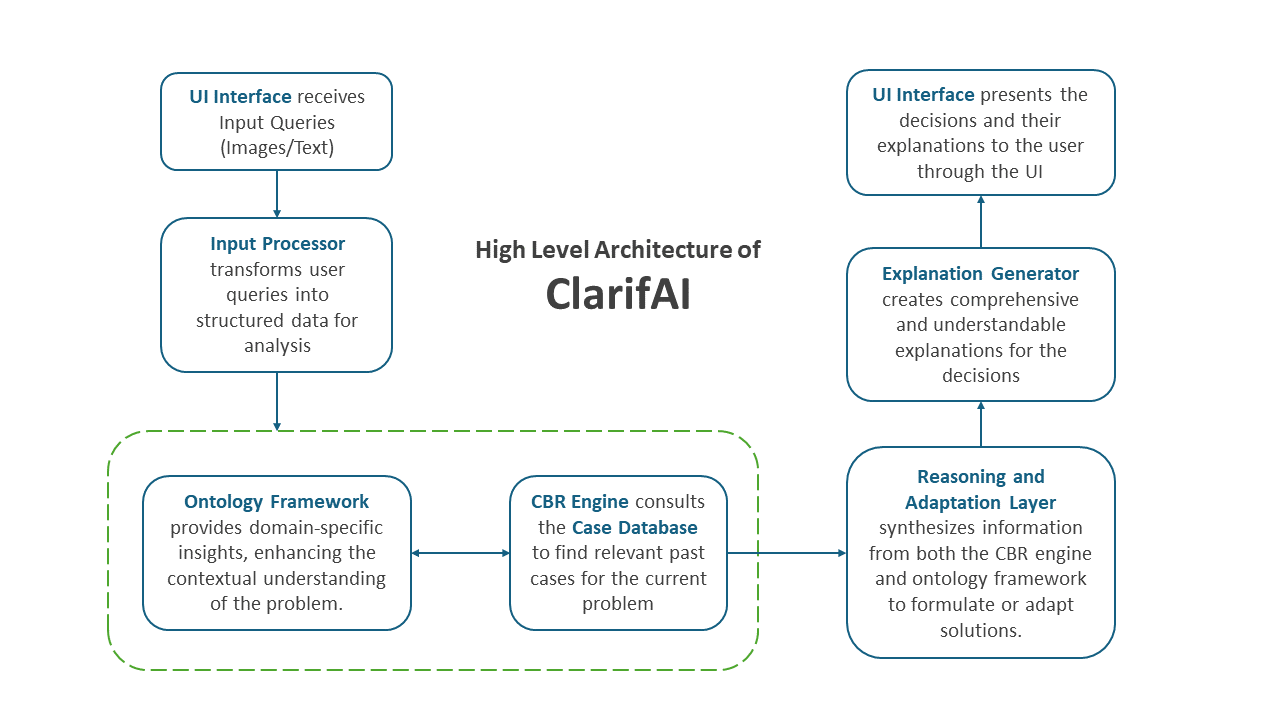
## Flowchart: High Level Architecture of ClarifAI
### Overview
The diagram illustrates the workflow of ClarifAI, a system designed to process user queries (images/text) and generate explanations for decisions. It depicts a cyclical process starting and ending at the **UI Interface**, with intermediate components handling data transformation, contextual analysis, case retrieval, reasoning, and explanation generation.
---
### Components/Axes
1. **UI Interface**: Receives input queries (images/text) and presents final decisions/explanations to the user.
2. **Input Processor**: Transforms raw user queries into structured data for analysis.
3. **Ontology Framework**: Provides domain-specific contextual insights to enhance problem understanding.
4. **CBR Engine**: Consults the **Case Database** to retrieve relevant past cases for the current problem.
5. **Reasoning and Adaptation Layer**: Synthesizes information from the CBR Engine and Ontology Framework to formulate/adapt solutions.
6. **Explanation Generator**: Creates comprehensive, understandable explanations for decisions.
7. **Case Database**: Stores past cases referenced by the CBR Engine.
**Flow Direction**: Arrows indicate data/process flow (e.g., "Input Processor → Ontology Framework," "CBR Engine ↔ Ontology Framework," "Reasoning Layer → Explanation Generator → UI Interface").
---
### Detailed Analysis
- **Input Processing**: User queries enter the system via the UI Interface and are preprocessed into structured data by the Input Processor.
- **Contextual Enrichment**: The Ontology Framework enriches the structured data with domain-specific context, improving problem comprehension.
- **Case Retrieval**: The CBR Engine uses the enriched data to query the Case Database for analogous past cases.
- **Adaptive Reasoning**: The Reasoning and Adaptation Layer integrates insights from both the CBR Engine (past cases) and Ontology Framework (context) to generate solutions.
- **Explanation Synthesis**: The Explanation Generator translates these solutions into human-understandable explanations.
- **Feedback Loop**: Explanations are sent back to the UI Interface for user interaction, completing the cycle.
---
### Key Observations
1. **Bidirectional Interaction**: The CBR Engine and Ontology Framework share a bidirectional connection, indicating collaborative refinement of solutions.
2. **Iterative Workflow**: The system emphasizes iterative improvement, with explanations feeding back into the UI for potential user adjustments.
3. **Modular Design**: Components are decoupled (e.g., Case Database is a standalone storage), suggesting scalability and maintainability.
---
### Interpretation
This architecture demonstrates a **hybrid AI system** combining **Case-Based Reasoning (CBR)** with **ontology-driven contextual understanding**. By integrating past case retrieval with domain-specific reasoning, ClarifAI aims to produce transparent, adaptable decisions. The feedback loop to the UI Interface highlights a user-centric design, where explanations are not static but can be refined based on user input. The modular structure suggests the system could be extended (e.g., adding new data sources or explanation styles) without overhauling the entire pipeline.