## Grid Diagram: Unlabeled Cartesian Plane with Shaded Region
### Overview
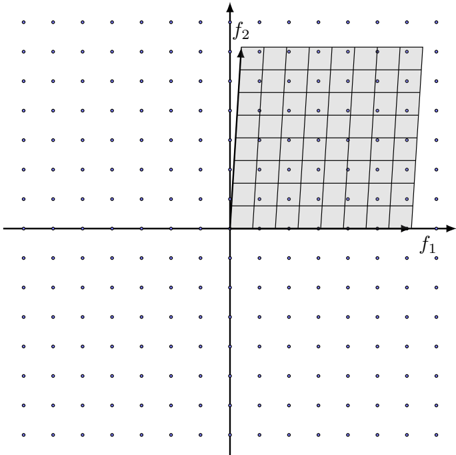
The image depicts a Cartesian coordinate system with a grid overlay. A rectangular region in the first quadrant (where both f₁ and f₂ are positive) is shaded in light gray. The grid consists of evenly spaced horizontal and vertical lines, with no numerical labels, axis markers, or legends visible.
### Components/Axes
- **Axes**:
- Horizontal axis labeled **f₁** (rightward direction).
- Vertical axis labeled **f₂** (upward direction).
- **Grid**:
- Uniform grid lines spaced at regular intervals.
- No numerical tick marks or axis scaling provided.
- **Shaded Region**:
- Rectangular area bounded by:
- Left edge: f₁ ≈ 0 (origin).
- Right edge: f₁ ≈ 10 (estimated based on grid spacing).
- Bottom edge: f₂ ≈ 0 (origin).
- Top edge: f₂ ≈ 8 (estimated based on grid spacing).
### Detailed Analysis
- **Grid Spacing**:
- Horizontal (f₁) and vertical (f₂) grid lines appear equidistant, suggesting a 1:1 aspect ratio.
- No explicit units or scaling defined.
- **Shaded Region**:
- Positioned entirely in the first quadrant.
- Dimensions: Approximately 10 units (f₁) × 8 units (f₂).
- No internal subdivisions or annotations.
### Key Observations
1. **No Data Points or Labels**: The absence of numerical values, legends, or textual annotations suggests this is a template or placeholder for data visualization.
2. **Shaded Region Ambiguity**: The purpose of the shaded area is unclear without contextual labels (e.g., "Region of Interest" or "Solution Set").
3. **Grid Uniformity**: The grid’s regularity implies potential use for plotting functions, inequalities, or geometric shapes.
### Interpretation
This image likely serves as a **base template** for technical or mathematical visualization. The shaded region could represent:
- A solution set for an inequality (e.g., f₁ ≤ 10, f₂ ≤ 8).
- A bounded domain for a function or optimization problem.
- A placeholder for heatmap data, where shading intensity might encode values.
The lack of explicit data or labels necessitates additional context to interpret the shaded region’s significance. The grid’s uniformity and axis labels (f₁, f₂) suggest applications in fields like engineering, economics, or computational modeling, where two-variable relationships are analyzed.