## Code Comparison: LLM vs. LLM + APOLLO
### Overview
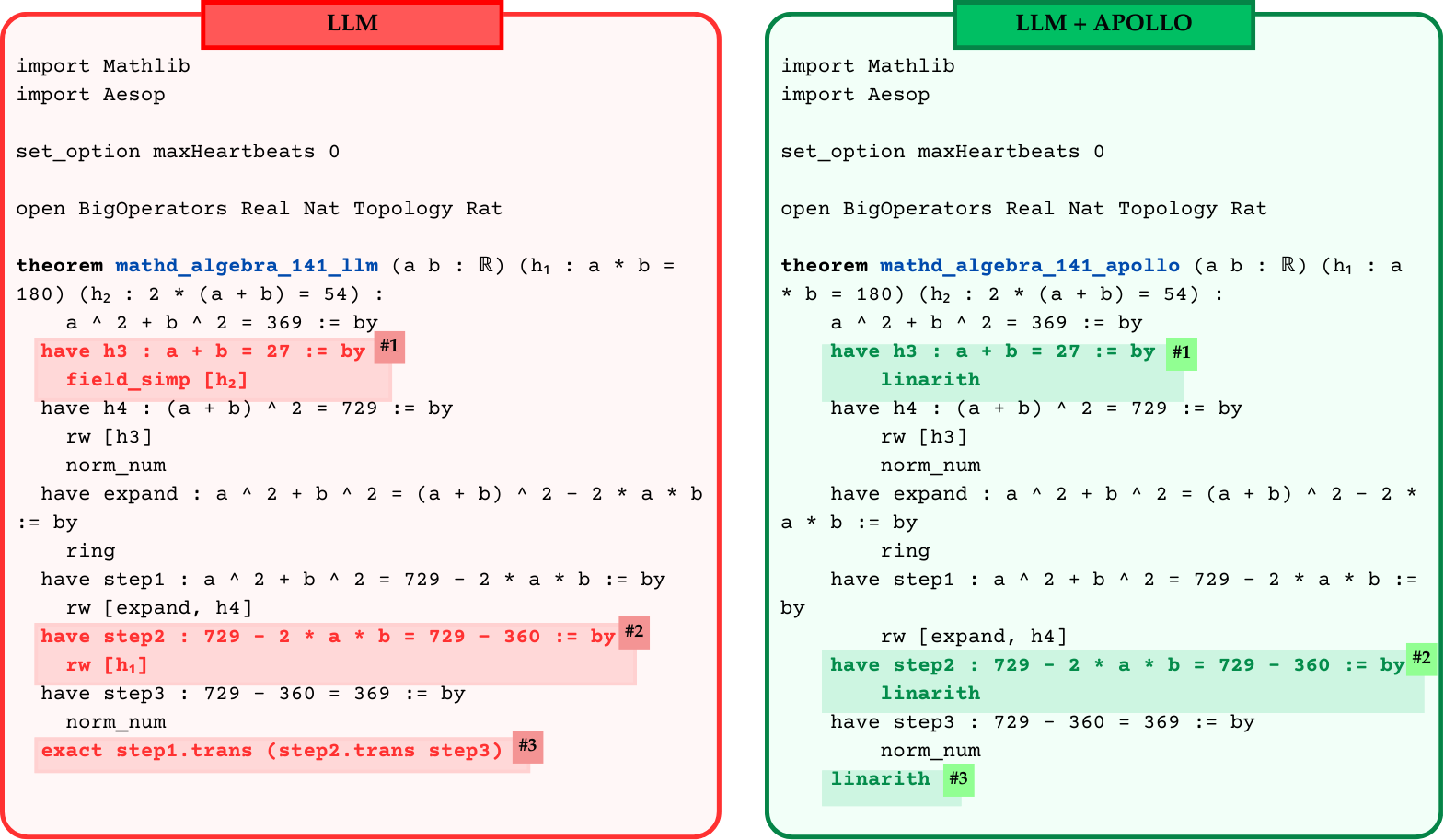
The image presents a side-by-side comparison of code snippets, labeled "LLM" (left) and "LLM + APOLLO" (right). The code appears to be a mathematical proof or derivation, likely written in a formal language like Lean or similar. The comparison highlights differences in the steps required to reach the same conclusion, with "LLM + APOLLO" using more automated tactics like `linarith` to simplify the proof.
### Components/Axes
* **Headers:**
* Left: "LLM" (red background)
* Right: "LLM + APOLLO" (green background)
* **Code Blocks:** Each side contains a code block with similar structure, including:
* Import statements (`import Mathlib`, `import Aesop`)
* Setting options (`set_option maxHeartbeats 0`)
* Opening operators (`open BigOperators Real Nat Topology Rat`)
* Theorem definition (`theorem mathd_algebra_141_llm` and `theorem mathd_algebra_141_apollo`)
* Proof steps using `have`, `rw`, `norm_num`, `ring`, and `exact`.
* **Annotations:** The code contains annotations marked with "#1", "#2", and "#3", highlighting specific lines or steps. These annotations are colored red in the "LLM" version and green in the "LLM + APOLLO" version.
### Detailed Analysis or ### Content Details
**LLM (Left Side):**
* `import Mathlib`
* `import Aesop`
* `set_option maxHeartbeats 0`
* `open BigOperators Real Nat Topology Rat`
* `theorem mathd_algebra_141_llm (a b : R) (h₁ : a * b = 180) (h₂ : 2 * (a + b) = 54) :`
* `a ^ 2 + b ^ 2 = 369 := by`
* `have h3 : a + b = 27 := by #1` (red highlight)
* `field_simp [h2]`
* `have h4 : (a + b) ^ 2 = 729 := by`
* `rw [h3]`
* `norm_num`
* `have expand : a ^ 2 + b ^ 2 = (a + b) ^ 2 - 2 * a * b := by`
* `ring`
* `have step1 : a ^ 2 + b ^ 2 = 729 - 2 * a * b := by`
* `rw [expand, h4]`
* `have step2 : 729 - 2 * a * b = 729 - 360 := by #2` (red highlight)
* `rw [h₁]`
* `have step3 : 729 - 360 = 369 := by`
* `norm_num`
* `exact step1.trans (step2.trans step3) #3` (red highlight)
**LLM + APOLLO (Right Side):**
* `import Mathlib`
* `import Aesop`
* `set_option maxHeartbeats 0`
* `open BigOperators Real Nat Topology Rat`
* `theorem mathd_algebra_141_apollo (a b : R) (h₁ : a * b = 180) (h₂ : 2 * (a + b) = 54) :`
* `a ^ 2 + b ^ 2 = 369 := by`
* `have h3 : a + b = 27 := by #1` (green highlight)
* `linarith`
* `have h4 : (a + b) ^ 2 = 729 := by`
* `rw [h3]`
* `norm_num`
* `have expand : a ^ 2 + b ^ 2 = (a + b) ^ 2 - 2 * a * b := by`
* `ring`
* `have step1 : a ^ 2 + b ^ 2 = 729 - 2 * a * b := by`
* `rw [expand, h4]`
* `have step2 : 729 - 2 * a * b = 729 - 360 := by #2` (green highlight)
* `linarith`
* `have step3 : 729 - 360 = 369 := by`
* `norm_num`
* `linarith #3` (green highlight)
### Key Observations
* The "LLM + APOLLO" version uses the `linarith` tactic more frequently, simplifying the proof steps.
* The annotations #1, #2, and #3 highlight the key differences in the proof strategies.
* In the LLM version, `field_simp [h2]` is used after `have h3`, while in the LLM + APOLLO version, `linarith` is used instead.
* In the LLM version, `rw [h1]` is used after `have step2`, while in the LLM + APOLLO version, `linarith` is used instead.
* In the LLM version, `exact step1.trans (step2.trans step3)` is used to complete the proof, while in the LLM + APOLLO version, `linarith` is used instead.
### Interpretation
The comparison demonstrates how the addition of the "APOLLO" tactic (likely an automated theorem prover or simplification tool) can significantly streamline mathematical proofs. The "LLM + APOLLO" version requires fewer explicit steps, relying on `linarith` to automatically deduce intermediate results. This suggests that "APOLLO" can automate certain aspects of the proof process, making it more efficient and potentially easier to understand. The annotations highlight specific points where "APOLLO" replaces manual steps, showcasing its impact on the overall proof structure.