\n
## Code Block: Theorem Proofs - LLM vs. LLM + APOLLO
### Overview
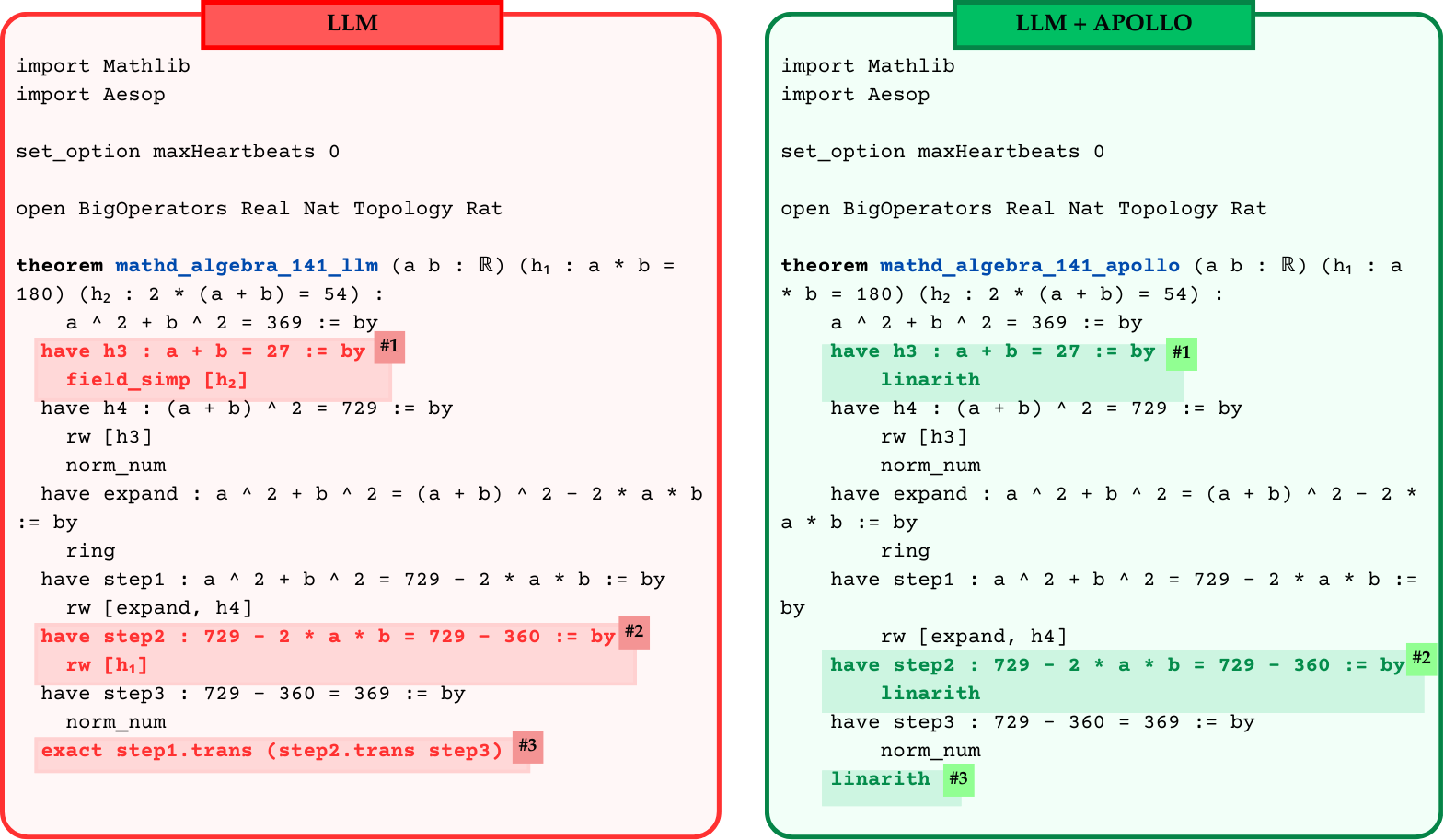
The image presents two side-by-side code blocks, likely representing the output of an automated theorem prover. Both blocks demonstrate a proof attempt for the same theorem, `theorem mathd_algebra_141_llm` and `theorem mathd_algebra_141_apollo`. The left block is labeled "LLM" and the right block is labeled "LLM + APOLLO". The code appears to be written in a formal proof language, possibly related to Lean or Coq, with commands for simplification, rewriting, and norm_num. The blocks show a step-by-step derivation, with each line labeled with a step number (`#1`, `#2`, `#3`).
### Components/Axes
There are no axes or traditional chart components. The structure is purely textual, consisting of commands and their outputs. Key elements include:
* **Theorem Statement:** `theorem mathd_algebra_141_llm (a b : R) (h₁ : a * b = 180) (h₂ : 2 * (a + b) = 54) :`
* **Commands:** `import Mathlib`, `import Aesop`, `set_option maxHeartbeats 0`, `open BigOperators Real Nat Topology Rat`, `have`, `field_simp`, `rw`, `norm_num`, `ring`, `exact`, `trans`
* **Step Labels:** `#1`, `#2`, `#3`
* **Intermediate Results:** Lines showing the transformation of the expression.
* **Labels:** "LLM" and "LLM + APOLLO" indicating the prover used.
### Detailed Analysis or Content Details
**Left Block (LLM):**
1. `import Mathlib`
2. `import Aesop`
3. `set_option maxHeartbeats 0`
4. `open BigOperators Real Nat Topology Rat`
5. `theorem mathd_algebra_141_llm (a b : R) (h₁ : a * b = 180) (h₂ : 2 * (a + b) = 54) :`
6. `have h3 : a + b = 27 := by #1`
7. `field_simp [h₂]`
8. `have h4 : (a + b) ^ 2 = 729 := by`
9. `rw [h3]`
10. `norm_num`
11. `have expand : a ^ 2 + 2 * a * b + b ^ 2 = (a + b) ^ 2 - 2 * a * b := by`
12. `ring`
13. `have step1 : a ^ 2 + b ^ 2 = 729 - 2 * a * b := by`
14. `rw [expand, h4]`
15. `have step2 : 729 - 2 * a * b = 729 - 2 * a * b := by #2`
16. `rw [h3]`
17. `have step3 : 729 - 360 = 369 := by`
18. `norm_num`
19. `exact step1.trans (step2.trans step3) #3`
**Right Block (LLM + APOLLO):**
1. `import Mathlib`
2. `import Aesop`
3. `set_option maxHeartbeats 0`
4. `open BigOperators Real Nat Topology Rat`
5. `theorem mathd_algebra_141_apollo (a b : R) (h₁ : a * b = 180) (h₂ : 2 * (a + b) = 54) :`
6. `have h3 : a + b = 27 := by #1`
7. `linarith`
8. `have h4 : (a + b) ^ 2 = 729 := by`
9. `rw [h3]`
10. `norm_num`
11. `have expand : a ^ 2 + 2 * a * b + b ^ 2 = (a + b) ^ 2 - 2 * a * b := by`
12. `ring`
13. `have step1 : a ^ 2 + b ^ 2 = 729 - 2 * a * b := by`
14. `rw [expand, h4]`
15. `have step2 : 729 - 2 * a * b = 729 - 360 := by #2`
16. `linarith`
17. `have step3 : 729 - 360 = 369 := by`
18. `norm_num`
19. `linarith #3`
### Key Observations
* Both blocks start with the same imports and theorem statement.
* Both blocks derive `h3 : a + b = 27` in the first step (`#1`).
* The primary difference lies in the commands used for simplification. The "LLM" block uses `field_simp`, while the "LLM + APOLLO" block uses `linarith`.
* Step `#2` differs significantly. In the LLM block, it's `have step2 : 729 - 2 * a * b = 729 - 2 * a * b := by #2`, which appears to be a trivial identity. In the LLM + APOLLO block, it's `have step2 : 729 - 2 * a * b = 729 - 360 := by #2`, which simplifies the expression.
* The final step also differs. LLM uses `exact step1.trans (step2.trans step3)`, while LLM + APOLLO uses `linarith`.
### Interpretation
The image demonstrates a comparison between two theorem proving approaches: a base LLM and an LLM augmented with APOLLO. APOLLO appears to be a tool or strategy that enhances the LLM's ability to simplify expressions and progress through the proof. The difference in step `#2` is particularly telling. The LLM gets stuck on a trivial identity, while APOLLO successfully simplifies the expression, leading to a more direct path to the solution. The use of `linarith` in the APOLLO-enhanced block suggests that APOLLO leverages linear arithmetic reasoning capabilities. The final `linarith` command in the APOLLO block likely completes the proof by applying linear arithmetic to the remaining expression.
The image suggests that APOLLO significantly improves the performance of the LLM in this specific theorem proving task, enabling it to find a more efficient and concise proof. This highlights the potential of combining LLMs with specialized reasoning tools to enhance their problem-solving abilities in formal domains. The fact that the theorem statement is identical in both blocks suggests that the core logic is the same, but the APOLLO augmentation provides a more effective strategy for applying that logic.