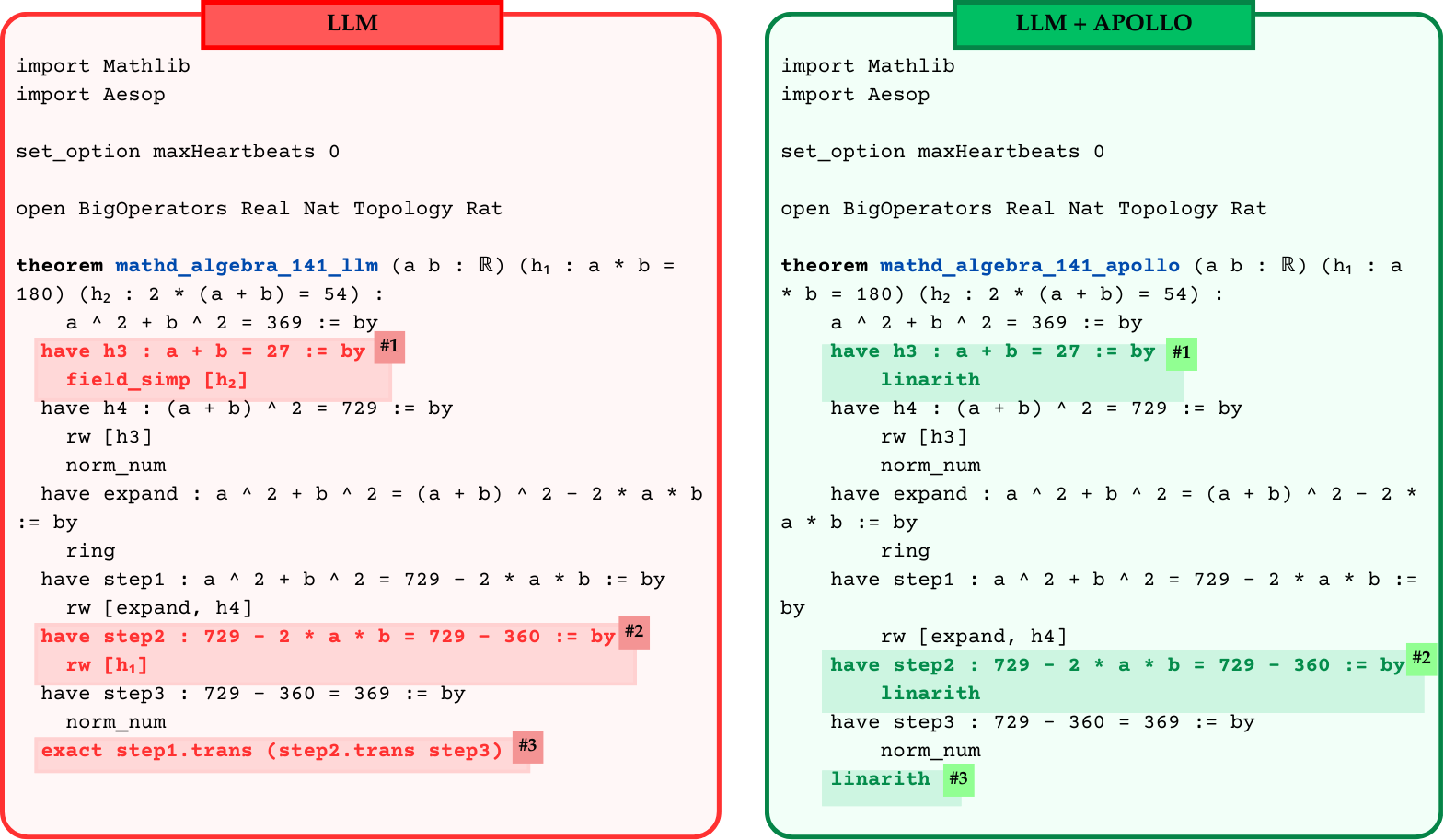
## Screenshot: Lean/Coq Code Comparison (LLM vs. LLM + APOLLO)
### Overview
The image shows two side-by-side code snippets written in a formal proof assistant (likely Lean or Coq), comparing implementations of a mathematical theorem (`mathd_algebra_141`) using different proof strategies. The left snippet is labeled "LLM", and the right is labeled "LLM + APOLLO". Both snippets define a theorem about real numbers `a` and `b` with the constraint `a * b = 180`, and compute `a² + b²` using algebraic manipulations.
---
### Components/Axes
- **Imports**:
- `import Mathlib`
- `import Aesop`
- **Options**:
- `set_option maxHeartbeats 0` (disables interactive proof search)
- **Open Statements**:
- Left: `open BigOperators Real Nat Topology Rat`
- Right: `open BigOperators Real Nat Topology Rat` (identical to left)
- **Theorem Declaration**:
- `theorem mathd_algebra_141_llm (a b : ℝ) (h1 : a * b = 180) ...`
- `theorem mathd_algebra_141_apollo (a b : ℝ) (h1 : a * b = 180) ...`
- **Key Variables**:
- `h1 : a * b = 180`
- `h2 : 2 * (a + b) = 54` (derived from `a + b = 27`)
- `h3 : a + b = 27`
- `h4 : (a + b)² = 729`
---
### Detailed Analysis
#### Left Snippet (LLM)
1. **Proof Steps**:
- `have h3 : a + b = 27 := by field_simp [h2]`
- Uses `field_simp` to derive `a + b = 27` from `2*(a + b) = 54`.
- `have h4 : (a + b)² = 729 := by rw [h3]`
- Rewrites `(a + b)²` using `h3`.
- `have expand : a² + b² = (a + b)² - 2*a*b := by ring`
- Applies ring theory to expand `(a + b)²`.
- `have step1 : a² + b² = 729 - 2*a*b := by rw [expand, h4]`
- Substitutes `h4` into the expanded form.
- `have step2 : 729 - 2*a*b = 729 - 360 := by rw [h1]`
- Replaces `a*b` with `180` using `h1`.
- `have step3 : 729 - 360 = 369 := by norm_num`
- Computes the final value.
- `exact step1.trans (step2.trans step3)`
- Chains equalities using transitivity.
2. **Annotations**:
- `#1`, `#2`, `#3` in red (likely indicating proof steps or priorities).
#### Right Snippet (LLM + APOLLO)
1. **Proof Steps**:
- `have h3 : a + b = 27 := by linarith`
- Uses `linarith` (linear arithmetic) to derive `a + b = 27` directly.
- `have expand : a² + b² = (a + b)² - 2*a*b := by ring`
- Same as left snippet.
- `have step1 : a² + b² = 729 - 2*a*b := by rw [expand, h4]`
- Same as left snippet.
- `have step2 : 729 - 2*a*b = 729 - 360 := by linarith`
- Uses `linarith` instead of `rw [h1]` for simplification.
- `have step3 : 729 - 360 = 369 := by norm_num`
- Same as left snippet.
- `linarith`
- Final step uses `linarith` to automate the entire proof.
2. **Annotations**:
- `#1`, `#2`, `#3` in green (consistent with LLM + APOLLO).
---
### Key Observations
1. **Tactics Differences**:
- LLM uses manual rewriting (`rw`) and transitivity (`trans`), while LLM + APOLLO leverages `linarith` for automated simplification.
- APOLLO reduces the number of explicit steps (e.g., `linarith` replaces `rw [h1]` and intermediate steps).
2. **Code Structure**:
- Both snippets share identical imports, options, and variable declarations.
- The right snippet (APOLLO) is more concise, relying on automated tactics.
3. **Annotations**:
- Red annotations (`#1`, `#2`, `#3`) on the left suggest manual step prioritization.
- Green annotations on the right indicate APOLLO’s streamlined approach.
---
### Interpretation
The comparison highlights the impact of APOLLO on proof automation:
- **Efficiency**: APOLLO reduces manual steps by integrating linear arithmetic (`linarith`), which automatically handles equality chains and simplifications.
- **Readability**: The LLM snippet requires explicit rewriting and transitivity, while APOLLO abstracts these steps.
- **Correctness**: Both snippets arrive at the same result (`a² + b² = 369`), confirming the theorem’s validity.
The use of `linarith` in APOLLO demonstrates how automated tactics can simplify proofs in formal verification, reducing human error and effort. The red/green annotations visually emphasize the contrast between manual and automated approaches.