## Flowchart Diagram: State Transition Relationships
### Overview
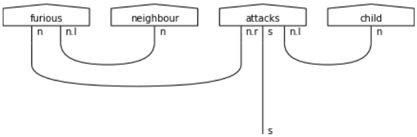
The diagram illustrates a state transition system with four primary nodes ("furious," "neighbour," "attacks," "child") connected by directional arrows. Each node contains sub-labels indicating state modifiers, and the flow suggests conditional transitions between states. The structure resembles a finite state machine or decision tree with explicit branching logic.
### Components/Axes
- **Nodes**:
1. **Furious** (top-left)
- Sub-labels: `n` (primary state), `n.l` (left modifier)
2. **Neighbour** (top-center)
- Sub-label: `n` (primary state)
3. **Attacks** (top-right)
- Sub-labels: `n.r` (right modifier), `s` (secondary state), `n.l` (left modifier)
4. **Child** (bottom-right)
- Sub-label: `n` (primary state)
- **Arrows**:
- Horizontal connections between nodes
- Vertical arrow from "Attacks" labeled `s` pointing downward to a terminal `s` state
### Detailed Analysis
1. **Furious Node**:
- Primary state: `n` (neutral/normal)
- Left modifier: `n.l` (possibly "neutral-left" or "non-lethal")
- Outgoing arrows to "Neighbour" and "Attacks"
2. **Neighbour Node**:
- Primary state: `n`
- Single incoming arrow from "Furious"
- Outgoing arrow to "Attacks"
3. **Attacks Node**:
- Primary state: `n.r` (right modifier, possibly "neutral-right" or "non-relative")
- Secondary state: `s` (terminal state)
- Left modifier: `n.l`
- Incoming arrows from "Furious" and "Neighbour"
- Outgoing arrow to "Child"
4. **Child Node**:
- Primary state: `n`
- Single incoming arrow from "Attacks"
5. **Terminal State**:
- Labeled `s` (possibly "stop" or "success")
- Reached via vertical arrow from "Attacks"
### Key Observations
- **Branching Logic**: The "Furious" state splits into two paths: one leading to "Neighbour" and another directly to "Attacks."
- **Convergence Point**: Both "Furious" and "Neighbour" feed into "Attacks," creating a decision node.
- **State Modifiers**: The use of `n.l`/`n.r` suggests directional or contextual variations of the neutral state.
- **Terminal State**: The `s` state acts as an endpoint, disconnected from further transitions.
### Interpretation
This diagram likely represents a conflict resolution or behavioral state machine:
1. **Initial State**: "Furious" (`n`) can escalate either through social interaction ("Neighbour") or direct action ("Attacks").
2. **Modifiers**: The `n.l`/`n.r` labels imply contextual adjustments to the base state (e.g., "non-lethal" or "non-relative" attacks).
3. **Terminal Outcome**: All paths eventually lead to the `s` state, suggesting resolution or termination of the conflict sequence.
4. **Child State**: The "Child" node (`n`) may represent a reset or neutral outcome after an attack, though its single connection makes its role ambiguous.
The structure emphasizes conditional transitions and state dependencies, with modifiers (`n.l`, `n.r`) potentially representing contextual flags influencing state behavior. The terminal `s` state acts as a system-wide endpoint, regardless of the path taken.