## Chart/Diagram Type: Multi-Panel Plot of Neural Network Activity
### Overview
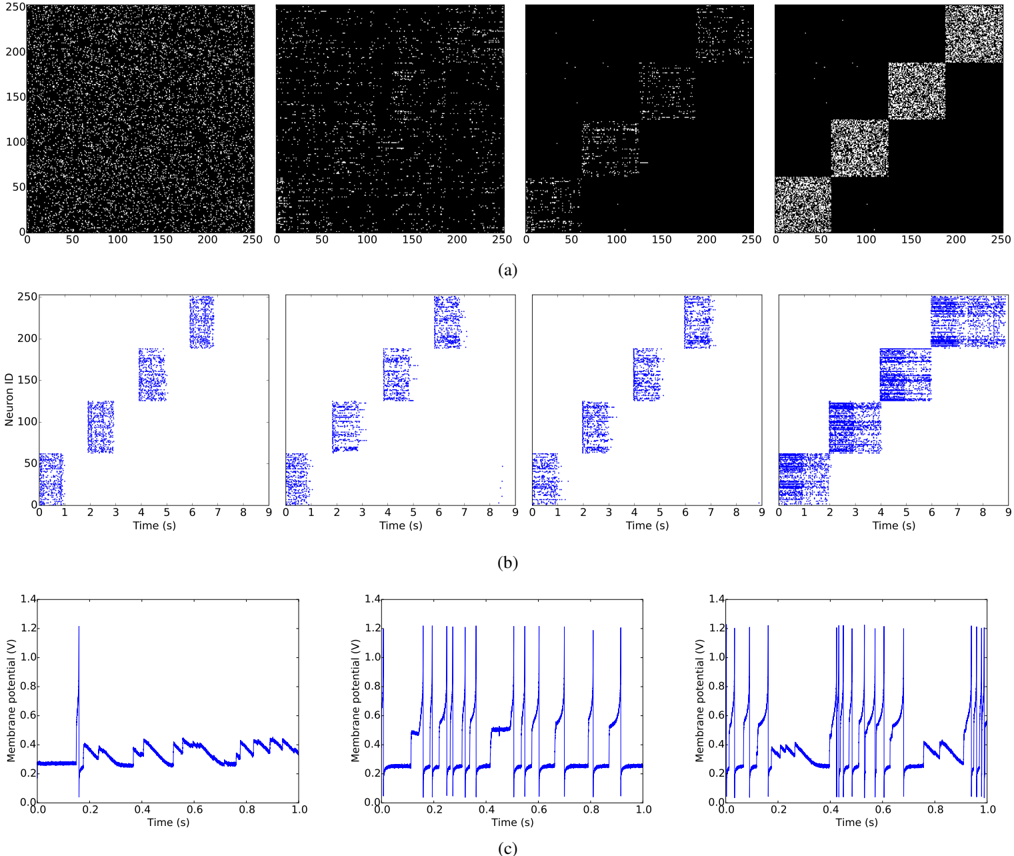
The image presents a multi-panel plot illustrating the activity of a neural network across different stages or conditions. It consists of three rows labeled (a), (b), and (c). Row (a) shows network connectivity patterns, row (b) displays neuron firing activity over time, and row (c) shows membrane potential fluctuations for individual neurons.
### Components/Axes
**Row (a): Network Connectivity**
* Four subplots showing network connectivity.
* X and Y axes are unlabeled but range from 0 to 250, presumably representing neuron indices.
* Each dot represents a connection between neurons.
**Row (b): Neuron Firing Activity**
* Four subplots showing neuron ID vs. time.
* Y-axis: "Neuron ID" ranging from 0 to 250.
* X-axis: "Time (s)" ranging from 0 to 9.
* Blue dots indicate neuron firing events.
**Row (c): Membrane Potential**
* Three subplots showing membrane potential vs. time.
* Y-axis: "Membrane potential (V)" ranging from 0 to 1.4.
* X-axis: "Time (s)" ranging from 0 to 1.0.
* Blue lines represent membrane potential fluctuations.
### Detailed Analysis
**Row (a): Network Connectivity**
* **Subplot 1:** Random, sparse connectivity. White dots are scattered randomly across the black background.
* **Subplot 2:** More structured connectivity than subplot 1. Some clusters of white dots are visible.
* **Subplot 3:** Clear block structure. Four distinct blocks of high connectivity are visible along the diagonal.
* **Subplot 4:** Block structure with noise. Similar to subplot 3, but with more scattered white dots within and outside the blocks.
**Row (b): Neuron Firing Activity**
* **Subplot 1:** Neurons fire in a block-like pattern between 0-100 Neuron ID, and between 3-5 seconds.
* **Subplot 2:** Neurons fire in a block-like pattern between 0-100 Neuron ID, and between 1-3 seconds. Neurons fire in a block-like pattern between 150-250 Neuron ID, and between 5-7 seconds.
* **Subplot 3:** Neurons fire in a block-like pattern between 0-100 Neuron ID, and between 1-3 seconds. Neurons fire in a block-like pattern between 150-250 Neuron ID, and between 3-5 seconds.
* **Subplot 4:** Neurons fire in a block-like pattern between 0-100 Neuron ID, and between 1-3 seconds. Neurons fire in a block-like pattern between 100-150 Neuron ID, and between 3-5 seconds. Neurons fire in a block-like pattern between 150-250 Neuron ID, and between 5-7 seconds.
**Row (c): Membrane Potential**
* **Subplot 1:** Initial rapid increase in membrane potential to ~1.2V at ~0.2s, followed by decay and smaller fluctuations around ~0.3V to ~0.5V.
* **Subplot 2:** Oscillating membrane potential with multiple spikes reaching ~1.2V, followed by rapid decay. The frequency of spikes increases over time.
* **Subplot 3:** Similar to subplot 2, but with a higher frequency of spikes and a more sustained elevated membrane potential.
### Key Observations
* Row (a) shows a progression from random to structured network connectivity.
* Row (b) shows how the firing patterns of neurons change over time, corresponding to the connectivity patterns in row (a).
* Row (c) shows the membrane potential dynamics, with varying spike frequencies and amplitudes.
### Interpretation
The image likely illustrates the development or adaptation of a neural network. The progression in row (a) suggests a learning process where the network evolves from random connections to a more organized, modular structure. The corresponding changes in neuron firing patterns (row b) and membrane potential dynamics (row c) reflect this adaptation. The block structure in the connectivity matrices and firing patterns suggests the emergence of functional modules within the network. The increasing spike frequency in row (c) could indicate increased excitability or activity within the neurons as the network learns.