## Diagram: Retrieval Methods with Large Language Models
### Overview
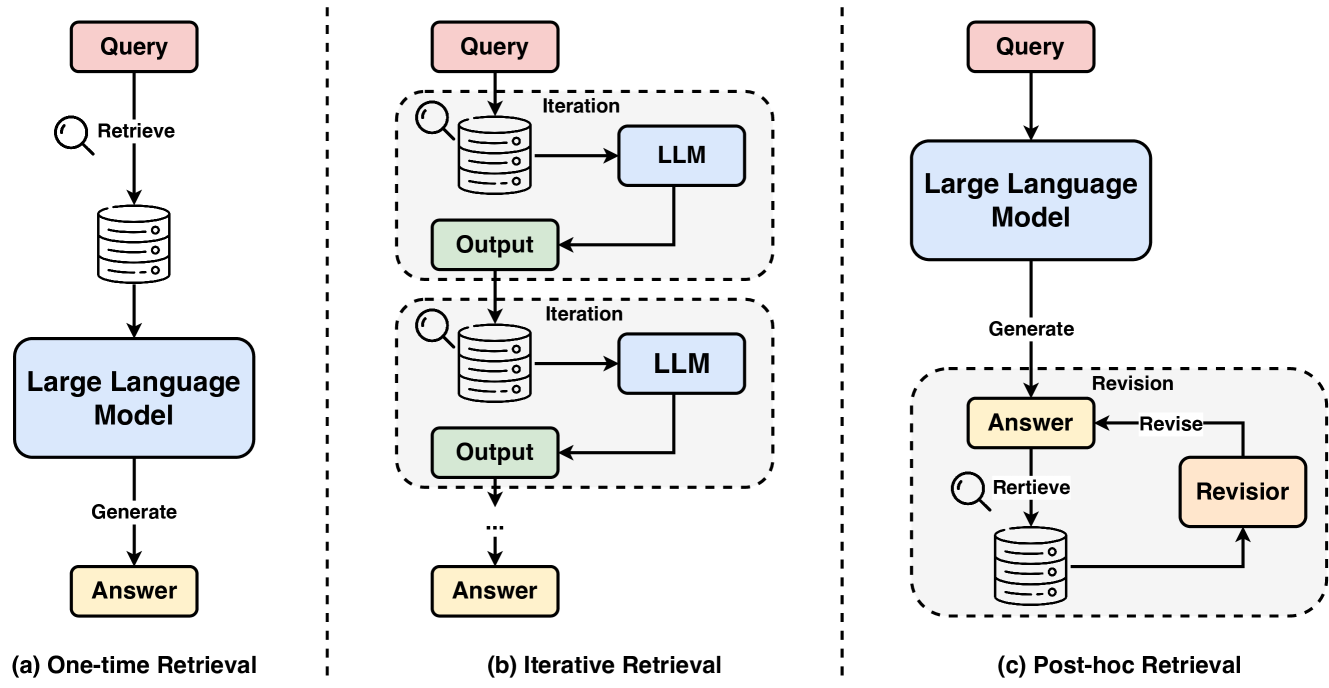
The image presents three distinct diagrams illustrating different retrieval methods using Large Language Models (LLMs): One-time Retrieval, Iterative Retrieval, and Post-hoc Retrieval. Each diagram outlines the flow of information and processes involved in generating an answer from a query.
### Components/Axes
* **Diagram Types:**
* (a) One-time Retrieval
* (b) Iterative Retrieval
* (c) Post-hoc Retrieval
* **Components (Common to all diagrams):**
* **Query:** Represented as a rounded rectangle with a pink fill.
* **Large Language Model (LLM):** Represented as a rounded rectangle with a light blue fill.
* **Answer:** Represented as a rounded rectangle with a light yellow fill.
* **Database:** Represented as a cylinder shape.
* **Output:** Represented as a rounded rectangle with a light green fill.
* **Revisor:** Represented as a rounded rectangle with a light orange fill.
* **Processes:**
* **Retrieve:** Text label with an arrow pointing from the Query to the Database. A magnifying glass icon is next to the word "Retrieve".
* **Generate:** Text label with an arrow pointing from the LLM to the Answer.
* **Iteration:** Text label indicating an iterative process.
* **Revision:** Text label with an arrow pointing from the Answer to the Revisor.
* **Revise:** Text label with an arrow pointing from the Revisor to the Answer.
* **Rertieve:** Text label with an arrow pointing from the Revisor to the Database. A magnifying glass icon is next to the word "Rertieve".
### Detailed Analysis
**Diagram (a): One-time Retrieval**
1. **Query:** A pink rounded rectangle at the top.
2. **Retrieve:** An arrow points from the Query to a Database.
3. **Database:** A cylinder shape below the "Retrieve" process.
4. **Large Language Model:** An arrow points from the Database to a light blue rounded rectangle labeled "Large Language Model".
5. **Generate:** An arrow points from the LLM to a light yellow rounded rectangle labeled "Answer".
**Diagram (b): Iterative Retrieval**
1. **Query:** A pink rounded rectangle at the top.
2. **Iteration 1:**
* A Database with a magnifying glass icon.
* An arrow points from the Database to a light blue rounded rectangle labeled "LLM".
* An arrow points from the LLM to a light green rounded rectangle labeled "Output".
* An arrow points from the Output back to the Database.
3. **Iteration 2:**
* A Database with a magnifying glass icon.
* An arrow points from the Database to a light blue rounded rectangle labeled "LLM".
* An arrow points from the LLM to a light green rounded rectangle labeled "Output".
* An arrow points from the Output back to the Database.
4. **Answer:** An arrow points from the second "Output" to a light yellow rounded rectangle labeled "Answer".
**Diagram (c): Post-hoc Retrieval**
1. **Query:** A pink rounded rectangle at the top.
2. **Large Language Model:** An arrow points from the Query to a light blue rounded rectangle labeled "Large Language Model".
3. **Generate:** An arrow points from the LLM to a light yellow rounded rectangle labeled "Answer".
4. **Revision:**
* An arrow points from the Answer to a light orange rounded rectangle labeled "Revisor".
* **Revise:** An arrow points from the Revisor back to the Answer.
* **Rertieve:** An arrow points from the Revisor to a Database with a magnifying glass icon.
* An arrow points from the Database back to the Revisor.
### Key Observations
* **One-time Retrieval:** A straightforward process where a query is used to retrieve information from a database, which is then fed into an LLM to generate an answer.
* **Iterative Retrieval:** Involves multiple iterations of retrieving information from a database and refining the output using an LLM before arriving at a final answer.
* **Post-hoc Retrieval:** The LLM generates an initial answer, which is then revised by a "Revisor" component, potentially using additional retrieval from a database.
### Interpretation
The diagrams illustrate three different strategies for leveraging LLMs in conjunction with information retrieval. One-time retrieval is the simplest, while iterative retrieval allows for refinement of the retrieved information. Post-hoc retrieval introduces a revision step after the initial answer generation, potentially improving the quality and accuracy of the final answer. The choice of method depends on the specific application and the desired trade-off between speed, accuracy, and complexity.