## Diagram: Retrieval Methods for Large Language Models
### Overview
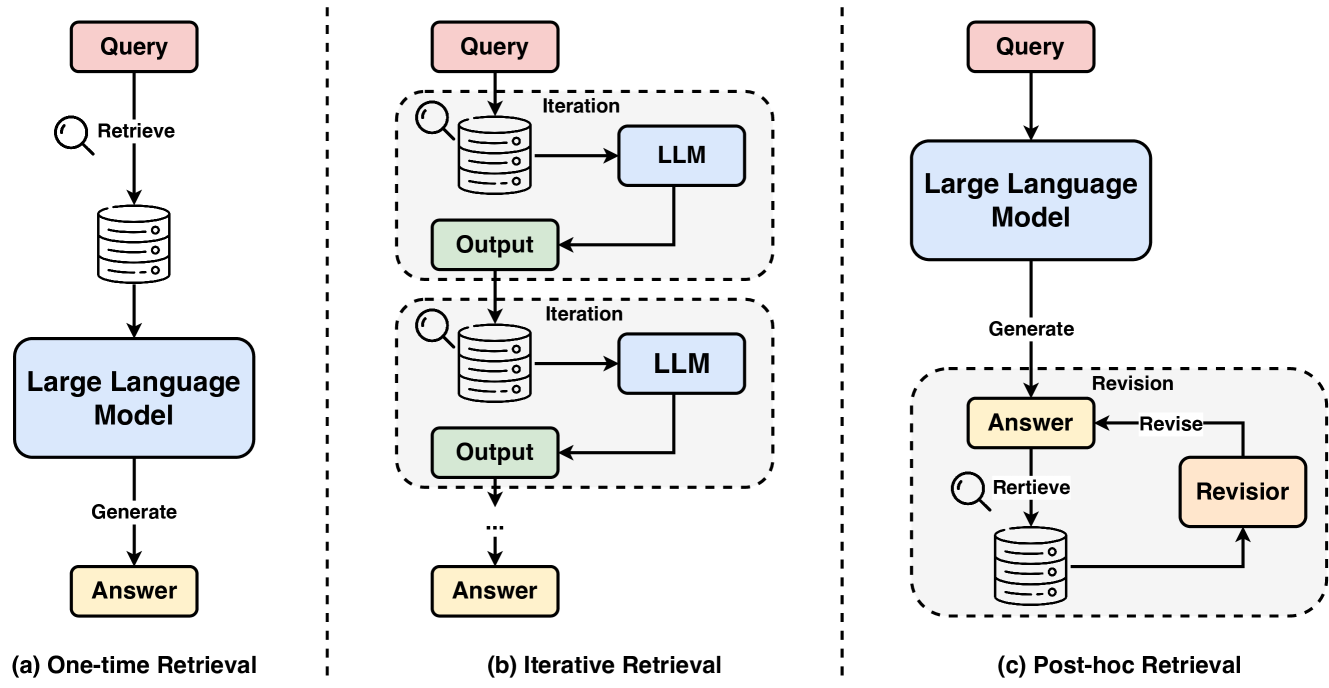
The diagram compares three retrieval strategies for a Large Language Model (LLM):
1. **(a) One-time Retrieval**: A linear process from query to answer.
2. **(b) Iterative Retrieval**: Involves repeated LLM processing with feedback loops.
3. **(c) Post-hoc Retrieval**: Adds a revision step after initial answer generation.
### Components/Axes
- **Key Elements**:
- **Query**: Input question (pink box).
- **Retrieve**: Database search (magnifying glass icon).
- **Large Language Model**: Core processing unit (blue box).
- **Output**: Intermediate results (green box).
- **Answer**: Final response (yellow box).
- **Revision**: Post-hoc refinement (orange box).
- **Database**: Data storage (stacked disks icon).
- **Flow Directions**:
- **(a)**: Linear flow: Query → Retrieve → LLM → Generate → Answer.
- **(b)**: Iterative loops: Query → LLM → Output → LLM → Output → Answer.
- **(c)**: Non-linear flow: Query → LLM → Generate → Answer → Revision → Retrieve → Revisor → Answer.
### Detailed Analysis
- **(a) One-time Retrieval**:
- Simplest method with no feedback loops.
- Direct path from query to answer via LLM.
- **(b) Iterative Retrieval**:
- Two iterations of LLM processing.
- Outputs from each iteration feed back into the LLM for refinement.
- **(c) Post-hoc Retrieval**:
- Adds a "Revision" step after initial answer generation.
- Revision involves retrieving additional data and refining the answer via a "Revisor" component.
### Key Observations
1. **Complexity Progression**:
- (a) < (b) < (c) in terms of process complexity.
2. **Feedback Mechanisms**:
- (b) and (c) incorporate iterative refinement, while (a) does not.
3. **Post-hoc Revision**:
- (c) uniquely includes a dedicated revision phase with external data retrieval.
### Interpretation
- **Purpose**: The diagram illustrates how retrieval strategies evolve from basic to advanced, emphasizing iterative refinement and post-hoc corrections.
- **Implications**:
- Iterative methods (b) improve answer quality through repeated LLM processing.
- Post-hoc retrieval (c) addresses errors or gaps by revising answers using additional data.
- **Design Insight**:
- The addition of revision steps (c) suggests a focus on accuracy over speed, as it introduces computational overhead.
- The absence of a legend or numerical data implies the diagram is conceptual, prioritizing workflow visualization over quantitative metrics.
This structured progression highlights trade-offs between simplicity, computational cost, and answer reliability in LLM-based systems.