## Scatter Plot: A-mem vs. Base Distribution
### Overview
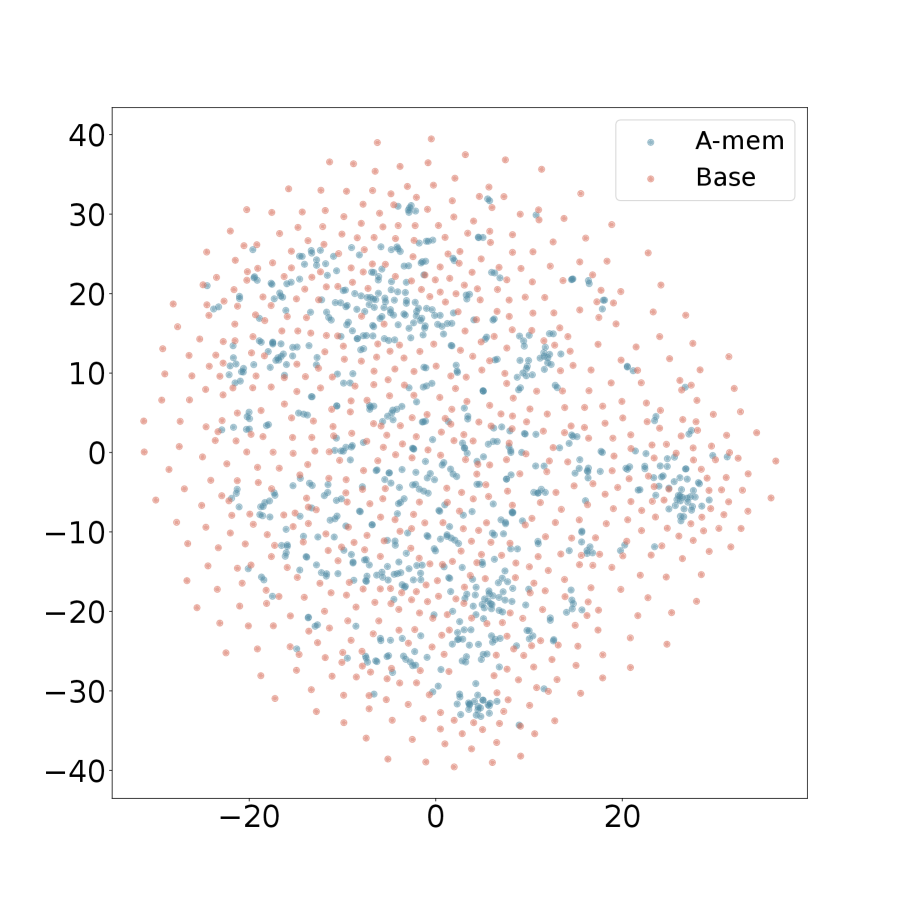
The image is a 2D scatter plot comparing the spatial distribution of two data series, labeled "A-mem" and "Base". The plot displays a large number of individual data points plotted against two unlabeled numerical axes. The overall visual impression is of two overlapping, cloud-like distributions with different densities and spreads.
### Components/Axes
* **Legend:** Located in the top-right corner of the plot area. It contains two entries:
* A blue dot labeled **"A-mem"**.
* A pink/salmon dot labeled **"Base"**.
* **X-Axis:** A horizontal numerical axis. Major tick marks and labels are present at **-20, 0, and 20**. The visible range extends slightly beyond these values, approximately from -25 to +25.
* **Y-Axis:** A vertical numerical axis. Major tick marks and labels are present at **-40, -30, -20, -10, 0, 10, 20, 30, and 40**. The visible range is from approximately -45 to +45.
* **Data Points:** Hundreds of small, circular markers. Blue markers represent the "A-mem" series, and pink markers represent the "Base" series.
### Detailed Analysis
* **Spatial Distribution & Density:**
* **"Base" Series (Pink):** This series forms a broad, roughly circular or elliptical cloud that fills most of the plot area. The points are widely dispersed, with a higher density near the center (around coordinate (0,0)) and gradually thinning out towards the periphery. The distribution appears relatively uniform in its spread.
* **"A-mem" Series (Blue):** This series is also widely distributed but shows a distinctly different pattern. It is less uniformly spread than the "Base" series. The blue points appear to form a denser, more concentrated cluster that is slightly offset from the absolute center. This cluster is most prominent in the region roughly between X = -10 to +10 and Y = -20 to +20. Outside this central cluster, blue points are scattered more sparsely, often intermingled with the pink points.
* **Overlap and Relationship:** There is significant overlap between the two distributions, particularly in the central region of the plot. However, the "A-mem" points are not randomly scattered within the "Base" cloud; they exhibit a clear tendency to group together, suggesting a more constrained or focused distribution compared to the more expansive "Base" distribution.
* **Trend Verification:** Neither series shows a linear trend (e.g., a clear upward or downward slope). Both are best described as amorphous clouds. The primary visual trend is the difference in **clustering density** between the two series.
### Key Observations
1. **Density Gradient:** The "Base" (pink) series has a clear density gradient, peaking at the center and fading outward. The "A-mem" (blue) series has a more complex density profile, with a pronounced central cluster and a sparse periphery.
2. **Central Tendency:** The highest density of "A-mem" points appears to be centered slightly to the left (negative X) and below (negative Y) the plot's origin (0,0), though the overall cloud is still centered near the origin.
3. **Absence of Axis Titles:** The plot lacks descriptive labels for the X and Y axes, making it impossible to know what specific variables or dimensions are being compared without external context.
4. **Scale:** The Y-axis has a larger numerical range (80 units) compared to the X-axis (40 units), but the visual scaling appears to be 1:1, making the distribution look circular.
### Interpretation
This scatter plot likely visualizes the output of a dimensionality reduction technique (like t-SNE or PCA) applied to two different datasets or model states, projecting high-dimensional data into a 2D space for comparison.
* **What the data suggests:** The plot demonstrates that the "A-mem" data points occupy a more specific and concentrated region within the broader feature space defined by the "Base" data. This could indicate that the "A-mem" condition (perhaps a model with a specific memory mechanism) produces more consistent, similar, or focused internal representations compared to the more varied or exploratory "Base" condition.
* **Relationship between elements:** The "Base" distribution acts as a background or reference manifold. The "A-mem" distribution is a subset or a specialization within that manifold. The significant overlap shows they share common characteristics, but the distinct clustering of "A-mem" points highlights a key differentiating factor.
* **Notable Anomalies/Patterns:** The most significant pattern is the **clustering vs. dispersion** dichotomy. There are no obvious outlier points far removed from the main clouds. The primary insight is not in individual points but in the collective shape and density of the two point clouds. The lack of axis labels is a critical limitation for full technical interpretation, as the meaning of the spatial separation is unknown.