## Diagram: Node-Based System Architecture Comparison
### Overview
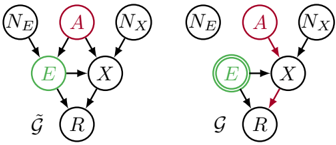
The image contains two side-by-side diagrams labeled **G** and **G̃**, each depicting a network of interconnected nodes with directional arrows. Both diagrams share similar node labels but differ in arrow colors, connections, and node emphasis (e.g., double green circles).
### Components/Axes
- **Nodes**:
- **NE** (Neighbor of E), **A** (Action), **NX** (Neighbor of X), **E** (Event), **X** (Execution), **R** (Result).
- **Legend**:
- Red: **A** (Action)
- Green: **E** (Event)
- Black: **NE**, **NX**, **X**, **R**
- **Arrows**:
- Black arrows indicate standard connections.
- Red arrows highlight critical or modified pathways.
- Double green circles emphasize **E** in **G̃**.
### Detailed Analysis
#### Diagram **G** (Left):
1. **NE** → **E** (black arrow).
2. **A** (red) → **E** (black).
3. **E** → **X** (black).
4. **X** → **R** (black).
5. **NX** → **X** (black).
#### Diagram **G̃** (Right):
1. **NE** → **E** (black).
2. **A** (red) → **X** (black).
3. **E** (double green) → **X** (black).
4. **X** → **R** (red arrow).
5. **NX** → **X** (black).
### Key Observations
- **Arrow Color Shifts**:
- In **G**, the **A** → **E** connection is red, while in **G̃**, **A** → **X** is red.
- **G̃** introduces a red arrow from **X** → **R**, suggesting a modified outcome pathway.
- **Node Emphasis**:
- **E** is double-circled in **G̃**, indicating heightened importance or a state change.
- **Connection Rearrangement**:
- **G̃** bypasses **E** in the **A** → **X** path, altering the flow compared to **G**.
### Interpretation
The diagrams likely represent two states of a system:
1. **G** (Standard State):
- **A** directly influences **E**, which propagates to **X** and **R**.
- **NE** and **NX** act as external inputs to **E** and **X**, respectively.
2. **G̃** (Modified State):
- **A** bypasses **E** to directly affect **X**, suggesting a shortcut or optimization.
- The red arrow from **X** → **R** implies a critical or error-prone step in the outcome.
- The double-circled **E** may represent a feedback loop or heightened monitoring.
The differences highlight trade-offs between direct action (**G̃**) and event-driven execution (**G**), with potential implications for system efficiency or error handling.