## Diagram: Machine Learning Model Architecture for Image Generation
### Overview
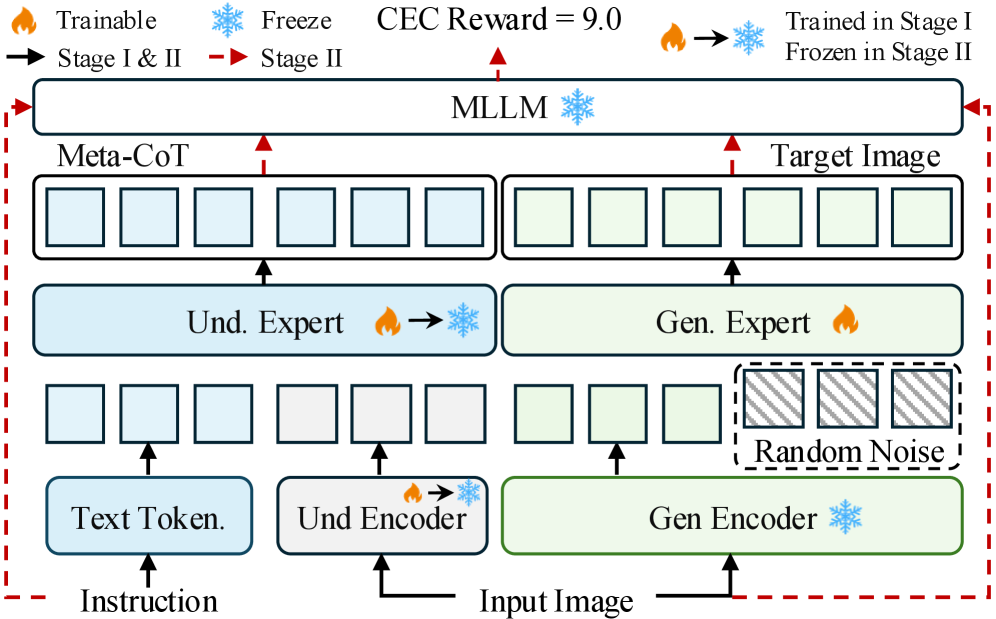
This diagram illustrates a two-stage machine learning model architecture for image generation, featuring components like Meta-CoT, MLLM, Und. Expert, Gen. Expert, and encoders. The flow progresses from an Input Image through text tokens, encoders, and experts to produce a Target Image. Key elements include trainable/frozen components, random noise, and a CEC Reward metric.
### Components/Axes
1. **Legend**:
- 🔥 **Trainable**: Components actively trained during specific stages.
- ❄️ **Frozen**: Components locked after training completion.
- **CEC Reward = 9.0**: Performance metric (likely accuracy or efficiency).
2. **Key Blocks**:
- **Meta-CoT**: Contains 8 text token slots (blue squares).
- **MLLM**: Frozen in Stage II (top block with snowflake).
- **Target Image**: Output of the model (green squares).
- **Und. Expert**: Trainable in Stage I, frozen in Stage II (blue block with fire).
- **Gen. Expert**: Trainable in Stage I, frozen in Stage II (green block with fire).
- **Text Token**: Input instruction (blue square).
- **Und Encoder**: Processes input image (blue block).
- **Gen Encoder**: Generates random noise (green block with striped squares).
3. **Flow Arrows**:
- Red arrows indicate progression between stages (Stage I → Stage II).
- Dashed red lines outline the entire architecture.
### Detailed Analysis
- **Stage I**:
- Input Image → Und Encoder → Und. Expert (trainable).
- Text Token → Meta-CoT (trainable).
- Gen Encoder → Random Noise → Gen. Expert (trainable).
- CEC Reward = 9.0 achieved during training.
- **Stage II**:
- MLLM and Und. Expert are frozen.
- Gen. Expert remains frozen after Stage I.
- Target Image is generated via frozen components.
### Key Observations
1. **Freezing Strategy**: Critical components (MLLM, Und. Expert, Gen. Expert) are frozen after Stage I, suggesting a focus on stability in later stages.
2. **Noise Integration**: Random Noise is injected via Gen Encoder, indicating a generative adversarial or diffusion-based approach.
3. **Text-Image Alignment**: Meta-CoT processes text tokens, linking instructions to image generation.
4. **Performance Metric**: CEC Reward = 9.0 (high value, but scale unspecified).
### Interpretation
This architecture prioritizes modular training, freezing components after initial stages to prevent overfitting or catastrophic forgetting. The CEC Reward of 9.0 suggests strong performance, though the metric's definition (e.g., accuracy, FID score) is unclear. The use of random noise and text tokens implies a hybrid model combining generative and instruction-following capabilities. The freezing strategy may enable efficient fine-tuning or deployment in resource-constrained environments.