## Diagram: Image Processing Pipeline
### Overview
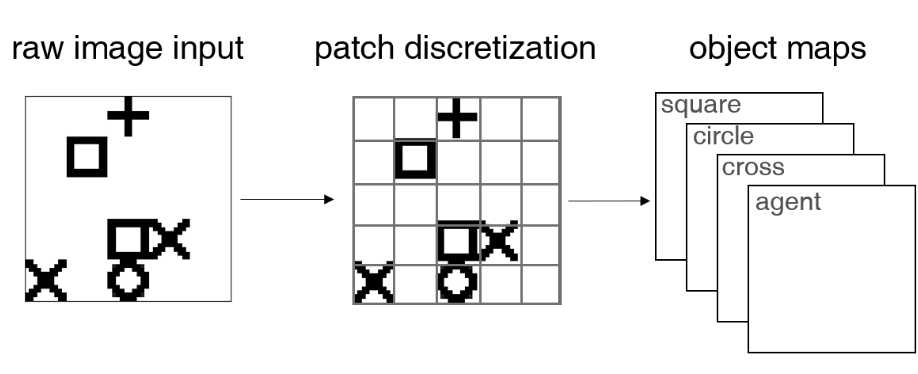
The image illustrates a simplified image processing pipeline. It shows the transformation of a raw image input through patch discretization into object maps. The pipeline consists of three stages: raw image input, patch discretization, and object maps.
### Components/Axes
* **Titles:**
* raw image input
* patch discretization
* object maps
* **Objects in raw image input:**
* cross
* square
* circle
* x
* **Objects in patch discretization:**
* cross
* square
* circle
* x
* **Object maps:**
* square
* circle
* cross
* agent
* **Arrows:** Two arrows indicate the flow of information from left to right.
### Detailed Analysis
The diagram shows the transformation of a raw image into object maps.
1. **Raw Image Input:** The raw image contains a collection of simple shapes: a cross, a square, a circle, and an "x". These shapes are arranged in a seemingly random configuration.
2. **Patch Discretization:** The raw image is then discretized into a grid of patches. The shapes from the raw image are now represented within this grid. The grid appears to be 6x6.
3. **Object Maps:** Finally, the discretized image is transformed into a series of object maps. Each object map corresponds to a specific object type (square, circle, cross, agent). These maps likely represent the probability or confidence of each patch containing the corresponding object.
### Key Observations
* The diagram simplifies the process of object recognition by breaking it down into distinct stages.
* The patch discretization stage is crucial for converting the continuous raw image into a discrete representation suitable for further processing.
* The object maps represent the final output of the pipeline, providing information about the location and type of objects present in the image.
### Interpretation
The diagram illustrates a basic image processing pipeline for object recognition. The raw image is first discretized into patches, and then object maps are generated for each object type. This pipeline demonstrates a common approach to object recognition, where the image is first preprocessed to extract relevant features, and then these features are used to identify objects. The "agent" object map suggests the system might be designed to identify agents or actors within the scene, implying a potential application in robotics or autonomous systems. The transformation from raw pixels to discrete patches and then to object-specific maps highlights a hierarchical approach to image understanding.