## Line Chart: Speedup Scaling with Problem Size
### Overview
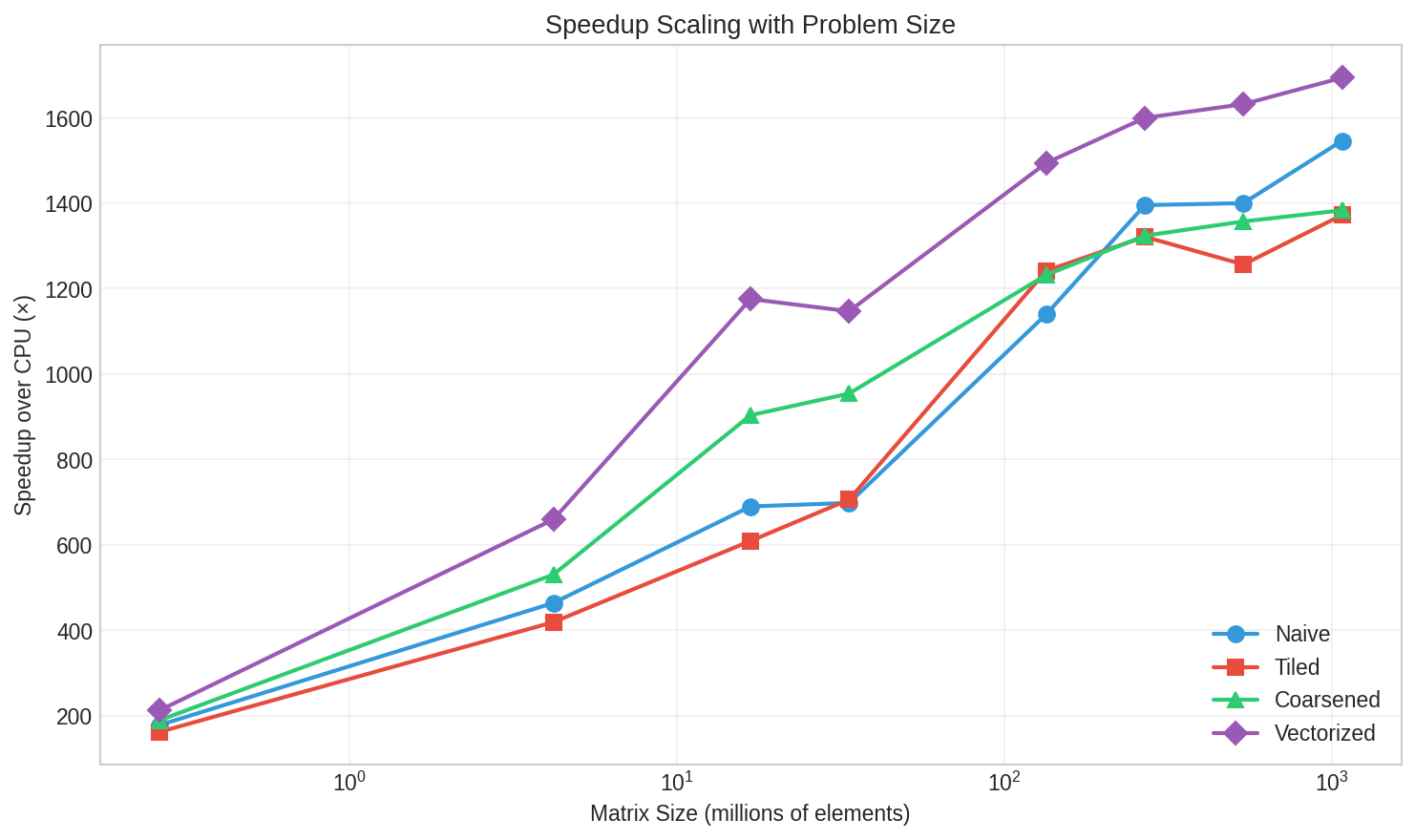
The chart illustrates the performance scaling of four computational methods (Naive, Tiled, Coarsened, Vectorized) across varying matrix sizes (10⁰ to 10³ million elements). Speedup is measured relative to a baseline CPU performance (x-axis), with logarithmic scaling on the x-axis to emphasize exponential growth in problem size.
### Components/Axes
- **X-axis**: Matrix Size (millions of elements), logarithmic scale (10⁰, 10¹, 10², 10³).
- **Y-axis**: Speedup over CPU (x), linear scale (0–1800).
- **Legend**: Located in the bottom-right corner, associating colors and markers:
- **Naive**: Blue circles.
- **Tiled**: Red squares.
- **Coarsened**: Green triangles.
- **Vectorized**: Purple diamonds.
### Detailed Analysis
1. **Vectorized (Purple Diamonds)**:
- Starts at ~200 speedup at 10⁰ elements.
- Increases sharply, reaching ~1,200 at 10¹, ~1,500 at 10², and ~1,700 at 10³.
- Maintains the highest speedup across all matrix sizes.
2. **Coarsened (Green Triangles)**:
- Begins at ~200 at 10⁰, rising to ~900 at 10¹, ~1,250 at 10², and ~1,400 at 10³.
- Shows steady growth but lags behind Vectorized.
3. **Tiled (Red Squares)**:
- Starts at ~200 at 10⁰, peaking at ~700 at 10¹, ~1,250 at 10², and ~1,400 at 10³.
- Converges with Coarsened at 10³ but underperforms at smaller sizes.
4. **Naive (Blue Circles)**:
- Begins at ~200 at 10⁰, rising to ~700 at 10¹, ~1,150 at 10², and ~1,600 at 10³.
- Outperforms Tiled and Coarsened at 10³ but remains the slowest at smaller sizes.
### Key Observations
- **Vectorized dominance**: Consistently achieves the highest speedup, suggesting superior parallelization or algorithmic efficiency.
- **Convergence at large sizes**: Tiled and Coarsened methods perform similarly at 10³ elements (~1,400 speedup), indicating diminishing returns for smaller optimizations.
- **Naive improvement**: Despite being the baseline, Naive methods show significant gains at 10³ elements (~1,600 speedup), though still trailing Vectorized.
### Interpretation
The data highlights that **Vectorized approaches scale most effectively** with problem size, likely due to optimized parallel execution or hardware utilization. Coarsened and Tiled methods exhibit comparable performance at large matrix sizes, suggesting that their optimizations (e.g., memory tiling, data compression) become less impactful as problem size grows. Naive methods, while improving, remain the least efficient, emphasizing the importance of algorithmic refinement for scalability. These trends are critical for selecting computational strategies in high-performance computing, where problem size and resource constraints dictate method choice.