## System Architecture Diagram: Multi-Agent System Paradigms
### Overview
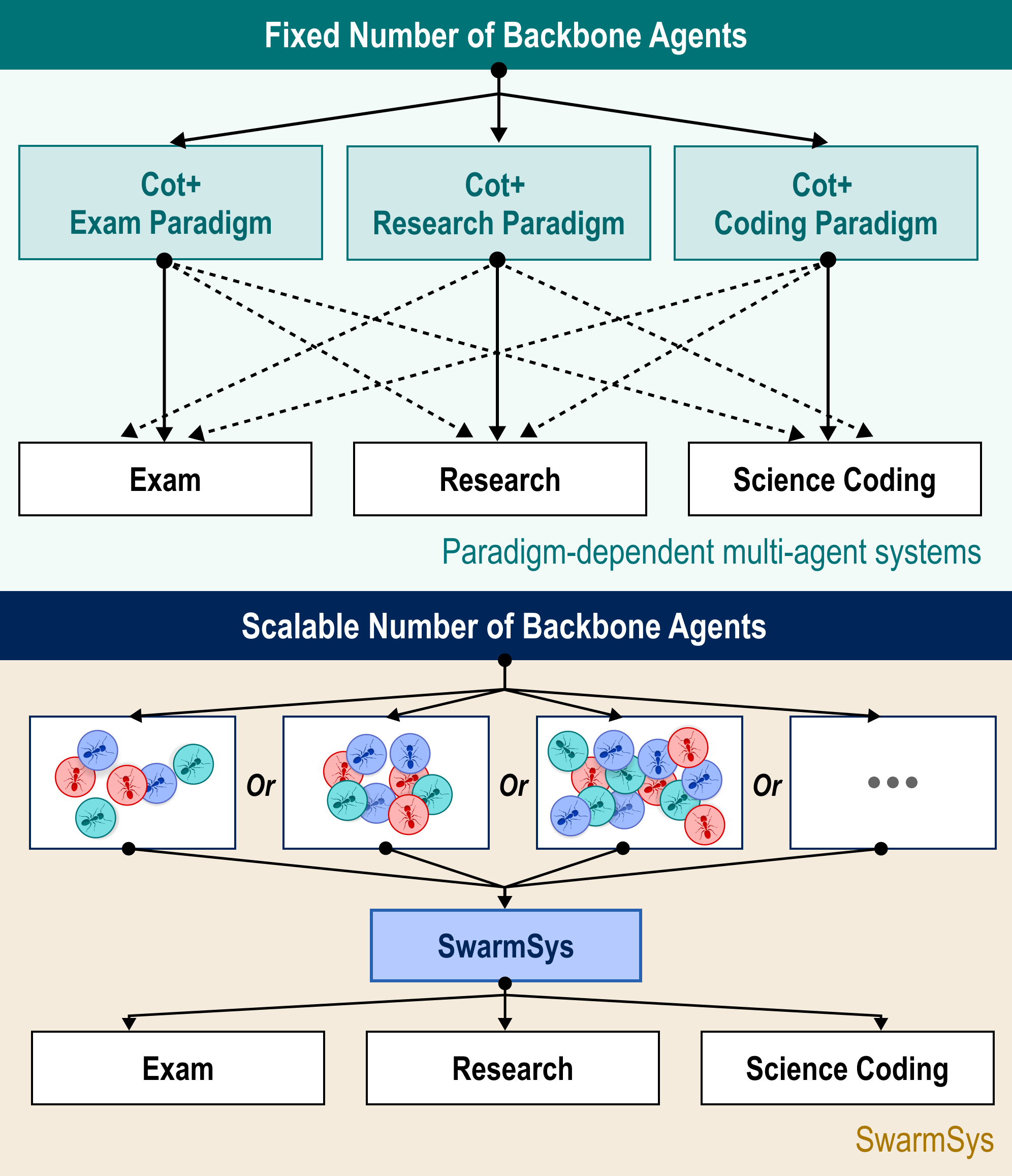
The image presents a system architecture diagram comparing two approaches to multi-agent systems: one with a fixed number of backbone agents and another with a scalable number of backbone agents. Both approaches are shown in relation to three paradigms: Exam, Research, and Science Coding. The diagram illustrates the flow and relationships between different components in each approach.
### Components/Axes
**Header:**
* "Fixed Number of Backbone Agents" (Top, Teal Background)
* "Scalable Number of Backbone Agents" (Middle, Dark Blue Background)
**Nodes and Connections:**
* **Fixed Number of Backbone Agents Section:**
* Three teal rectangular nodes labeled: "Cot+ Exam Paradigm", "Cot+ Research Paradigm", and "Cot+ Coding Paradigm".
* Three white rectangular nodes labeled: "Exam", "Research", and "Science Coding".
* Solid black arrows connect each "Cot+" paradigm to its corresponding "Exam", "Research", or "Science Coding" node.
* Dashed black arrows connect each "Cot+" paradigm to the other two "Exam", "Research", or "Science Coding" nodes, indicating potential interactions or dependencies.
* **Scalable Number of Backbone Agents Section:**
* Four nodes representing agent configurations:
* Node 1: A collection of blue, teal, and red circles, each containing an ant-like figure.
* "Or"
* Node 2: A collection of blue, teal, and red circles, each containing an ant-like figure.
* "Or"
* Node 3: A collection of blue, teal, and red circles, each containing an ant-like figure.
* "Or"
* Node 4: Three gray dots in a horizontal line, representing scalability or an unspecified number of agents.
* A blue rectangular node labeled "SwarmSys".
* Three white rectangular nodes labeled: "Exam", "Research", and "Science Coding".
* Solid black arrows connect each agent configuration node to the "SwarmSys" node.
* A solid black arrow connects the "SwarmSys" node to each of the "Exam", "Research", and "Science Coding" nodes.
**Labels:**
* "Paradigm-dependent multi-agent systems" (Teal text, between the two sections)
* "SwarmSys" (Gold text, bottom-right corner)
### Detailed Analysis or Content Details
**Fixed Number of Backbone Agents:**
* The "Cot+ Exam Paradigm" node is connected with a solid arrow to the "Exam" node and with dashed arrows to the "Research" and "Science Coding" nodes.
* The "Cot+ Research Paradigm" node is connected with a solid arrow to the "Research" node and with dashed arrows to the "Exam" and "Science Coding" nodes.
* The "Cot+ Coding Paradigm" node is connected with a solid arrow to the "Science Coding" node and with dashed arrows to the "Exam" and "Research" nodes.
**Scalable Number of Backbone Agents:**
* The agent configuration nodes show varying numbers and arrangements of agents represented by colored circles with ant-like figures. The colors are blue, teal, and red.
* The "SwarmSys" node acts as a central processing or control unit, connecting the agent configurations to the final output nodes.
* The "Exam", "Research", and "Science Coding" nodes represent the outcomes or applications of the "SwarmSys" system.
### Key Observations
* The diagram contrasts two approaches to multi-agent systems based on the number of backbone agents.
* The "Fixed Number of Backbone Agents" approach uses "Cot+" paradigms and has direct and indirect connections to the "Exam", "Research", and "Science Coding" nodes.
* The "Scalable Number of Backbone Agents" approach uses a "SwarmSys" system and agent configurations with varying numbers of agents.
* Both approaches ultimately lead to the same outcomes: "Exam", "Research", and "Science Coding".
### Interpretation
The diagram illustrates two different architectures for multi-agent systems. The "Fixed Number of Backbone Agents" approach might represent a more traditional or static system where the roles and interactions of agents are predefined. The dashed lines suggest that while each paradigm primarily focuses on one outcome (Exam, Research, or Science Coding), there are also cross-dependencies or interactions with the other outcomes.
The "Scalable Number of Backbone Agents" approach, using "SwarmSys", suggests a more dynamic and adaptable system. The varying agent configurations and the "Or" connectors indicate that the system can adjust the number and arrangement of agents based on the task or environment. The "SwarmSys" node likely represents a central control mechanism that manages the agents and directs their efforts towards the desired outcomes.
The diagram suggests that both approaches can achieve the same goals (Exam, Research, Science Coding), but they differ in their underlying architecture and adaptability. The "Scalable Number of Backbone Agents" approach, with its "SwarmSys" system, may be more suitable for complex or changing environments where a fixed number of agents would be insufficient.