TECHNICAL ASSET FINGERPRINT
310b6469d81e6a27d99ae398
Click to view fullscreen
Press ESC or click to close
FOUND IN PAPERS
EXPERT: healer-alpha-free VERSION 1
RUNTIME: free/openrouter/healer-alpha
INTEL_VERIFIED
\n
## Diagram: Multi-Agent System Paradigms - Fixed vs. Scalable Architectures
### Overview
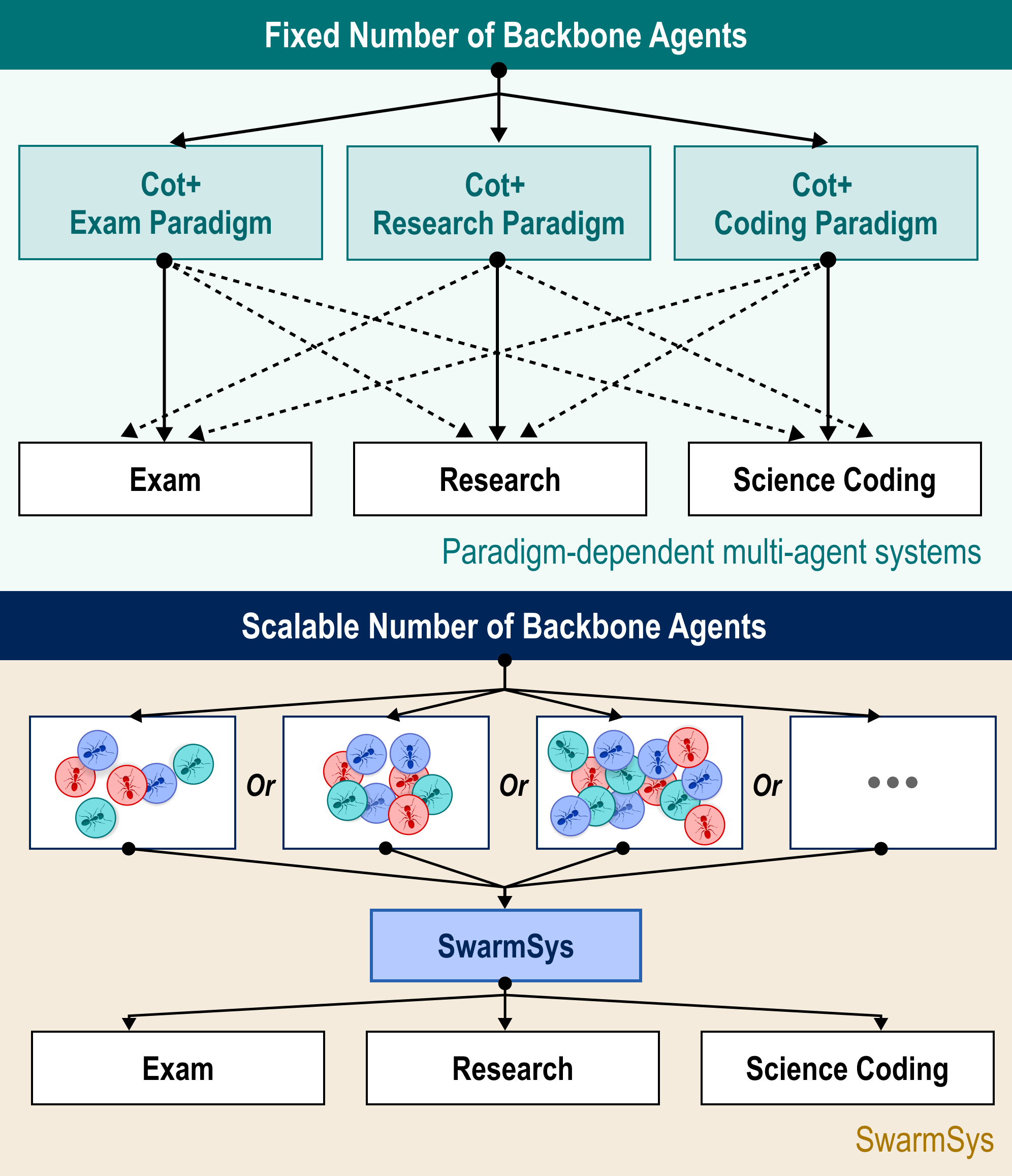
The image is a conceptual diagram comparing two architectural approaches for multi-agent systems: a "Fixed Number of Backbone Agents" paradigm and a "Scalable Number of Backbone Agents" paradigm. It illustrates how different agent configurations map to three core task domains: Exam, Research, and Science Coding. The diagram uses a flowchart style with boxes, arrows, and icons to represent systems, paradigms, and tasks.
### Components/Axes
The diagram is divided into two primary horizontal sections, each with a distinct header.
**Top Section: Fixed Number of Backbone Agents**
* **Header:** A teal-colored bar at the top with white text: "Fixed Number of Backbone Agents".
* **Paradigm Layer:** Three light-blue boxes connected by solid arrows from the header.
* Left box: "Cot+ Exam Paradigm"
* Center box: "Cot+ Research Paradigm"
* Right box: "Cot+ Coding Paradigm"
* **Task Layer:** Three white boxes below the paradigms.
* Left box: "Exam"
* Center box: "Research"
* Right box: "Science Coding"
* **Connections:**
* Solid black arrows point directly down from each "Cot+" paradigm to its namesake task (e.g., Cot+ Exam Paradigm → Exam).
* Dashed black arrows create a cross-connected mesh, indicating that each paradigm can also contribute to the other two tasks (e.g., Cot+ Exam Paradigm also points to Research and Science Coding).
* **Label:** Below the task boxes, centered text in teal reads: "Paradigm-dependent multi-agent systems".
**Bottom Section: Scalable Number of Backbone Agents**
* **Header:** A dark blue bar with white text: "Scalable Number of Backbone Agents".
* **Agent Swarm Layer:** Four white boxes arranged horizontally, connected by solid arrows from the header.
* The first three boxes contain clusters of ant icons inside colored circles. The circles are red, blue, and teal/green. The number of ants increases from left to right.
* Between each box is the word "Or" in black text.
* The fourth box contains an ellipsis ("..."), indicating an indefinite or continuing number of similar configurations.
* **System Layer:** A single light-blue box below the agent swarms, labeled "SwarmSys". Solid arrows from all four agent swarm boxes point down to this box.
* **Task Layer:** Three white boxes below "SwarmSys", identical to those in the top section.
* Left box: "Exam"
* Center box: "Research"
* Right box: "Science Coding"
* **Connections:** Solid arrows point from "SwarmSys" down to each of the three task boxes.
* **Watermark:** In the bottom-right corner, the text "SwarmSys" appears in a gold/brown color.
### Detailed Analysis
* **Text Transcription:** All text in the image is in English. The complete list of unique text elements is:
* "Fixed Number of Backbone Agents"
* "Cot+ Exam Paradigm"
* "Cot+ Research Paradigm"
* "Cot+ Coding Paradigm"
* "Exam"
* "Research"
* "Science Coding"
* "Paradigm-dependent multi-agent systems"
* "Scalable Number of Backbone Agents"
* "Or" (appears twice)
* "SwarmSys" (appears twice: once in the system box, once as a watermark)
* **Visual Elements & Flow:**
* **Top (Fixed) Flow:** The flow is top-down and rigid. A fixed set of specialized paradigms ("Cot+") is predefined. Each paradigm has a primary task but can assist others, creating a fixed, interconnected network. The system's capability is defined by the pre-configured paradigms.
* **Bottom (Scalable) Flow:** The flow is also top-down but emphasizes flexibility. The input is a variable number of agent swarms (represented by ants in colored circles). These swarms, regardless of their specific composition or size, are unified under a single system called "SwarmSys". This system then interfaces with the same three task domains. The "Or" separators and ellipsis explicitly denote scalability and optionality in the agent pool.
* **Color Coding:**
* **Teal/Dark Blue Headers:** Distinguish the two main architectural concepts.
* **Light Blue Boxes:** Denote system components or paradigms ("Cot+" paradigms, "SwarmSys").
* **White Boxes:** Denote concrete tasks or agent swarm instances.
* **Ant Icons (Red, Blue, Teal):** Likely represent different types or roles of agents within a swarm. No legend is provided to specify their exact meaning.
### Key Observations
1. **Architectural Contrast:** The core contrast is between a **fixed, paradigm-centric** model (top) and a **scalable, swarm-centric** model (bottom). The top model relies on pre-specialized "Cot+" modules, while the bottom model relies on a unified system ("SwarmSys") that can manage a variable number of generic or heterogeneous agents.
2. **Task Consistency:** Both architectures ultimately serve the same three task domains: Exam, Research, and Science Coding. This highlights that the difference is in the *means* (agent organization), not the *ends* (application domains).
3. **Complexity vs. Flexibility:** The top diagram shows a complex web of dashed lines, indicating intricate, predefined inter-paradigm dependencies. The bottom diagram shows a simpler, convergent flow where diverse agent swarms are funneled through a single system, suggesting a more flexible and unified management approach.
4. **Visual Metaphor:** The use of ant icons for the scalable model is a direct visual metaphor for "swarm intelligence," implying collective, decentralized problem-solving. The "Cot+" label in the fixed model is less visually explained but suggests a "Chain-of-Thought" enhancement applied to specific paradigms.
### Interpretation
This diagram argues for the advantages of a **scalable, swarm-based multi-agent system ("SwarmSys")** over a **fixed set of paradigm-dependent agents**.
* **The Fixed Model's Limitation:** The top section depicts a system where capabilities are hard-coded into specific paradigms ("Cot+ Exam," etc.). While these can cross-talk (dashed lines), the system's overall flexibility is bounded by its initial design. Adding new capabilities would likely require creating a new "Cot+" paradigm box and integrating it into the existing mesh—a potentially complex process.
* **The Scalable Model's Proposition:** The bottom section presents "SwarmSys" as a more adaptive solution. It decouples the agent pool from the task interface. The system can ingest swarms of varying size and composition (the "Or" options) and still deliver to the same task endpoints. This implies that "SwarmSys" contains the coordination logic to dynamically allocate and manage agents for different tasks, making it more robust to changes in scale or agent type.
* **Underlying Message:** The diagram suggests that moving from a paradigm-dependent architecture to a swarm-system architecture shifts the complexity from **design-time interconnections** (the dashed lines) to **run-time coordination** (within "SwarmSys"). The scalability and flexibility of the bottom model are presented as evolutionarily superior for handling the Exam, Research, and Science Coding domains. The watermark reinforces "SwarmSys" as the branded solution embodying this scalable approach.
DECODING INTELLIGENCE...