## Executing Machine Diagram
### Overview
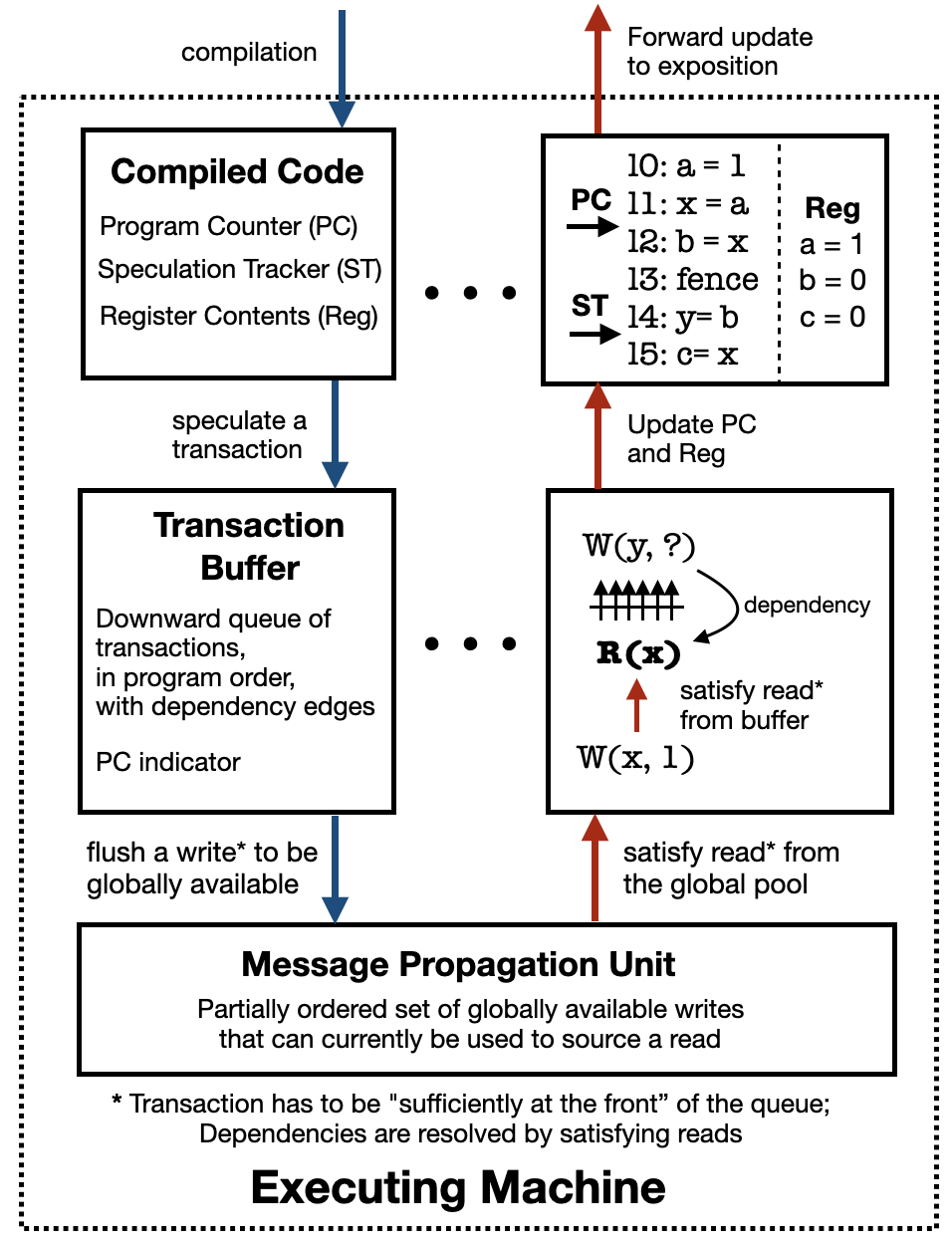
The image is a diagram illustrating the architecture and data flow within an "Executing Machine." It depicts the interaction between compiled code, a transaction buffer, and a message propagation unit, highlighting how transactions are speculated, managed, and made globally available. The diagram uses arrows to indicate the direction of data flow and includes annotations to explain the processes involved.
### Components/Axes
* **Title:** Executing Machine (located at the bottom center)
* **Main Components (from top to bottom):**
* Compiled Code
* Transaction Buffer
* Message Propagation Unit
* **Data Flow Arrows:** Blue arrows indicate the flow of transactions and writes, while red arrows indicate updates and read satisfaction.
* **Annotations:** Textual descriptions explaining the purpose and function of each component and the data flow between them.
* **PC/ST Block:** Shows the program counter and speculation tracker with example code execution.
* **Legend:** There is no explicit legend, but the colors of the arrows (red and blue) implicitly represent different types of data flow.
### Detailed Analysis
1. **Compiled Code (Top-Left):**
* Contains: Program Counter (PC), Speculation Tracker (ST), Register Contents (Reg).
* Process: Receives "compilation" input (blue arrow from top).
* Action: "speculate a transaction" (blue arrow downwards).
2. **Transaction Buffer (Middle-Left):**
* Description: "Downward queue of transactions, in program order, with dependency edges."
* Includes: "PC indicator."
* Process: Receives speculated transactions from "Compiled Code" (blue arrow).
* Action: "flush a write* to be globally available" (blue arrow downwards).
3. **Message Propagation Unit (Bottom):**
* Description: "Partially ordered set of globally available writes that can currently be used to source a read."
* Process: Receives flushed writes from "Transaction Buffer" (blue arrow).
4. **PC/ST Block (Top-Right):**
* Code Snippet:
* 10: a = 1
* 11: x = a
* 12: b = x
* 13: fence
* 14: y = b
* 15: c = x
* Registers (Reg):
* a = 1
* b = 0
* c = 0
* Arrows:
* "Forward update to exposition" (red arrow upwards).
* "Update PC and Reg" (red arrow upwards).
5. **Read/Write Operations (Middle-Right):**
* W(y, ?) - Write operation with unknown value.
* R(x) - Read operation on x.
* W(x, 1) - Write operation setting x to 1.
* Arrows:
* "satisfy read* from buffer" (red arrow upwards from W(x, 1) to R(x)).
* "satisfy read* from the global pool" (red arrow upwards from Message Propagation Unit to W(x, 1)).
* Dependency: A curved arrow labeled "dependency" connects W(y, ?) to R(x).
6. **Additional Notes:**
* "* Transaction has to be "sufficiently at the front" of the queue; Dependencies are resolved by satisfying reads" (located above "Executing Machine" title).
### Key Observations
* The diagram illustrates a pipelined execution model with speculation.
* The Transaction Buffer manages the order and dependencies of transactions.
* The Message Propagation Unit ensures that writes are globally available for reads.
* The PC/ST block provides a snapshot of the program execution state.
* Read operations can be satisfied either from the Transaction Buffer or the global pool (Message Propagation Unit).
### Interpretation
The diagram presents a high-level view of an executing machine designed for efficient transaction processing. The use of speculation, a transaction buffer, and a message propagation unit suggests an architecture that aims to maximize parallelism and minimize latency. The "dependency" arrow indicates that read operations may depend on previous write operations, and the system must ensure that these dependencies are resolved correctly. The distinction between satisfying reads from the buffer versus the global pool implies a caching or buffering mechanism to speed up access to frequently used data. The "fence" instruction in the code snippet suggests a memory barrier or synchronization point to ensure proper ordering of operations. Overall, the diagram illustrates a complex system designed for high-performance execution of transactional workloads.