TECHNICAL ASSET FINGERPRINT
311c0478b6c50307eb80169d
Click to view fullscreen
Press ESC or click to close
FOUND IN PAPERS
EXPERT: healer-alpha-free VERSION 1
RUNTIME: free/openrouter/healer-alpha
INTEL_VERIFIED
## Diagram: Executing Machine - Speculative Transactional Execution Flow
### Overview
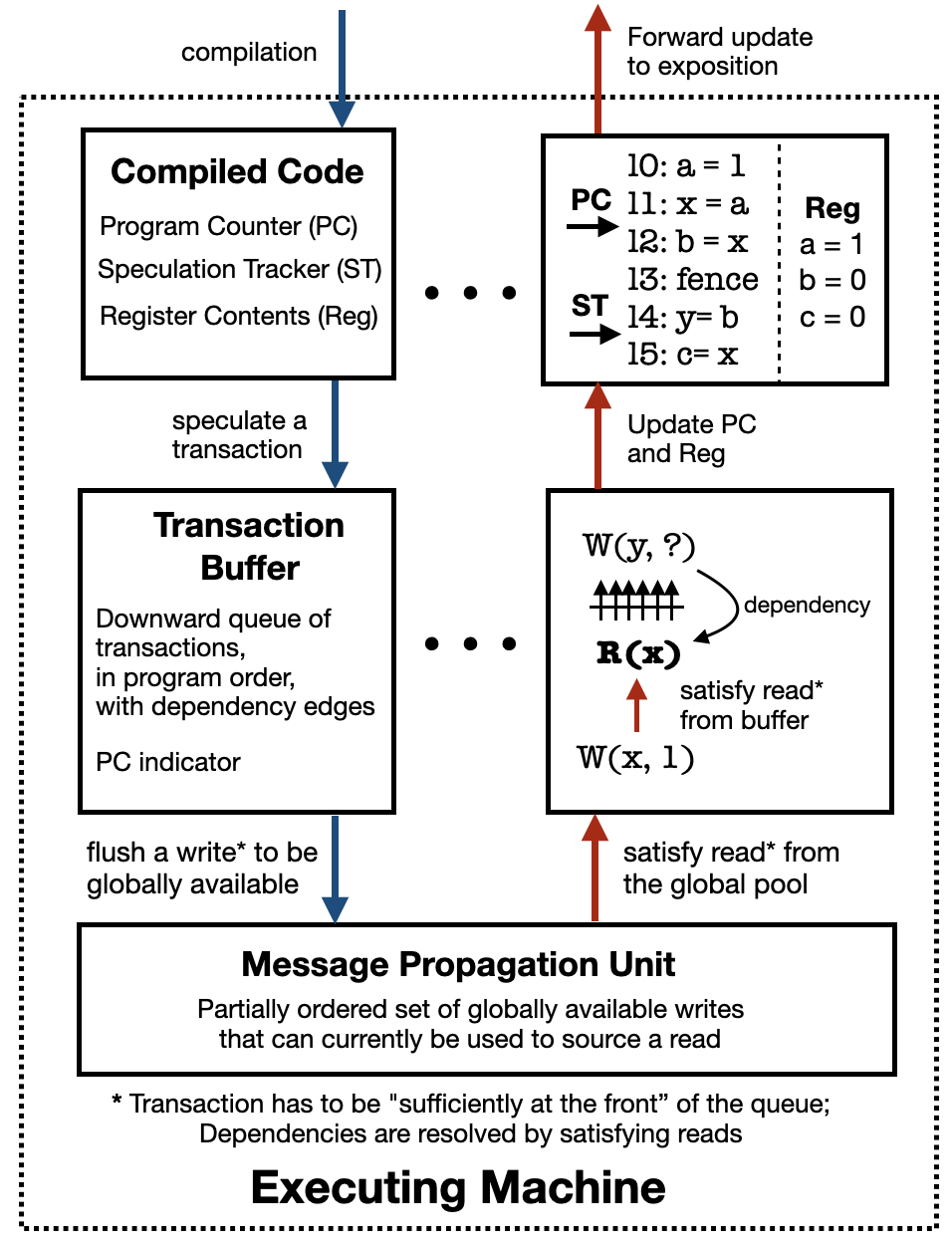
This image is a technical block diagram illustrating the architecture and data flow of an "Executing Machine" that performs speculative transactional execution. The diagram shows how compiled code is processed through a transaction buffer and a message propagation unit, with mechanisms for speculation, dependency tracking, and making writes globally available. The flow is bidirectional, with blue arrows indicating the forward speculative path and red arrows indicating the resolution and update path.
### Components/Axes
The diagram is contained within a large dotted rectangle labeled **"Executing Machine"** at the bottom center. It consists of three primary rectangular blocks connected by labeled arrows.
**Primary Blocks (from top to bottom):**
1. **Compiled Code** (Top Left Box)
* Contains: Program Counter (PC), Speculation Tracker (ST), Register Contents (Reg).
2. **Transaction Buffer** (Middle Left Box)
* Contains: Downward queue of transactions, in program order, with dependency edges; PC indicator.
3. **Message Propagation Unit** (Bottom Center Box)
* Contains: Partially ordered set of globally available writes that can currently be used to source a read.
**Supporting Visual Elements (to the right of the main blocks):**
* **Code Snippet & Register State** (Top Right Box): Shows an example of compiled code lines (10-15) and the corresponding register state.
* **Dependency Graph** (Middle Right Box): Illustrates a specific transaction's read/write operations and their dependencies.
**Flow Arrows & Labels:**
* **Blue Arrows (Speculative/Forward Path):**
* From top, into "Compiled Code": `compilation`
* From "Compiled Code" to "Transaction Buffer": `speculate a transaction`
* From "Transaction Buffer" to "Message Propagation Unit": `flush a write* to be globally available`
* **Red Arrows (Resolution/Update Path):**
* From "Message Propagation Unit" upward: `satisfy read* from the global pool`
* From the Dependency Graph upward: `satisfy read* from buffer` and `Update PC and Reg`
* From the Code Snippet box upward: `Forward update to exposition`
**Footnote:**
An asterisk (*) note at the bottom clarifies: `* Transaction has to be "sufficiently at the front" of the queue; Dependencies are resolved by satisfying reads`.
### Detailed Analysis
**1. Compiled Code & Initial State (Top Section):**
* The process begins with `compilation` feeding into the **Compiled Code** block.
* The adjacent box provides a concrete example:
* **Code Lines:**
* `10: a = 1`
* `11: x = a` (PC arrow points here)
* `12: b = x`
* `13: fence`
* `14: y = b` (ST arrow points here)
* `15: c = x`
* **Register Contents (Reg):** `a = 1`, `b = 0`, `c = 0`.
* This shows the Program Counter (PC) at line 11 and the Speculation Tracker (ST) at line 14, indicating the state of speculative execution.
**2. Transaction Buffer & Dependency Tracking (Middle Section):**
* A transaction is speculated from the Compiled Code and placed into the **Transaction Buffer**.
* The buffer is described as a "Downward queue of transactions, in program order, with dependency edges."
* The adjacent dependency graph visualizes a transaction's internal state:
* It contains operations: `W(y, ?)`, `R(x)`, and `W(x, 1)`.
* A curved arrow labeled `dependency` points from `W(y, ?)` to `R(x)`, indicating that writing to `y` depends on the result of reading `x`.
* A red arrow labeled `satisfy read* from buffer` points to `R(x)`, showing how a pending read can be resolved from the buffer itself.
**3. Message Propagation Unit & Global Visibility (Bottom Section):**
* Writes are flushed from the Transaction Buffer to the **Message Propagation Unit** to become "globally available."
* This unit holds a "Partially ordered set of globally available writes that can currently be used to source a read."
* A red arrow labeled `satisfy read* from the global pool` points upward from this unit, indicating it can fulfill read requests (`R(x)`) for other transactions.
**4. Resolution and Update Flow (Red Path):**
* Once reads are satisfied (either from the buffer or the global pool), the system proceeds to `Update PC and Reg`.
* Finally, there is a `Forward update to exposition` at the very top, suggesting the committed results are made visible to the broader system.
### Key Observations
1. **Dual-Path Architecture:** The system clearly separates the speculative forward path (blue) from the resolution and commit path (red).
2. **Two-Level Read Resolution:** Reads can be satisfied from two sources: the local **Transaction Buffer** (for intra-transaction or recent dependencies) or the **Message Propagation Unit** (for globally visible writes from other transactions).
3. **Explicit Dependency Modeling:** The diagram explicitly models data dependencies (`W(y, ?)` depends on `R(x)`) within a transaction, which is critical for correct speculative execution.
4. **Program Order Maintenance:** The Transaction Buffer maintains transactions "in program order," which is essential for preserving semantics in a speculative system.
5. **Conditional Flushing:** The footnote indicates that not all writes in the buffer are immediately flushed; a transaction must be "sufficiently at the front," implying a policy for managing buffer resources and ordering.
### Interpretation
This diagram models a **speculative transactional memory or out-of-order execution engine**. Its purpose is to execute instructions (transactions) speculatively before knowing if all dependencies and conditions are met, to improve performance.
* **How it works:** The machine speculatively executes code, tracking dependencies and buffering writes. It attempts to resolve reads locally within the transaction buffer. If a read cannot be satisfied locally (e.g., it depends on an older, globally visible write), it queries the Message Propagation Unit. Once all dependencies for a transaction are resolved, its Program Counter and Register state are updated, and its results are "forwarded to exposition," meaning they are committed and become the new architectural state.
* **Why it matters:** This architecture allows for parallel execution of transactions that don't have conflicting memory accesses, hiding latency and increasing throughput. The separation of global visibility (Message Propagation Unit) from speculative state (Transaction Buffer) is a key design pattern for managing consistency in such systems.
* **Notable Design Choice:** The use of a "Speculation Tracker (ST)" separate from the Program Counter suggests the machine tracks not just *where* it is in the code, but also the *speculative context* or checkpoint from which the current speculation originated. The "fence" instruction in the example code (line 13) is likely a synchronization point that affects speculation boundaries.
DECODING INTELLIGENCE...