## Diagram: Executing Machine Architecture
### Overview
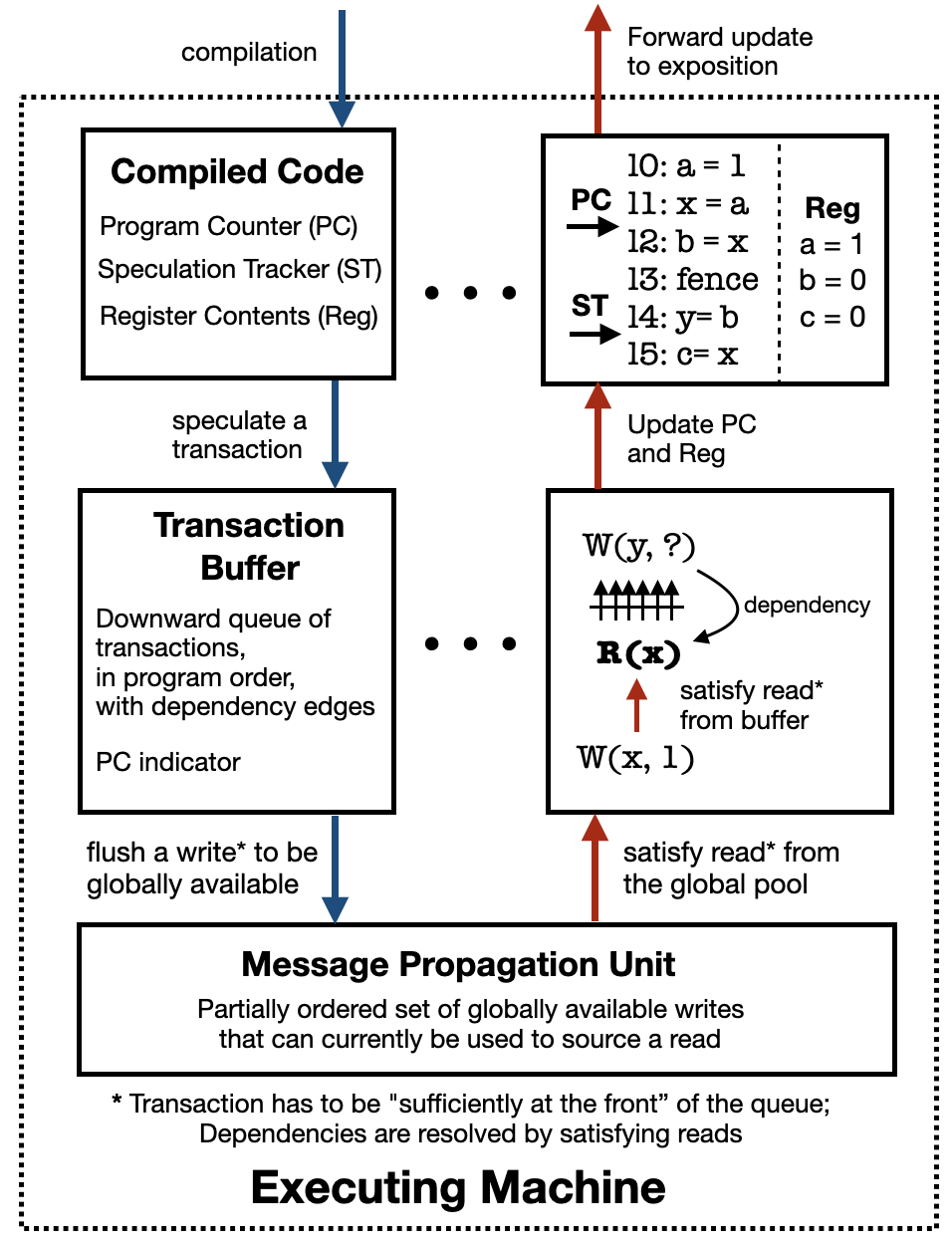
The diagram illustrates the components and data flow of an executing machine, focusing on transaction speculation, dependency resolution, and global write propagation. It emphasizes speculative execution, buffer management, and read/write operations with explicit dependency tracking.
### Components/Axes
1. **Compiled Code**
- Contains: Program Counter (PC), Speculation Tracker (ST), Register Contents (Reg)
- Function: Speculates transactions and tracks program state.
2. **Transaction Buffer**
- Contains: Downward queue of transactions (in program order with dependency edges), PC indicator
- Function: Manages speculative transactions and flushes writes to global availability.
3. **Message Propagation Unit**
- Contains: Partially ordered set of globally available writes (W(y, ?), W(x, 1))
- Function: Sources reads from global writes and resolves dependencies.
4. **Executing Machine**
- Central component integrating all subsystems.
**Arrows/Dependencies**:
- Red arrows indicate "Forward update to exposition" (e.g., PC/ST/Reg updates).
- Blue arrows show "speculate a transaction" flow.
- Dependency edges link writes (W(y, ?)) to reads (R(x)).
### Detailed Analysis
- **Compiled Code**:
- PC, ST, and Reg are updated via red arrows (e.g., PC → 10: a = 1, 11: x = a).
- ST tracks speculative states (e.g., ST → 13: fence, 14: y = b).
- **Transaction Buffer**:
- Queues transactions with explicit dependencies (e.g., W(y, ?) → R(x)).
- Flushes writes to global availability (e.g., "flush a write* to be globally available").
- **Message Propagation Unit**:
- Resolves dependencies via "satisfy read* from buffer" (e.g., R(x) → W(x, 1)).
- Sources reads from global pool (e.g., "satisfy read* from the global pool").
- **Asterisk Note**:
- Transactions must be "sufficiently at the front" of the queue to resolve dependencies.
### Key Observations
1. **Speculative Execution Flow**:
- Compiled code speculates transactions, which are buffered and ordered with dependency edges.
- Writes are propagated globally only after dependency resolution.
2. **Dependency Resolution**:
- Reads (R(x)) are satisfied either from the buffer (via W(x, 1)) or the global pool.
- Fences (e.g., 13: fence) enforce ordering constraints.
3. **Global Availability**:
- Writes are flushed to a global pool only after being "sufficiently at the front" of the transaction queue.
### Interpretation
The diagram demonstrates a speculative execution model where:
- **Compiled Code** initiates speculative transactions, tracked by the Speculation Tracker (ST).
- **Transaction Buffer** ensures transactions are processed in program order while managing dependencies.
- **Message Propagation Unit** resolves dependencies by linking reads to writes, either locally (buffer) or globally.
- The asterisk note highlights a critical constraint: transactions must progress far enough in the queue to avoid dependency bottlenecks.
This architecture prioritizes correctness in speculative execution by decoupling write propagation from dependency resolution, ensuring globally available writes are only exposed after dependencies are satisfied. The use of fences and explicit dependency edges suggests a focus on memory consistency and atomicity in a multi-threaded or parallel computing context.