## Photograph: Industrial Containers with Residue
### Overview
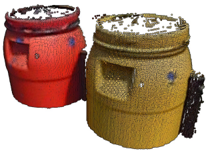
The image depicts two cylindrical industrial containers positioned side-by-side against a plain background. Both containers exhibit signs of wear and contain residual white powdery material. The containers differ in color, material texture, and design features, suggesting distinct functional or material properties.
### Components/Axes
- **Left Container (Red)**:
- Color: Bright red with a matte finish.
- Material: Appears to be plastic or composite.
- Features:
- Circular opening at the top with a raised rim.
- Small blue circular marking near the base.
- Rectangular handle or grip on the side.
- **Right Container (Brown)**:
- Color: Earthy brown with a textured surface.
- Material: Likely metal or heavy-duty plastic.
- Features:
- Similar circular opening at the top with a recessed rim.
- Black rectangular handle or grip on the side.
- No visible markings or labels.
### Detailed Analysis
- **Residue**: Both containers contain a white powdery substance, possibly a chemical, powdered material, or byproduct. The residue is unevenly distributed, with clumping near the openings.
- **Condition**:
- Red container shows minor scratches and discoloration.
- Brown container has a more rugged texture, possibly from abrasion or environmental exposure.
- **Design Differences**:
- The red container’s handle is flush with the body, while the brown container’s handle is slightly protruding.
- The brown container’s surface has a granular texture, whereas the red container’s surface is smoother.
### Key Observations
1. **Contrast in Materials**: The red container’s smoother surface contrasts with the brown container’s textured exterior, potentially indicating differences in intended use (e.g., chemical resistance vs. durability).
2. **Residue Consistency**: The white powder in both containers suggests a shared application or storage purpose, though the residue quantity and distribution vary.
3. **Handle Design**: The handles’ differing orientations (left vs. right) may reflect ergonomic considerations for handling or transportation.
### Interpretation
The containers likely serve industrial or laboratory purposes, given their robust construction and residue content. The red container’s brighter color and simpler design might prioritize visibility or cost-effectiveness, while the brown container’s textured surface and heavier build suggest use in harsher conditions. The absence of labels or markings implies either a generic design or a context where identification is unnecessary. The residual material’s uniformity across both containers hints at a common origin or processing step, though further analysis (e.g., chemical testing) would be required to confirm this.
### Notable Anomalies
- No visible text, labels, or identifiers on either container.
- Uneven residue distribution, which may indicate partial emptying or settling over time.
- The blue marking on the red container lacks context (e.g., no legend or reference scale).