## Flowchart: Topological RAG Architecture
### Overview
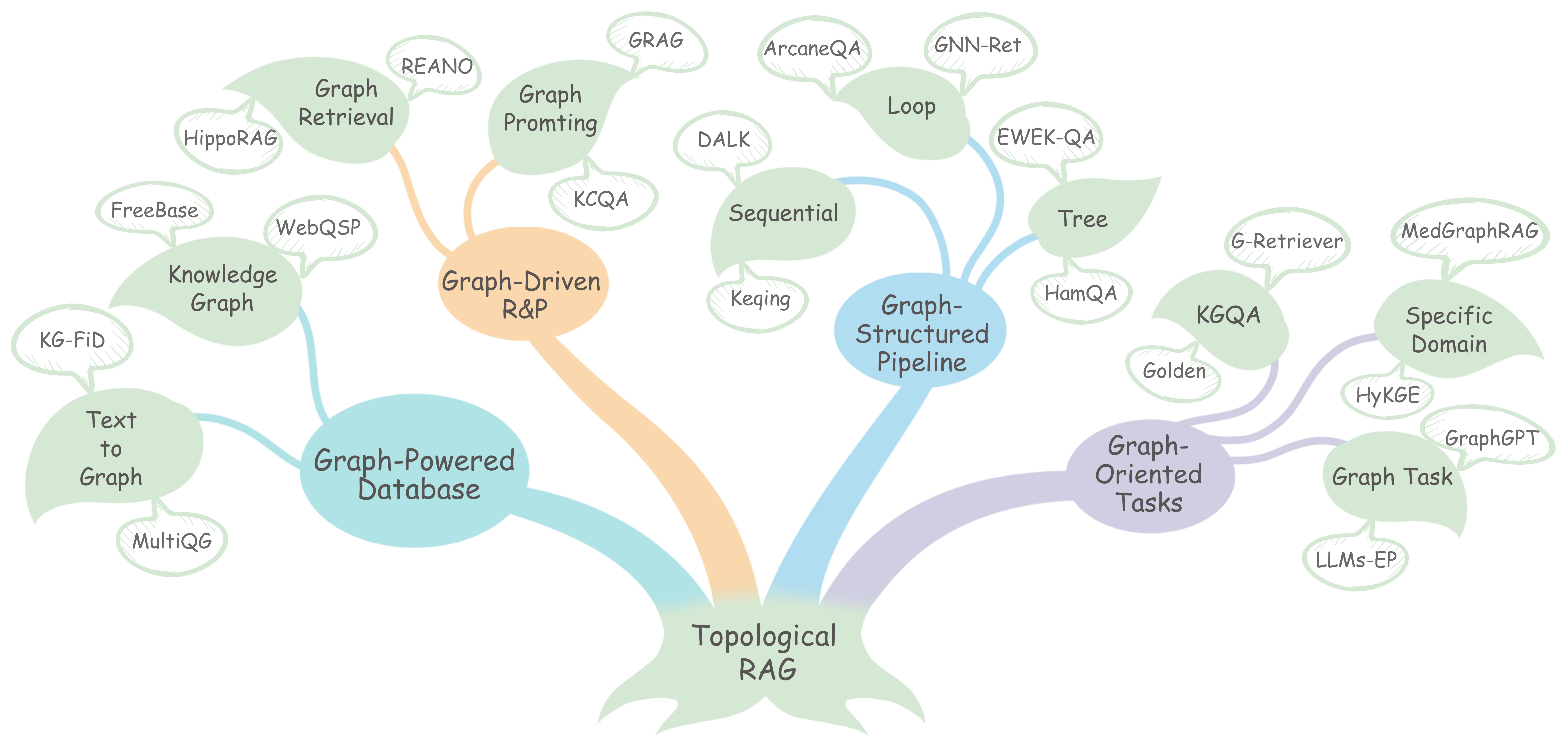
The diagram illustrates a hierarchical framework for "Topological RAG" (Retrieval-Augmented Generation), categorizing graph-based methodologies into four main branches: **Graph-Powered Database**, **Graph-Driven R&P**, **Graph-Structured Pipeline**, and **Graph-Oriented Tasks**. Each branch further subdivides into specific techniques, tools, or applications, emphasizing the integration of graph technologies in RAG systems.
---
### Components/Axes
- **Main Branches** (colored in blue, orange, and purple):
1. **Graph-Powered Database** (blue)
2. **Graph-Driven R&P** (orange)
3. **Graph-Structured Pipeline** (blue)
4. **Graph-Oriented Tasks** (purple)
- **Subcategories** (green bubbles with labels):
- **Graph-Powered Database**:
- Knowledge Graph (FreeBase, WebQSP, KG-FiD)
- Text to Graph (MultiQG)
- Graph Database (HipoRAG, REANO)
- **Graph-Driven R&P**:
- Graph Retrieval (HipoRAG, REANO)
- Graph Prompting (GRAG, KCQA)
- Knowledge Graph (FreeBase, WebQSP, KG-FiD)
- **Graph-Structured Pipeline**:
- Sequential (DALK, Keqing)
- Loop (ArcaneQA, GNN-Ret)
- Tree (EWEK-QA, HamQA)
- **Graph-Oriented Tasks**:
- Graph Task (LLMs-EP, GraphGPT)
- Specific Domain (KGQA, G-Retriever, MedGraphRAG, HyKGE, Golden)
---
### Detailed Analysis
- **Graph-Powered Database**: Focuses on foundational graph technologies for data storage and retrieval. Tools like **HipoRAG** and **REANO** are listed under both this branch and **Graph-Driven R&P**, suggesting their dual role in database management and retrieval/prompting workflows.
- **Graph-Driven R&P**: Highlights retrieval and prompting strategies, with **Graph Prompting** (GRAG, KCQA) and **Graph Retrieval** (HipoRAG, REANO) as core components. The repetition of **Knowledge Graph** tools indicates their centrality to both database and R&P layers.
- **Graph-Structured Pipeline**: Organizes processing workflows into **Sequential**, **Loop**, and **Tree** structures, each with domain-specific tools (e.g., **DALK** for sequential processing, **GNN-Ret** for loop-based retrieval).
- **Graph-Oriented Tasks**: Addresses specialized applications, including **Graph Task** (LLMs-EP, GraphGPT) and **Specific Domain** (KGQA, MedGraphRAG, HyKGE). The inclusion of **Golden** (likely a reference to gold-standard datasets) underscores the importance of benchmarking.
---
### Key Observations
1. **Overlap in Tools**: Tools like **HipoRAG**, **REANO**, **FreeBase**, and **WebQSP** appear in multiple branches, indicating their versatility across database, retrieval, and prompting tasks.
2. **Hierarchical Structure**: The diagram emphasizes a layered approach, where foundational databases (e.g., **Knowledge Graph**) support higher-level processes like **Graph Prompting** and **Graph-Structured Pipelines**.
3. **Domain Specialization**: The **Specific Domain** subcategory under **Graph-Oriented Tasks** highlights tailored applications (e.g., **MedGraphRAG** for medical graphs, **KGQA** for knowledge graph question answering).
---
### Interpretation
The diagram presents a comprehensive taxonomy for graph-driven RAG systems, illustrating how graph technologies are stratified into database infrastructure, retrieval/prompting strategies, processing pipelines, and domain-specific applications. The repetition of tools across branches suggests a modular design where components can be reused or adapted for different stages of the RAG workflow. For example:
- **HipoRAG** and **REANO** bridge database management and retrieval, acting as both storage solutions and retrieval engines.
- **Graph Prompting** (GRAG, KCQA) and **Graph Retrieval** (HipoRAG, REANO) are tightly coupled, reflecting the interdependence of data access and query formulation in RAG systems.
- The **Specific Domain** subcategory underscores the need for domain adaptation, with tools like **MedGraphRAG** and **KGQA** addressing niche use cases.
This framework provides a roadmap for integrating graph-based methods into RAG pipelines, emphasizing scalability, modularity, and domain-specific optimization.