## Diagram: Topological RAG Structure
### Overview
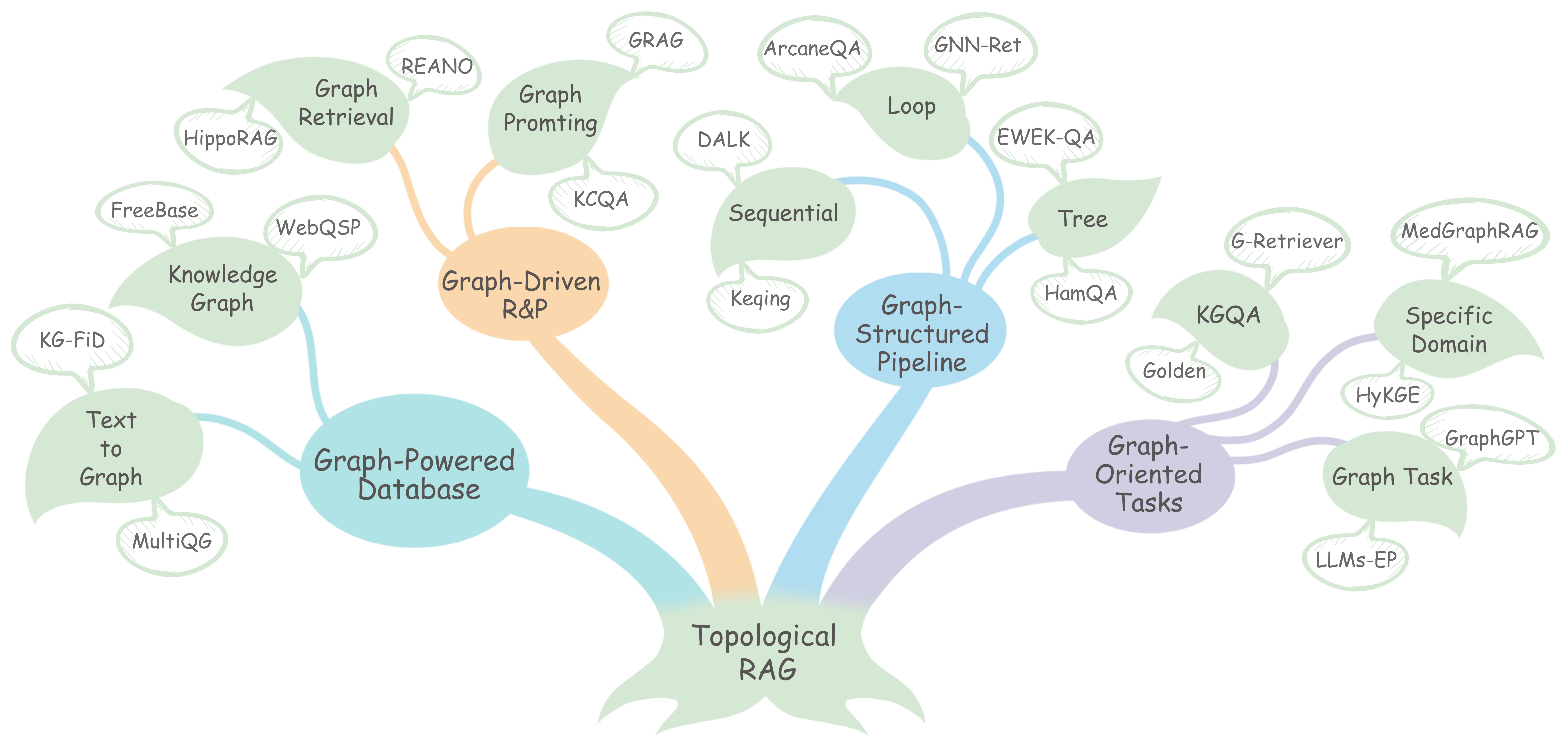
The image is a diagram illustrating the structure of Topological Retrieval-Augmented Generation (RAG). It shows how Topological RAG branches out into different categories, each representing a specific approach or application within the field. The diagram uses a tree-like structure with nodes representing different concepts and connections indicating relationships between them.
### Components/Axes
* **Central Node:** Topological RAG (located at the bottom-center)
* **Branches:** The diagram branches out into four main categories:
* Graph-Powered Database (light blue)
* Graph-Driven R&P (orange)
* Graph-Structured Pipeline (light blue)
* Graph-Oriented Tasks (purple)
* **Nodes:** Each branch further divides into specific applications or methods, represented by green nodes. These include:
* **Graph Retrieval:** REANO, HippoRAG
* **Knowledge Graph:** FreeBase, WebQSP, KG-FID
* **Text to Graph:** MultiQG
* **Graph Prompting:** GRAG, KCQA
* **Loop:** ArcaneQA, GNN-Ret
* **Sequential:** DALK, Keqing
* **Tree:** EWEK-QA, HamQA
* **Specific Domain:** MedGraphRAG, G-Retriever, KGQA, Golden, HyKGE
* **Graph Task:** GraphGPT, LLMS-EP
### Detailed Analysis
The diagram visually represents how Topological RAG serves as a foundation for various graph-based approaches. Each branch represents a different way of leveraging graphs in the RAG process.
* **Graph-Powered Database:** This branch focuses on using graphs as the underlying data structure for retrieval. It includes applications like Knowledge Graph retrieval and converting text to graphs.
* **Knowledge Graph** connects to FreeBase, WebQSP, and KG-FID.
* **Text to Graph** connects to MultiQG.
* **Graph-Driven R&P:** This branch emphasizes the use of graphs to drive the retrieval and prompting stages.
* **Graph Retrieval** connects to REANO and HippoRAG.
* **Graph Prompting** connects to GRAG and KCQA.
* **Graph-Structured Pipeline:** This branch focuses on structuring the RAG pipeline itself using graphs.
* **Loop** connects to ArcaneQA and GNN-Ret.
* **Sequential** connects to DALK and Keqing.
* **Tree** connects to EWEK-QA and HamQA.
* **Graph-Oriented Tasks:** This branch is dedicated to specific tasks that benefit from graph-based approaches.
* **Specific Domain** connects to MedGraphRAG, G-Retriever, KGQA, Golden, and HyKGE.
* **Graph Task** connects to GraphGPT and LLMS-EP.
### Key Observations
* The diagram highlights the versatility of Topological RAG, showcasing its applicability across various domains and tasks.
* The branching structure indicates a hierarchical relationship, with Topological RAG as the central concept and the other nodes representing specific implementations or applications.
* The use of different colors for the main branches helps to visually distinguish the different categories of graph-based approaches.
### Interpretation
The diagram illustrates the breadth and depth of Topological RAG as a framework for leveraging graphs in retrieval-augmented generation. It demonstrates how different graph-based techniques can be integrated into various stages of the RAG pipeline, from data storage and retrieval to task-specific applications. The diagram suggests that Topological RAG is a flexible and adaptable approach that can be tailored to meet the needs of diverse applications. The connections between the nodes highlight the interdisciplinary nature of the field, drawing upon concepts from graph theory, natural language processing, and knowledge representation.