## Diagram: Taxonomy of Topological RAG Methods
### Overview
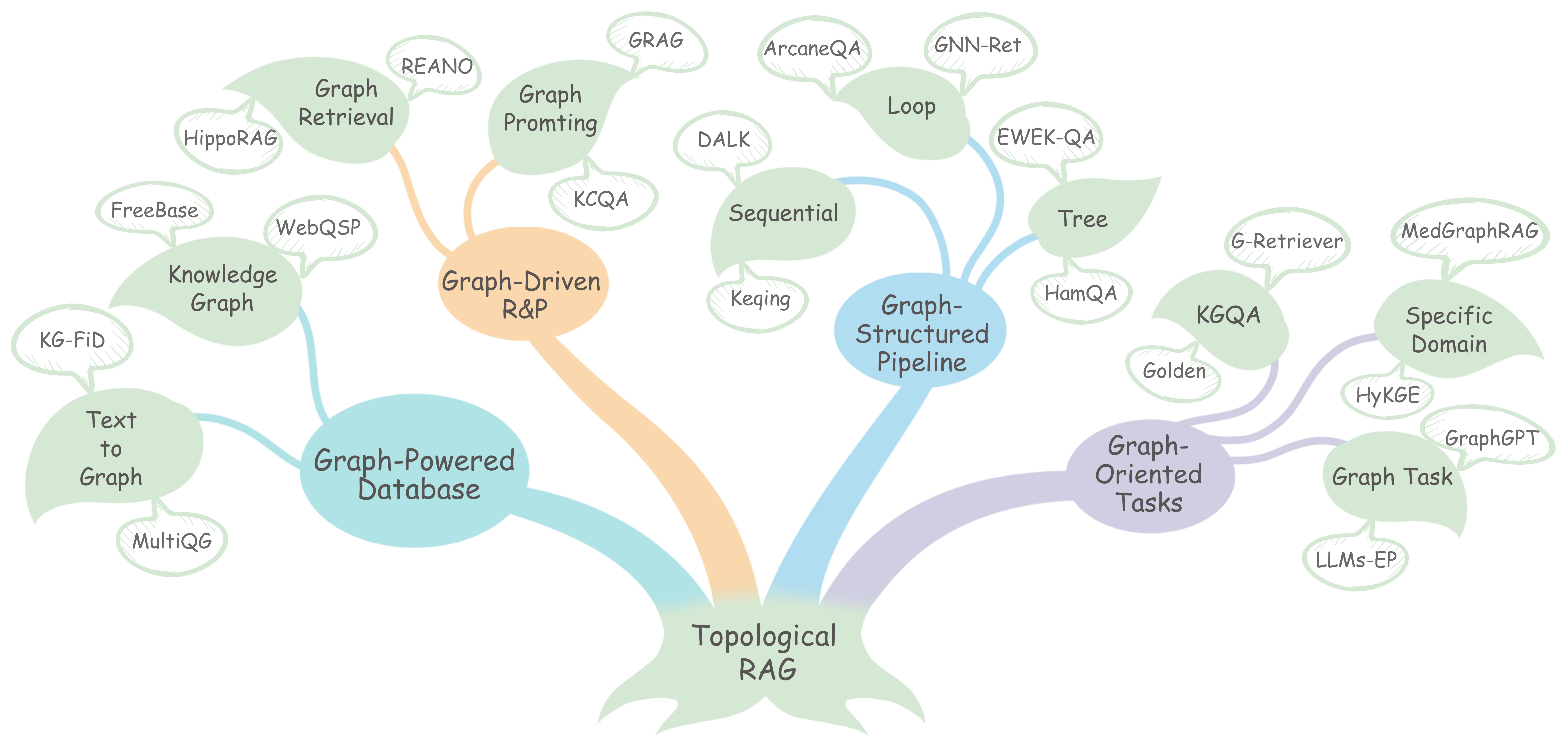
The image is a hand-drawn style mind map or concept tree illustrating a taxonomy of methods and datasets related to "Topological RAG" (Retrieval-Augmented Generation). The diagram organizes concepts hierarchically, with the central root node branching into four primary categories, which further subdivide into specific techniques, models, or datasets. The visual style uses organic, leaf-like shapes connected by colored, flowing lines.
### Components/Axes
* **Central Root Node:** "Topological RAG" (located at the bottom center).
* **Primary Branches (4):** These are the main categories stemming directly from the root.
1. **Graph-Powered Database** (Light blue branch, extending to the left).
2. **Graph-Driven R&P** (Orange branch, extending to the upper left).
3. **Graph-Structured Pipeline** (Light blue branch, extending to the upper right).
4. **Graph-Oriented Tasks** (Light purple branch, extending to the right).
* **Secondary Nodes (Sub-categories):** Each primary branch splits into one or more secondary nodes (green leaf shapes).
* **Leaf Nodes (Specific Methods/Datasets):** Attached to the secondary nodes are smaller, white, speech-bubble-shaped nodes containing specific names (e.g., "HippoRAG", "GRAG", "GNN-Ret").
### Content Details
The following is a complete hierarchical extraction of all textual labels from the diagram, organized by branch.
**1. Graph-Powered Database Branch (Left)**
* **Sub-category:** Text to Graph
* Leaf Nodes: `KG-FiD`, `MultiQG`
* **Sub-category:** Knowledge Graph
* Leaf Nodes: `FreeBase`, `WebQSP`
**2. Graph-Driven R&P Branch (Upper Left)**
* **Sub-category:** Graph Retrieval
* Leaf Nodes: `HippoRAG`, `REANO`
* **Sub-category:** Graph Promting [sic - likely a typo for "Prompting"]
* Leaf Nodes: `GRAG`, `KCQA`
**3. Graph-Structured Pipeline Branch (Upper Right)**
* **Sub-category:** Sequential
* Leaf Nodes: `DALK`, `Keqing`
* **Sub-category:** Loop
* Leaf Nodes: `ArcaneQA`, `GNN-Ret`
* **Sub-category:** Tree
* Leaf Nodes: `EWEK-QA`, `HamQA`
**4. Graph-Oriented Tasks Branch (Right)**
* **Sub-category:** KGQA (Knowledge Graph Question Answering)
* Leaf Nodes: `G-Retriever`, `Golden`
* **Sub-category:** Specific Domain
* Leaf Nodes: `MedGraphRAG`, `HyKGE`
* **Sub-category:** Graph Task
* Leaf Nodes: `GraphGPT`, `LLMs-EP`
### Key Observations
* **Hierarchical Structure:** The diagram presents a clear three-level hierarchy: Core Concept (Topological RAG) -> Methodological Categories (e.g., Graph-Powered Database) -> Specific Instances (e.g., HippoRAG).
* **Visual Grouping:** Related concepts are grouped under common sub-category nodes (e.g., all methods for "Graph Retrieval" are clustered together).
* **Asymmetry:** The branches are not symmetrical. The "Graph-Structured Pipeline" branch has the most sub-categories (Sequential, Loop, Tree), while "Graph-Powered Database" has two.
* **Terminology:** The diagram uses a mix of established acronyms (KGQA, RAG, LLMs) and what appear to be specific model or dataset names (Keqing, HamQA, EWEK-QA). The term "R&P" in "Graph-Driven R&P" is not defined in the image.
### Interpretation
This diagram serves as a conceptual map for the research landscape surrounding "Topological RAG," which likely refers to RAG systems that explicitly leverage graph structures (topologies) for retrieval or generation.
* **What it demonstrates:** It categorizes approaches based on their primary function or architectural pattern. For instance, some methods focus on creating or using graph databases ("Graph-Powered Database"), others on driving retrieval and prompting with graphs ("Graph-Driven R&P"), structuring the entire pipeline as a graph ("Graph-Structured Pipeline"), or applying graph-based methods to specific tasks ("Graph-Oriented Tasks").
* **Relationships:** The tree structure implies that "Topological RAG" is an umbrella term encompassing all these diverse graph-centric approaches. The sub-categories define the specific *role* the graph plays within the RAG framework.
* **Notable Patterns:** The presence of specific dataset names (FreeBase, WebQSP, Golden) alongside model names suggests the taxonomy includes both the techniques and the benchmarks used to evaluate them. The "Specific Domain" sub-branch under "Graph-Oriented Tasks" indicates a recognized niche for applying these methods to specialized fields like medicine (implied by "MedGraphRAG").
* **Potential Anomaly:** The label "Graph Promting" contains a probable typo ("Promting" instead of "Prompting"). This should be noted for accuracy but is transcribed as seen.