## Topological RAG: A Comprehensive Overview
### Overview
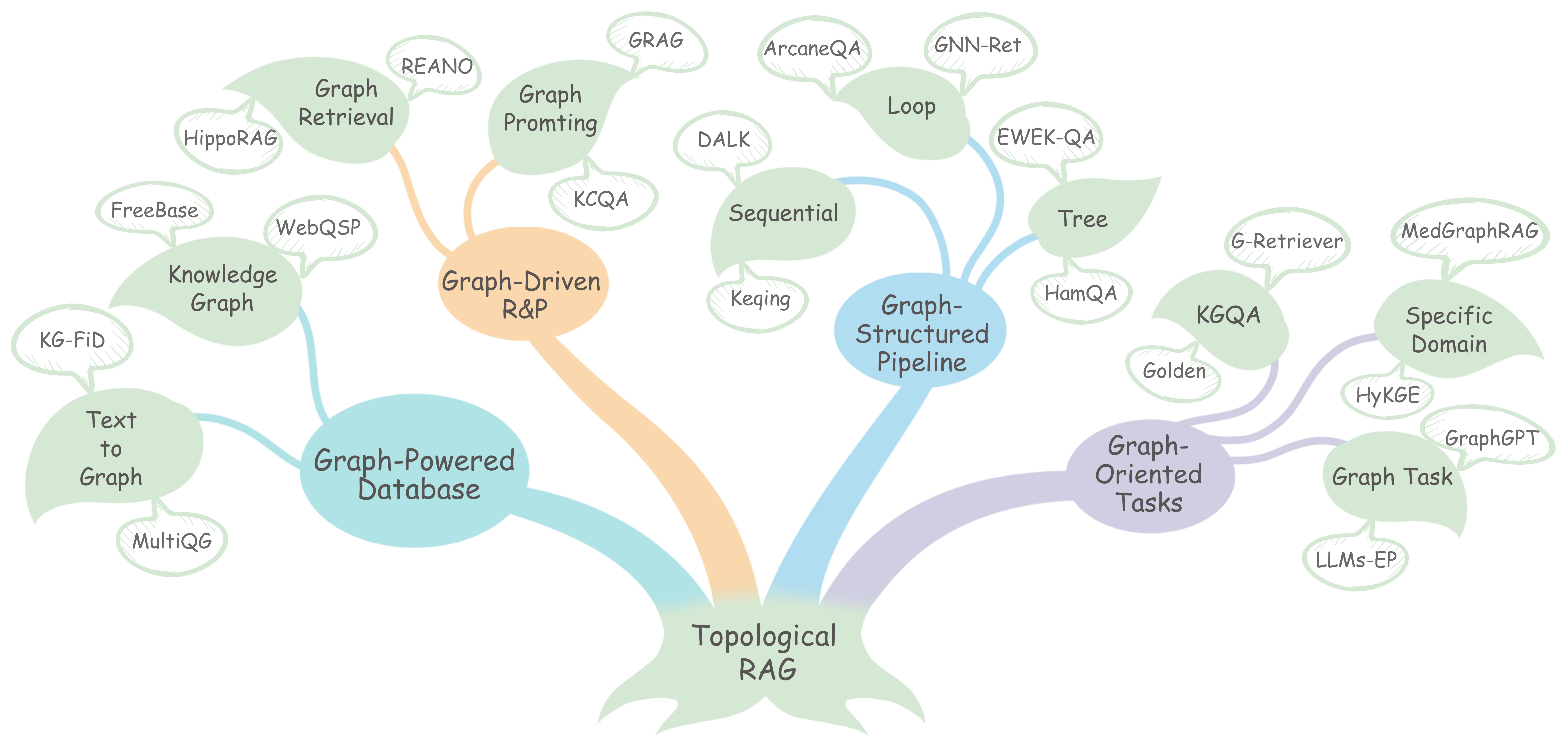
The diagram illustrates the various components and sub-components of a Topological Retrieval-Augmented Generation (RAG) system, which is a hybrid approach that combines the strengths of Retrieval-Augmented Generation (RAG) with topological reasoning. The system is designed to enhance the performance of language models by leveraging the structure and relationships within data.
### Components/Axes
- **Graph-Powered Database**: This is the central node from which all other components branch out. It represents the database that stores the knowledge graph.
- **Graph-Driven R&P**: This sub-node includes Graph Retrieval, Graph Prompting, and Graph-Structured Pipeline. These components are responsible for retrieving relevant information, generating prompts, and structuring the data for better understanding.
- **Graph-Structured Pipeline**: This sub-node includes Sequential, Tree, Loop, and Graph-Oriented Tasks. These components are designed to handle different types of tasks that require structured data.
- **Graph-Oriented Tasks**: This sub-node includes Graph Task, Specific Domain, and GraphPT. These components are tailored for specific tasks that require domain-specific knowledge.
- **Graph Task**: This sub-node includes LLMs-EP, HyKGE, and Golden. These components are designed to handle specific tasks that require the use of Large Language Models (LLMs) and other techniques.
- **Specific Domain**: This sub-node includes MedGraphRAG, G-Retriever, and KGQA. These components are tailored for specific domains such as medicine.
- **GraphPT**: This sub-node includes GraphPT, KGQA, and EWEK-QA. These components are designed to handle specific tasks that require the use of Graph-based techniques.
### Detailed Analysis or ### Content Details
- **Graph-Powered Database**: This database is the foundation of the system. It stores the knowledge graph, which is a network of entities and their relationships.
- **Graph-Driven R&P**: This sub-node includes Graph Retrieval, Graph Prompting, and Graph-Structured Pipeline. Graph Retrieval involves retrieving relevant information from the database. Graph Prompting involves generating prompts that can be used to retrieve information. Graph-Structured Pipeline involves structuring the data for better understanding.
- **Graph-Structured Pipeline**: This sub-node includes Sequential, Tree, Loop, and Graph-Oriented Tasks. Sequential tasks involve processing data in a linear manner. Tree tasks involve processing data in a hierarchical manner. Loop tasks involve processing data in a cyclic manner. Graph-Oriented Tasks involve processing data using graph-based techniques.
- **Graph-Oriented Tasks**: This sub-node includes Graph Task, Specific Domain, and GraphPT. Graph Task involves processing data using graph-based techniques. Specific Domain involves processing data using domain-specific techniques. GraphPT involves processing data using graph-based techniques.
- **Graph Task**: This sub-node includes LLMs-EP, HyKGE, and Golden. LLMs-EP involves processing data using Large Language Models (LLMs). HyKGE involves processing data using Hybrid Knowledge Graph Embeddings. Golden involves processing data using Golden Knowledge Graph Embeddings.
- **Specific Domain**: This sub-node includes MedGraphRAG, G-Retriever, and KGQA. MedGraphRAG involves processing data using medical knowledge graphs. G-Retriever involves processing data using graph-based techniques. KGQA involves processing data using knowledge graph embeddings.
- **GraphPT**: This sub-node includes GraphPT, KGQA, and EWEK-QA. GraphPT involves processing data using graph-based techniques. KGQA involves processing data using knowledge graph embeddings. EWEK-QA involves processing data using EWEK-QA techniques.
### Key Observations
- The system is designed to handle a wide range of tasks that require structured data.
- The system is tailored for specific domains such as medicine.
- The system is designed to leverage the structure and relationships within data to enhance the performance of language models.
### Interpretation
The Topological RAG system is a powerful tool for enhancing the performance of language models by leveraging the structure and relationships within data. The system is designed to handle a wide range of tasks that require structured data and is tailored for specific domains such as medicine. The system is designed to leverage the structure and relationships within data to enhance the performance of language models. The system is designed to handle a wide range of tasks that require structured data and is tailored for specific domains such as medicine. The system is designed to leverage the structure and relationships within data to enhance the performance of language models.