\n
## Diagram: State Transition Equivalence
### Overview
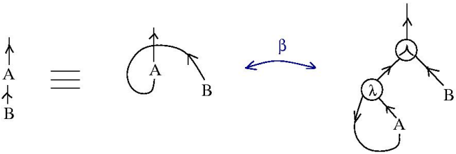
The image presents a diagram illustrating the equivalence between a set of state transitions represented by vertical arrows and a corresponding state machine diagram. It demonstrates how a simple sequential process can be represented using a more complex state machine with loops and transitions.
### Components/Axes
The diagram consists of three main parts:
1. **Left Side:** Two vertical arrows labeled 'A' and 'B', with an equivalence symbol (three horizontal lines) connecting them to the next part.
2. **Center:** A state transition diagram with a single state 'A' and a transition to state 'B'. A curved arrow loops back from 'B' to 'A'. A bidirectional arrow labeled 'β' is present.
3. **Right Side:** A state machine diagram with two states, represented by circles. The top circle is unlabeled, and the bottom circle is labeled 'λ'. The top circle has an outgoing arrow to 'B' and another to the 'λ' state. The 'λ' state has an outgoing arrow to 'A' and a loop back to itself.
### Detailed Analysis or Content Details
* **Left Side:** The vertical arrows 'A' and 'B' represent sequential actions or states. The equivalence symbol indicates that the following diagram is equivalent to this sequence.
* **Center:** The state 'A' transitions to 'B'. The loop from 'B' back to 'A' indicates a possible return or repetition of the 'A' state. The bidirectional arrow 'β' suggests a possible relationship or transformation between the states.
* **Right Side:** The unlabeled top state transitions to both 'B' and the 'λ' state. The 'λ' state transitions to 'A' and has a self-loop, indicating it can remain in the 'λ' state. The 'λ' state is likely an intermediate state or a holding state.
### Key Observations
The diagram shows a transformation from a simple sequential process (A, B) to a state machine representation. The state machine introduces the concept of intermediate states ('λ') and loops, allowing for more complex behavior. The 'β' arrow in the center diagram suggests a possible transformation or relationship between the initial states and the state machine.
### Interpretation
This diagram likely illustrates a concept in automata theory or formal languages. It demonstrates how a simple sequence of actions can be modeled using a state machine. The 'β' arrow could represent a transformation or a function that maps the initial sequence to the state machine. The state 'λ' could represent an internal state or a temporary holding state within the machine. The diagram suggests that state machines can represent more complex behaviors than simple sequential processes, allowing for loops, branching, and intermediate states. The equivalence shown implies that the state machine behaves in the same way as the original sequence of actions. This is a common technique used in computer science to model and analyze systems with different states and transitions.