## Diagram: Conceptual Relationship Model
### Overview
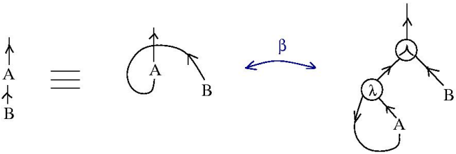
The image depicts a conceptual relationship model with two primary sections:
1. **Left Side**: A bidirectional equivalence between two vertical arrows labeled **A** (upward) and **B** (downward).
2. **Right Side**: A complex network of nodes (circles) and directional arrows, labeled **λ** and **β**, illustrating hierarchical or feedback relationships.
### Components/Axes
- **Left Section**:
- **Vertical Arrows**:
- **A**: Upward-pointing arrow labeled "A".
- **B**: Downward-pointing arrow labeled "B".
- **Equivalence Symbol**: Three horizontal lines (≡) connecting A and B, indicating bidirectional equivalence.
- **Right Section**:
- **Nodes**:
- **Upper Node**: Circle with a Y-shaped arrow pointing upward (no explicit label).
- **Lower Node**: Circle with a looped arrow labeled **λ**.
- **Arrows**:
- **β**: Double-headed blue arrow connecting the upper and lower nodes.
- **Directional Arrows**:
- Upper node → A and B (arrows point to labels A and B).
- Lower node → B and A (arrows point to labels B and A).
### Detailed Analysis
- **Left Section**:
- The equivalence (≡) suggests A and B are interchangeable or mutually dependent in this context.
- Spatial grounding: A is positioned above B, with the equivalence symbol centered between them.
- **Right Section**:
- **λ**: The looped arrow on the lower node implies a self-referential or cyclical process.
- **β**: The bidirectional arrow between nodes suggests a reversible or bidirectional interaction.
- **Flow**: Arrows from both nodes point to A and B, indicating these labels are outcomes or targets of the network.
### Key Observations
1. **Symmetry**: The left section’s equivalence mirrors the right section’s bidirectional β arrow.
2. **Cyclicality**: The λ loop on the lower node introduces a feedback mechanism absent in the left section.
3. **Hierarchy**: The upper node’s Y-shaped arrow may represent a bifurcation or decision point.
### Interpretation
This diagram likely models a system where:
- **A and B** are foundational elements (left section) that can exist in equilibrium.
- The **right section** expands this into a dynamic system with feedback (λ) and bidirectional interactions (β), where A and B are influenced by higher-order processes (upper node).
- The Y-shaped arrow on the upper node could symbolize a branching logic or probabilistic outcome, while the looped λ suggests iterative refinement or self-sustaining cycles.
The model may represent concepts in systems theory, control theory, or decision-making frameworks, where simple equivalences evolve into complex, interdependent structures.