\n
## Logical/Semantic Tree Diagram: Propositional Decomposition
### Overview
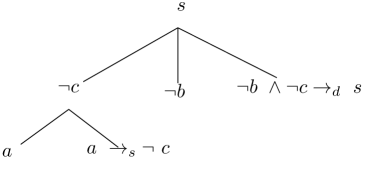
The image displays a hierarchical tree diagram, likely representing a logical proof, semantic decomposition, or derivation in a formal system (e.g., modal logic, proof theory). The structure consists of nodes connected by lines, with logical symbols and propositional variables as labels. The diagram is monochrome (black lines and text on a white background).
### Components/Axes
This is not a chart with axes but a node-link diagram. The components are:
* **Nodes**: Labeled with logical symbols and variables.
* **Edges (Lines)**: Represent relationships or derivations between nodes.
* **Labels**: The textual content of each node.
* **Spatial Layout**: A top-down tree structure with a root node and branching children.
### Detailed Analysis
**1. Root Node:**
* **Position**: Top center.
* **Label**: `s`
**2. First-Level Branches (from root `s`):**
The root `s` has three direct child nodes, connected by lines branching downwards.
* **Left Branch**: Leads to a node labeled `¬c` (negation of proposition `c`).
* **Middle Branch**: Leads to a node labeled `¬b` (negation of proposition `b`).
* **Right Branch**: Leads to a node labeled `¬b ∧ ¬c →_d s`. This is a compound formula: "not `b` AND not `c` implies (with subscript `d`) `s`".
**3. Subtree under Left Branch (`¬c`):**
The node `¬c` itself has two child nodes, forming a smaller subtree.
* **Left Child of `¬c`**: A node labeled `a`.
* **Right Child of `¬c`**: A node labeled `→_s ¬c`. This appears to be an implication operator (with subscript `s`) pointing to `¬c`. The arrow `→_s` is part of the node's label.
**4. Complete Node Inventory (Transcription):**
* `s` (Root)
* `¬c` (Child of root, left)
* `¬b` (Child of root, middle)
* `¬b ∧ ¬c →_d s` (Child of root, right)
* `a` (Child of `¬c`, left)
* `→_s ¬c` (Child of `¬c`, right)
**5. Language Identification:**
The text consists of **logical and mathematical notation**. This is a formal symbolic language, not a natural language. The symbols include:
* Propositional variables: `a`, `b`, `c`, `s`.
* Logical connectives: `¬` (negation), `∧` (conjunction), `→` (implication).
* Subscripts: `_s`, `_d` attached to implication arrows, likely denoting different modalities, derivation rules, or semantic relations.
### Key Observations
1. **Asymmetric Structure**: The tree is not balanced. The left branch (`¬c`) has a deeper subtree (two additional levels) compared to the middle (`¬b`) and right (`¬b ∧ ¬c →_d s`) branches, which are terminal nodes at the first level.
2. **Subscripted Implications**: The diagram uses two distinct implication symbols: `→_d` (in the right branch of the root) and `→_s` (in the subtree under `¬c`). This suggests the formal system distinguishes between at least two types of implication or inference steps.
3. **Self-Reference in Label**: The rightmost child of the root, `¬b ∧ ¬c →_d s`, contains the root label `s` within its own formula, indicating a recursive or self-referential relationship in the logical structure.
4. **Leaf Nodes**: The terminal nodes (leaves) of the entire tree are: `¬b`, `¬b ∧ ¬c →_d s`, `a`, and `→_s ¬c`.
### Interpretation
This diagram visually represents a **formal logical argument or semantic analysis**. The root `s` is being decomposed or justified by three conditions or premises (`¬c`, `¬b`, and the implication `¬b ∧ ¬c →_d s`). The structure suggests that `s` might be true if any of these child conditions hold, or perhaps they are conjunctive requirements.
The deeper analysis under `¬c` indicates that the truth or derivation of `¬c` itself depends on two further elements: a proposition `a` and an implication `→_s ¬c`. This could represent a case analysis or a sub-proof where `¬c` is established via `a` and a specific rule (`→_s`).
The use of distinct subscripts (`_s`, `_d`) is critical. In contexts like modal logic or proof theory, these often denote different modalities (e.g., "s" for "strict" or "system", "d" for "derived" or "deontic") or different inference rules. The diagram therefore likely illustrates a proof in a **multi-modal or multi-relation logical system**, where the path to establishing `s` involves different kinds of logical steps. The self-reference in `¬b ∧ ¬c →_d s` hints at a fixed-point or recursive definition within the system.