\n
## Diagram: Logical Tree Structure
### Overview
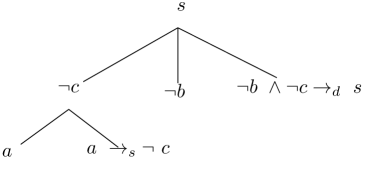
The image depicts a tree-like diagram representing a logical structure or derivation. It shows a hierarchical breakdown of a statement 's' into its constituent parts, using logical operators and variables. The diagram appears to illustrate a proof or a logical implication.
### Components/Axes
The diagram consists of nodes connected by branches. The nodes contain logical expressions. The root node is labeled 's'. The branches represent logical dependencies or derivations. The diagram does not have traditional axes, but rather a top-down hierarchical structure.
### Detailed Analysis or Content Details
The diagram can be described as follows, starting from the root:
1. **Root Node:** 's'
2. **First Branch (Left):** From 's' branches to '¬c' (not c).
3. **Second Branch (Right):** From 's' branches to '¬b ∧ ¬c → d' (not b and not c implies d).
4. **Sub-branch of '¬c':** From '¬c' branches to 'a'.
5. **Sub-branch of 'a':** From 'a' branches to 'a →s ¬c' (if a then s not c).
The expressions within the nodes are:
* s
* ¬c
* ¬b ∧ ¬c → d
* a
* a →s ¬c
### Key Observations
The diagram shows a logical decomposition of 's' into two main components: '¬c' and '¬b ∧ ¬c → d'. The '¬c' component is further broken down into 'a', which then leads to 'a →s ¬c'. The diagram suggests a conditional relationship between 'a' and '¬c' within the context of 's'.
### Interpretation
The diagram represents a logical argument or proof. The root 's' is the statement being proven or derived. The branches show how 's' can be broken down into simpler statements. The '¬b ∧ ¬c → d' component suggests a conditional implication. The sub-branch involving 'a' and '¬c' indicates that 'a' is a condition for '¬c' to be true, within the larger context of 's'. The diagram is a visual representation of a logical deduction, showing the steps involved in deriving 's' from its constituent parts. It is a formal representation of a logical argument, likely used in mathematical logic or computer science. The '→s' notation is unusual and may indicate a specific proof system or convention. It could mean "implies s" or "derived from s". Without further context, the precise meaning of '→s' is ambiguous.