## Scatter Plots: Log-Log Error vs. n
### Overview
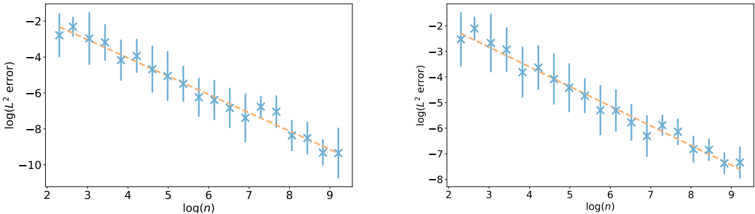
The image contains two scatter plots, each displaying the relationship between the logarithm of the L² error and the logarithm of 'n'. Both plots show a decreasing trend, with error bars indicating variability around each data point. A dashed orange line is overlaid on each plot, representing a linear fit to the data.
### Components/Axes
**Both Plots Share the Following Structure:**
* **X-axis:** log(n)
* Scale: 2 to 9, with integer markers at each value.
* **Y-axis:** log(L² error)
* **Data Points:** Blue 'x' markers with vertical blue error bars.
* **Trend Line:** Dashed orange line representing a linear fit.
**Plot 1 (Left):**
* Y-axis Scale: -10 to -2, with integer markers at each value.
**Plot 2 (Right):**
* Y-axis Scale: -8 to -2, with integer markers at each value.
### Detailed Analysis
**Plot 1 (Left):**
* **Trend:** The blue data points, represented by 'x' markers, show a clear downward trend as log(n) increases.
* **Data Points (Approximate):**
* log(n) = 2, log(L² error) ≈ -2.5 ± 1.0
* log(n) = 3, log(L² error) ≈ -3.5 ± 1.0
* log(n) = 4, log(L² error) ≈ -4.5 ± 1.0
* log(n) = 5, log(L² error) ≈ -5.5 ± 1.0
* log(n) = 6, log(L² error) ≈ -6.5 ± 1.0
* log(n) = 7, log(L² error) ≈ -7.0 ± 1.0
* log(n) = 8, log(L² error) ≈ -8.0 ± 1.0
* log(n) = 9, log(L² error) ≈ -9.0 ± 1.0
**Plot 2 (Right):**
* **Trend:** Similar to Plot 1, the blue data points show a downward trend as log(n) increases.
* **Data Points (Approximate):**
* log(n) = 2, log(L² error) ≈ -2.0 ± 0.5
* log(n) = 3, log(L² error) ≈ -3.0 ± 0.5
* log(n) = 4, log(L² error) ≈ -4.0 ± 0.5
* log(n) = 5, log(L² error) ≈ -5.0 ± 0.5
* log(n) = 6, log(L² error) ≈ -5.7 ± 0.5
* log(n) = 7, log(L² error) ≈ -6.3 ± 0.5
* log(n) = 8, log(L² error) ≈ -6.8 ± 0.5
* log(n) = 9, log(L² error) ≈ -7.0 ± 0.5
### Key Observations
* Both plots exhibit a negative correlation between log(n) and log(L² error).
* The error bars suggest variability in the L² error for each value of n.
* The linear fit (dashed orange line) appears to capture the general trend in both plots.
* The Y-axis scales are different between the two plots, indicating potentially different magnitudes of error.
### Interpretation
The plots suggest that as 'n' increases, the L² error decreases. The logarithmic scales imply that the relationship might be a power law. The error bars indicate the uncertainty associated with the error measurements. The linear fit provides a simplified model for this relationship, suggesting a consistent rate of error reduction as 'n' increases. The difference in Y-axis scales between the two plots could indicate different experimental conditions or parameter settings leading to different error magnitudes.