## Histogram: LLaMa-2-7B-Chat Eigenvalues Distribution of Keys
### Overview
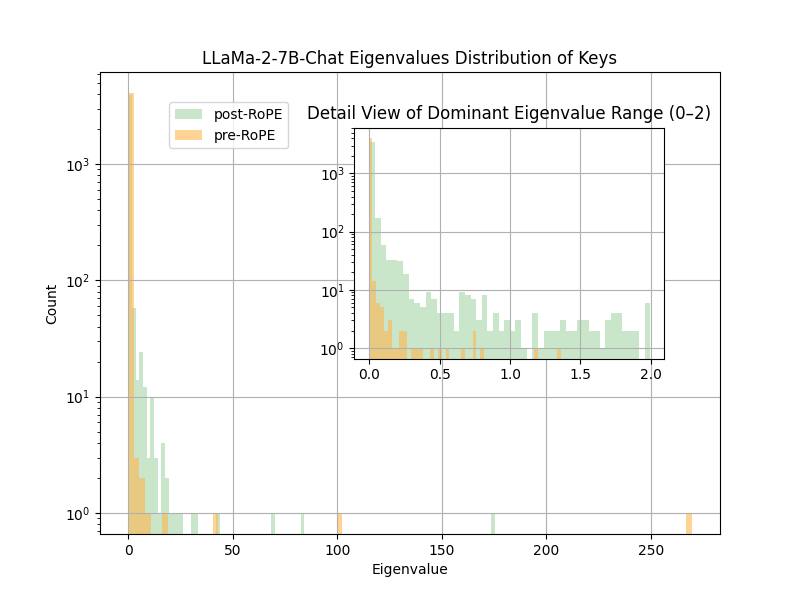
The chart compares eigenvalue distributions of keys in LLaMa-2-7B-Chat before and after applying Rotary Positional Encoding (RoPE). Two histograms are overlaid: "post-RoPE" (green) and "pre-RoPE" (orange). A secondary inset provides a zoomed view of the dominant eigenvalue range (0–2).
---
### Components/Axes
- **X-axis (Eigenvalue)**: Logarithmic scale from 0 to 250, with gridlines at 0, 0.5, 1.0, 1.5, 2.0, 50, 100, 150, 200, 250.
- **Y-axis (Count)**: Logarithmic scale from 10⁰ to 10³.
- **Legend**:
- Green: post-RoPE
- Orange: pre-RoPE
- **Inset**: Focuses on eigenvalue range 0–2 with the same axes and legend.
---
### Detailed Analysis
#### Main Chart
- **pre-RoPE (orange)**:
- Dominates the lower eigenvalue range (0–0.5), with a peak count of ~10³ at eigenvalue 0.
- Counts drop sharply after 0.5, with sparse values beyond 1.0.
- A single outlier at ~250 with a count of ~10⁰.
- **post-RoPE (green)**:
- Lower counts than pre-RoPE in 0–0.5 (~10² at 0).
- More evenly distributed across 0–2, with gradual declines.
- Sparse values beyond 1.0, with a notable peak at ~1.5 (~10¹).
#### Inset (0–2 Eigenvalue Range)
- **pre-RoPE**:
- Tallest bars in 0–0.5 (~10³ at 0, ~10² at 0.5).
- Minimal presence beyond 1.0.
- **post-RoPE**:
- Lower counts than pre-RoPE in 0–0.5 (~10² at 0, ~10¹ at 0.5).
- More pronounced distribution in 0.5–2, peaking at ~1.5 (~10¹).
---
### Key Observations
1. **Concentration vs. Spread**:
- pre-RoPE eigenvalues are highly concentrated near 0, suggesting uniform key initialization.
- post-RoPE eigenvalues are more spread out, indicating positional encoding introduces variability.
2. **Dominant Eigenvalue Behavior**:
- pre-RoPE dominates eigenvalues <1.0, while post-RoPE shows non-negligible values up to 2.0.
3. **Outliers**:
- A single pre-RoPE eigenvalue at ~250 with negligible count (~10⁰), likely an artifact.
---
### Interpretation
The data suggests RoPE modifies eigenvalue distributions to enhance positional awareness:
- **pre-RoPE**: Uniform initialization (low eigenvalues) may limit positional differentiation.
- **post-RoPE**: Broader eigenvalue spread (up to 2.0) implies improved handling of positional relationships, though most dominant eigenvalues (<1.0) remain pre-RoPE-dominated. The presence of post-RoPE eigenvalues in the 0–2 range confirms partial effectiveness in redistributing key magnitudes. The outlier at 250 is insignificant but highlights potential edge cases in eigenvalue computation.