## Diagram: Directed Acyclic Graph
### Overview
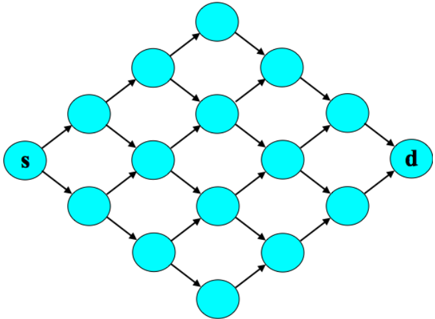
The image depicts a directed acyclic graph (DAG) with nodes arranged in a diamond shape. The graph starts with a node labeled "s" and ends with a node labeled "d". The nodes are connected by directed edges, indicating the flow from "s" to "d".
### Components/Axes
* **Nodes:** The graph consists of 16 nodes, each represented by a cyan-filled circle. Two nodes are labeled "s" (start) and "d" (destination).
* **Edges:** The nodes are connected by black arrows, indicating the direction of the graph.
* **Labels:** The start node is labeled "s" and the destination node is labeled "d".
### Detailed Analysis
The graph can be visualized as a grid of nodes arranged in a diamond shape. The start node "s" is located on the left side of the diamond, and the destination node "d" is located on the right side. The arrows indicate the possible paths from "s" to "d".
The graph has the following structure:
* **Level 1:** 1 node (s)
* **Level 2:** 2 nodes
* **Level 3:** 3 nodes
* **Level 4:** 4 nodes
* **Level 5:** 3 nodes
* **Level 6:** 2 nodes
* **Level 7:** 1 node (d)
Each node (except the nodes in the last level) has two outgoing edges, pointing to the nodes in the next level. Each node (except the nodes in the first level) has two incoming edges, coming from the nodes in the previous level.
### Key Observations
* The graph is directed and acyclic.
* The graph has a clear start and destination node.
* The graph has a diamond shape.
* The graph has multiple paths from "s" to "d".
### Interpretation
The diagram represents a directed acyclic graph, which is a type of graph where the edges have a direction and there are no cycles. This type of graph is often used to model processes or relationships where the order of events is important. In this case, the graph could represent a network, a workflow, or a decision tree. The multiple paths from "s" to "d" suggest that there are multiple ways to reach the destination. The diamond shape of the graph could be related to the complexity of the process, with the middle levels representing the most complex stages.