## Diagram: Directed Grid Network with Source and Destination Nodes
### Overview
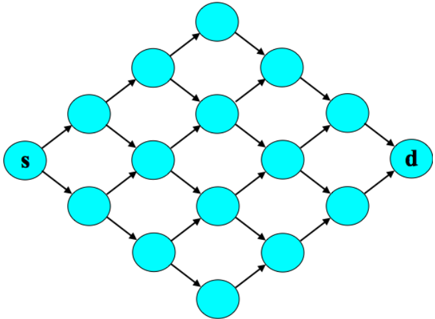
The image depicts a directed graph structured as a 4x4 grid of nodes. Arrows indicate unidirectional connections between nodes. Two nodes are explicitly labeled: "s" (source) in the bottom-left corner and "d" (destination) in the top-right corner. All other nodes are unlabeled and uniformly colored in cyan.
### Components/Axes
- **Nodes**:
- Total nodes: 16 (4 rows × 4 columns).
- Labeled nodes:
- "s" (source): Bottom-left corner (row 4, column 1).
- "d" (destination): Top-right corner (row 1, column 4).
- Unlabeled nodes: 14 cyan-colored nodes with no textual identifiers.
- **Edges**:
- Arrows connect nodes in a grid pattern:
- Horizontal edges: Left-to-right direction (e.g., node (i,j) → (i,j+1)).
- Vertical edges: Top-to-bottom direction (e.g., node (i,j) → (i+1,j)).
- No bidirectional or diagonal edges.
- **Color Coding**:
- All nodes are cyan; no legend or color differentiation exists.
### Detailed Analysis
- **Node Placement**:
- "s" is spatially isolated in the bottom-left, with edges only pointing right and upward.
- "d" is isolated in the top-right, with edges only pointing left and downward.
- Intermediate nodes form a fully connected grid with no missing edges.
- **Edge Directionality**:
- All edges follow a strict grid-aligned flow, creating a layered structure from "s" to "d."
- No cycles or feedback loops are present.
### Key Observations
1. The diagram represents a **directed acyclic graph (DAG)** with a clear start ("s") and end ("d").
2. The grid structure suggests a **layered network** where data/flow progresses sequentially from source to destination.
3. The absence of labels on intermediate nodes implies they may represent generic processing units or relay points.
### Interpretation
This diagram likely models a **data flow network**, **routing protocol**, or **process workflow** where:
- "s" initiates the process, and "d" terminates it.
- Intermediate nodes act as intermediaries, passing information strictly along grid-aligned paths.
- The lack of alternative paths (e.g., diagonal edges) suggests a **deterministic flow** with no redundancy or branching.
- The uniform node coloring implies homogeneity in node functionality (e.g., all nodes perform identical operations).
The structure emphasizes **linear progression** and **hierarchical organization**, typical of systems requiring controlled, step-by-step execution (e.g., computational pipelines, task scheduling).