## Flowchart: Multi-Agent System with Policy Update Mechanisms
### Overview
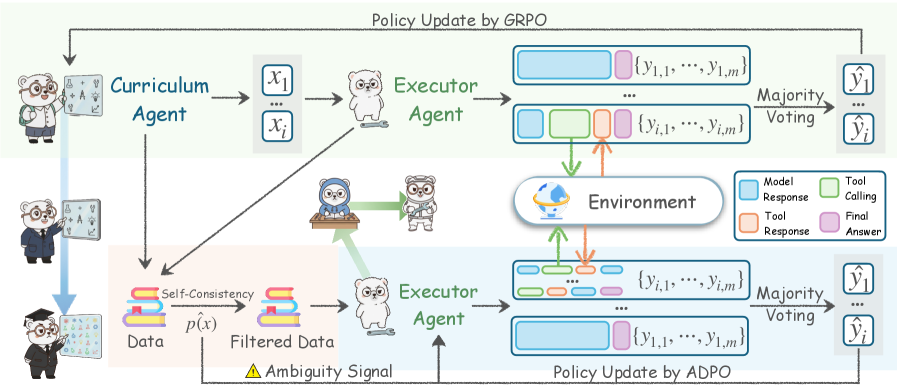
The flowchart depicts a multi-agent system involving a Curriculum Agent, Executor Agent, and Environment. It illustrates data processing, tool interaction, and policy updates via GRPO (Gradient-based Reinforcement Policy Optimization) and ADPO (Adaptive Policy Optimization). Key elements include data filtering, ambiguity signals, and majority voting for decision-making.
### Components/Axes
1. **Agents**:
- **Curriculum Agent**: Processes input data (`x₁, ..., xᵢ`) and outputs filtered data (`p(x)`).
- **Executor Agent**: Interacts with the Environment, generating responses (Model Response, Tool Calling, Tool Response, Final Answer).
2. **Environment**: Contains tools and receives inputs from the Executor Agent.
3. **Policy Update Mechanisms**:
- **GRPO**: Policy update via majority voting of responses (`{y₁₁, ..., yᵢₘ}`).
- **ADPO**: Policy update via majority voting of responses (`{y₁, ..., yᵢ}`).
4. **Legend**:
- **Blue**: Model Response
- **Green**: Tool Calling
- **Orange**: Tool Response
- **Purple**: Final Answer
### Detailed Analysis
1. **Data Flow**:
- **Curriculum Agent**:
- Input: Raw data (`x₁, ..., xᵢ`).
- Output: Filtered data (`p(x)`) after self-consistency checks.
- Ambiguity Signal: Flagged when data uncertainty exceeds thresholds.
- **Executor Agent**:
- Processes filtered data and interacts with the Environment.
- Generates responses categorized by color (see legend).
2. **Environment Interaction**:
- The Executor Agent sends Tool Calling (green) and receives Tool Response (orange).
- Final Answer (purple) is derived from Model Response (blue) and Tool Response.
3. **Policy Updates**:
- **GRPO**: Aggregates responses (`{y₁₁, ..., yᵢₘ}`) via majority voting to update policies.
- **ADPO**: Uses simpler majority voting (`{y₁, ..., yᵢ}`) for policy adjustments.
### Key Observations
- **Majority Voting**: Dominates decision-making in both GRPO and ADPO, suggesting consensus-driven optimization.
- **Ambiguity Handling**: Self-consistency filtering reduces noise, but ambiguity signals indicate unresolved uncertainties.
- **Tool Integration**: The Executor Agent relies on external tools (e.g., APIs, databases) for complex tasks.
### Interpretation
The system emphasizes **robustness** through self-consistency filtering and **adaptability** via dual policy update mechanisms (GRPO and ADPO). The majority voting ensures decisions reflect collective agent responses, while ambiguity signals highlight areas needing human or automated intervention. The Curriculum Agent’s role in preprocessing data ensures the Executor Agent operates on high-quality inputs, reducing errors in tool interactions. The Environment acts as a bridge between theoretical policy updates and practical execution, underscoring the system’s focus on real-world applicability.