## Diagram and Heatmap: Materials Network and Correlation of Path Metrics
### Overview
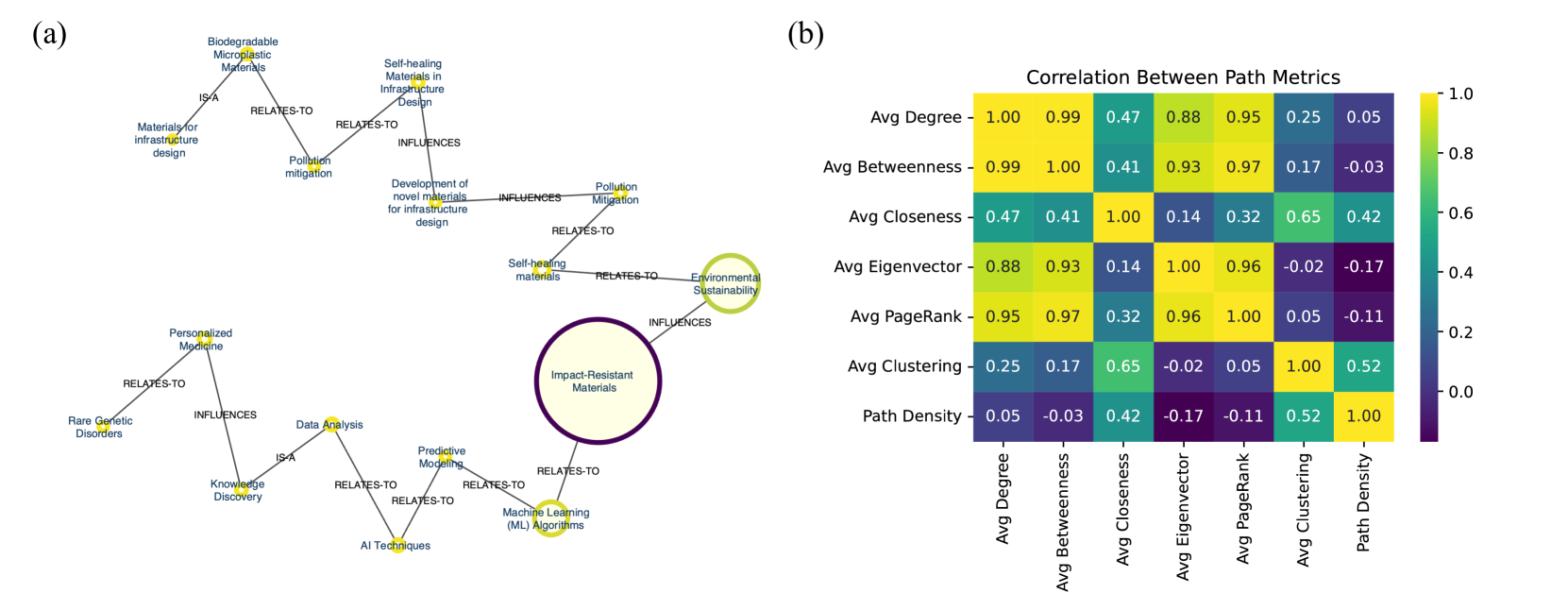
The image presents two distinct visualizations. Part (a) is a network diagram illustrating relationships between various materials and concepts, with "Impact-Resistant Materials" as a central node. Part (b) is a heatmap showing the correlation between different path metrics (Avg Degree, Avg Betweenness, etc.).
### Components/Axes
#### Part (a): Materials Network Diagram
* **Nodes:** Represent materials, concepts, or fields. Examples include "Impact-Resistant Materials," "Biodegradable Microplastic Materials," "Environmental Sustainability," "Data Analysis," and "Machine Learning (ML) Algorithms."
* **Edges:** Labeled with relationship types such as "RELATES-TO," "INFLUENCES," and "IS-A."
* **Node Colors:** Yellow and light green, with "Impact-Resistant Materials" having a darker yellow fill and a dark purple border.
* **Positioning:** Nodes are arranged around the central "Impact-Resistant Materials" node, with connections radiating outwards.
#### Part (b): Correlation Heatmap
* **Axes:** Both X and Y axes list the following path metrics: "Avg Degree," "Avg Betweenness," "Avg Closeness," "Avg Eigenvector," "Avg PageRank," "Avg Clustering," and "Path Density."
* **Color Scale:** Ranges from dark purple (-0.0) to bright yellow (1.0), indicating the strength and direction of correlation.
* **Values:** Numerical values within each cell represent the correlation coefficient between the corresponding path metrics.
### Detailed Analysis
#### Part (a): Materials Network Diagram
* **Impact-Resistant Materials:** This is the central node, influencing "Environmental Sustainability" and relating to "Machine Learning (ML) Algorithms."
* **Biodegradable Microplastic Materials:** "IS-A" type relationship with "Materials for infrastructure design" and "RELATES-TO" "Pollution mitigation".
* **Self-healing Materials in Infrastructure Design:** "RELATES-TO" "Pollution mitigation" and "INFLUENCES" "Development of novel materials for infrastructure design".
* **Environmental Sustainability:** Connected to "Self-healing materials" via "RELATES-TO" and influenced by "Impact-Resistant Materials."
* **Data Analysis:** Connected to "Knowledge Discovery" via "IS-A", "Predictive Modeling" and "AI Techniques" via "RELATES-TO".
* **Personalized Medicine:** "RELATES-TO" "Rare Genetic Disorders".
#### Part (b): Correlation Heatmap
* **Avg Degree:** Highly correlated with "Avg Betweenness" (0.99), "Avg Eigenvector" (0.88), and "Avg PageRank" (0.95).
* **Avg Betweenness:** Highly correlated with "Avg Degree" (0.99), "Avg Eigenvector" (0.93), and "Avg PageRank" (0.97).
* **Avg Closeness:** Shows moderate positive correlation with "Avg Clustering" (0.65) and "Path Density" (0.42).
* **Avg Eigenvector:** Highly correlated with "Avg Degree" (0.88), "Avg Betweenness" (0.93), and "Avg PageRank" (0.96).
* **Avg PageRank:** Highly correlated with "Avg Degree" (0.95), "Avg Betweenness" (0.97), and "Avg Eigenvector" (0.96).
* **Avg Clustering:** Shows moderate positive correlation with "Avg Closeness" (0.65) and "Path Density" (0.52).
* **Path Density:** Shows moderate positive correlation with "Avg Closeness" (0.42) and "Avg Clustering" (0.52).
### Key Observations
* **Network Diagram:** "Impact-Resistant Materials" acts as a central hub, connecting to concepts related to sustainability, advanced materials, and computational methods.
* **Heatmap:** Strong positive correlations exist between degree, betweenness, eigenvector centrality, and PageRank, suggesting these metrics capture similar aspects of network structure. Closeness, clustering, and path density show weaker, but still positive, correlations with each other.
### Interpretation
The network diagram illustrates the relationships between different materials and concepts, highlighting the central role of "Impact-Resistant Materials." The heatmap quantifies the relationships between different network metrics. The high correlation between degree, betweenness, eigenvector centrality, and PageRank suggests redundancy; these metrics may be measuring similar aspects of node importance within the network. The weaker correlations involving closeness, clustering, and path density suggest these metrics capture different, more nuanced aspects of network structure. The data suggests that improving impact resistance in materials can influence environmental sustainability and is related to advancements in machine learning.