\n
## Diagram: Knowledge Graph Task Resolution
### Overview
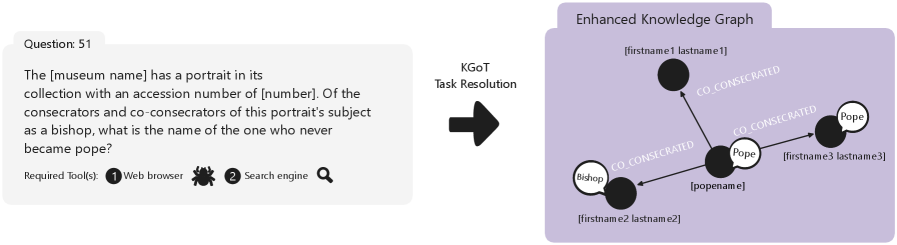
The image depicts a diagram illustrating the resolution of a Knowledge Graph (KG) task, specifically question 51. The diagram shows a question presented on the left, and the resulting enhanced knowledge graph on the right, connected by an arrow labeled "KGoT Task Resolution". The knowledge graph represents relationships between entities like "Pope" and "Bishop" through the "CO-CONSECRATED" relation.
### Components/Axes
The diagram consists of two main sections:
1. **Question Section (Left):** Contains the question text and required tools.
2. **Enhanced Knowledge Graph Section (Right):** Displays the graph with nodes and edges representing entities and relationships.
The question section includes:
* **Question:** "The [museum name] has a portrait in its collection with an accession number of [number]. Of the consecrators and co-consecrators of this portrait's subject as a bishop, what is the name of the one who never became pope?"
* **Required Tools:**
* Web browser (icon of a globe with a spiderweb)
* Search engine (icon of a magnifying glass)
The knowledge graph section includes:
* **Nodes:** Represent entities like "Pope", "Bishop", and individuals represented by placeholders like "[firstname1 lastname1]", "[firstname2 lastname2]", and "[firstname3 lastname3]". Nodes are represented as black circles.
* **Edges:** Represent relationships between entities, labeled "CO-CONSECRATED". Edges are represented as arrows.
* **Title:** "Enhanced Knowledge Graph"
### Detailed Analysis or Content Details
The knowledge graph shows the following relationships:
* A node labeled "[firstname1 lastname1]" is connected to a "Pope" node via a "CO-CONSECRATED" edge.
* A "Bishop" node is connected to a node labeled "[firstname2 lastname2]" via a "CO-CONSECRATED" edge.
* The "Bishop" node is also connected to a "Pope" node labeled "[firstname3 lastname3]" via a "CO-CONSECRATED" edge.
* The "Pope" node labeled "[firstname3 lastname3]" is connected to another "Pope" node via a "CO-CONSECRATED" edge.
The question asks for the name of the individual who was a co-consecrator of a bishop but never became pope. Based on the graph, the possible candidates are "[firstname1 lastname1]" and "[firstname2 lastname2]". The question implies that only one of them did not become pope.
### Key Observations
The diagram illustrates how a complex question can be represented and potentially answered using a knowledge graph. The placeholders in the graph suggest that the specific entities are to be filled in based on the information retrieved using the required tools (web browser and search engine). The graph structure highlights the relationships between individuals and their roles (Bishop, Pope) and the "CO-CONSECRATED" relationship.
### Interpretation
The diagram demonstrates a process for answering a complex question using a knowledge graph. The question requires identifying individuals connected to a specific bishop through the "CO-CONSECRATED" relationship and then filtering those individuals based on whether they became a pope. The knowledge graph provides a visual representation of the relevant entities and relationships, making it easier to identify the answer. The use of placeholders indicates that the graph is a template that will be populated with specific data retrieved from external sources. The diagram suggests that the KGoT Task Resolution process transforms the initial question into a structured knowledge graph representation, facilitating the answer retrieval process. The diagram does not provide the actual answer, but rather illustrates the method for finding it.