## Diagram: Speculative Decoding and KV Cache Process Flow
### Overview
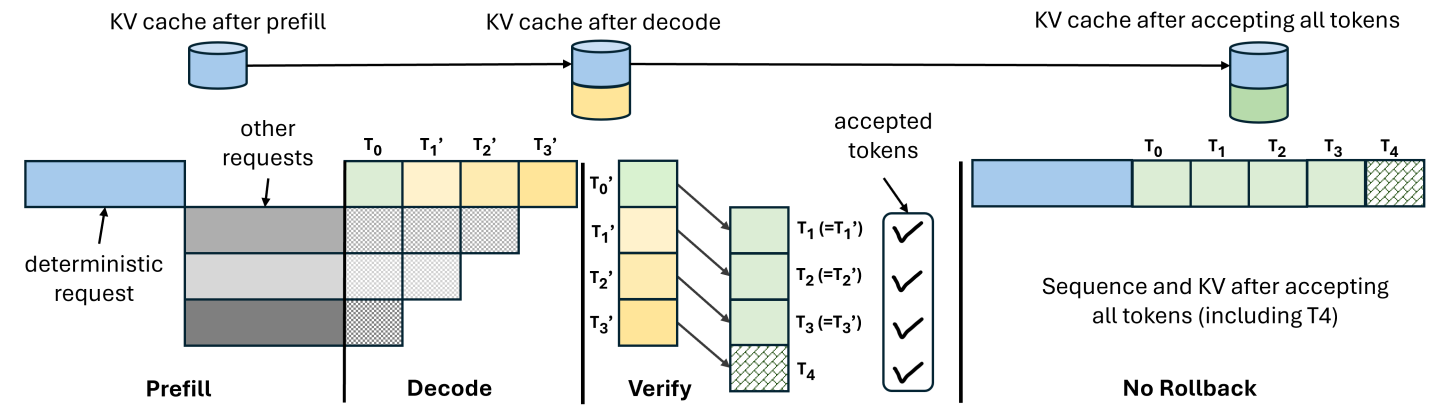
This diagram illustrates the lifecycle of a Key-Value (KV) cache during a speculative decoding process in a Large Language Model (LLM). It depicts the progression from the initial "Prefill" stage, through a "Decode" (speculation) stage, a "Verify" stage, and finally the state of "No Rollback" where all speculated tokens are accepted.
### Components/Axes
The diagram is organized into three distinct horizontal layers and four vertical process stages:
**Top Layer (KV Cache State):**
* **Three Cylinder Icons:** Representing the state of the KV cache at different points in time.
* Left: "KV cache after prefill" (Blue).
* Middle: "KV cache after decode" (Blue + Yellow).
* Right: "KV cache after accepting all tokens" (Blue + Green).
* **Arrows:** Connect the cylinders from left to right, indicating the temporal progression of the cache state.
**Middle/Bottom Layer (Process Stages):**
* **Prefill:** The initial phase involving a "deterministic request" (Blue rectangle) and "other requests" (Grey rectangles).
* **Decode:** The speculative phase where tokens $T_0, T_1', T_2', T_3'$ are generated (Yellow squares).
* **Verify:** The validation phase where speculative tokens are compared against the model's output.
* **No Rollback:** The final state showing the sequence after all tokens are accepted.
### Detailed Analysis
#### 1. Prefill and Decode Stages (Left)
* **Deterministic Request:** Represented by a large blue rectangle.
* **Other Requests:** Represented by a stack of grey rectangles below the deterministic request.
* **Speculative Tokens:** A staircase-patterned grid of yellow squares labeled $T_0, T_1', T_2', T_3'$. These represent the tokens generated by a smaller, faster model (the "draft" model).
#### 2. Verify Stage (Center)
* **Input:** A vertical column of yellow squares labeled $T_0', T_1', T_2', T_3'$.
* **Mapping:** Arrows point from the speculative tokens to a new column of green squares.
* **Output:** The new column contains $T_1 (=T_1')$, $T_2 (=T_2')$, $T_3 (=T_3')$, and a new token $T_4$ (hatched pattern).
* **Verification:** To the right of this column, a list labeled "accepted tokens" contains four checkmarks, indicating that all speculative tokens ($T_1', T_2', T_3'$) matched the actual model output.
#### 3. No Rollback Stage (Right)
* **Sequence:** A long horizontal bar representing the final sequence.
* **Composition:**
* Blue segment (Deterministic request).
* Green segments ($T_0, T_1, T_2, T_3$).
* Hatched segment ($T_4$).
* **Label:** "Sequence and KV after accepting all tokens (including T4)".
### Key Observations
* **Speculation Accuracy:** The diagram depicts a "perfect" speculation scenario. Every speculative token ($T_1', T_2', T_3'$) is verified as correct ($T_1, T_2, T_3$).
* **Token Generation:** The process generates one additional token ($T_4$) during the verification step, which is standard in speculative decoding (the model verifies the draft tokens and generates one new token in parallel).
* **Cache Growth:** The KV cache cylinder transitions from Blue (Prefill) to Blue+Yellow (Decode) to Blue+Green (Accepted). This visually represents the accumulation of context in the cache.
### Interpretation
This diagram demonstrates the **Speculative Decoding** optimization technique.
* **The Logic:** Instead of generating tokens one by one (which is slow), a smaller, faster model "speculates" a sequence of future tokens ($T_0'$ through $T_3'$). The larger, more accurate model then processes these tokens in parallel to verify them.
* **The "No Rollback" Significance:** In speculative decoding, if a speculative token is incorrect, the system must "rollback" (discard the incorrect tokens and the associated KV cache entries). This diagram illustrates the ideal path where the speculation is 100% accurate, meaning no rollback is required, and the KV cache is simply extended with the verified tokens.
* **Efficiency:** The "Verify" column shows that the model validates multiple tokens simultaneously. The checkmarks confirm that the draft model's predictions were correct, allowing the system to append them to the KV cache immediately, significantly increasing throughput compared to standard autoregressive decoding.