\n
## Diagram: KV Cache and Token Processing Flow
### Overview
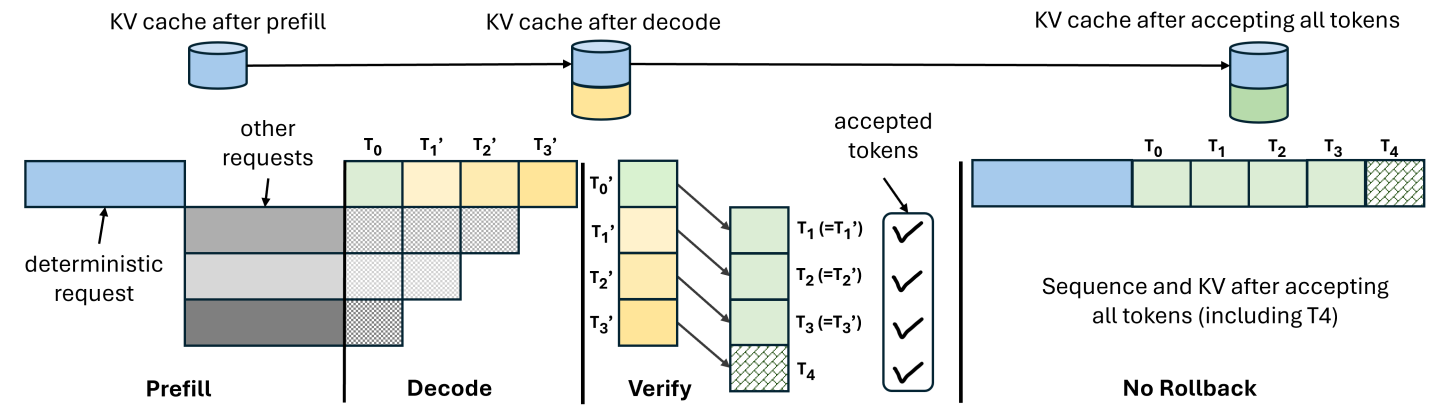
The image is a diagram illustrating the flow of tokens through a system involving a KV (Key-Value) cache during prefill, decode, and verify stages. It demonstrates how the KV cache is populated and updated as tokens are processed, and highlights a "No Rollback" feature. The diagram shows three sequential states of the KV cache and token sequence.
### Components/Axes
The diagram is divided into three main sections, each representing a stage:
1. **Prefill:** Shows the initial state with a deterministic request and the KV cache.
2. **Decode & Verify:** Illustrates the processing of tokens (T₀, T₁', T₂', T₃') and their corresponding verification (T₀, T₁(=T₁'), T₂(=T₂'), T₃(=T₃')).
3. **Final State:** Depicts the KV cache and token sequence after accepting all tokens, including T₄.
Key labels include:
* "KV cache after prefill"
* "KV cache after decode"
* "KV cache after accepting all tokens (including T₄)"
* "other requests"
* "accepted tokens"
* "deterministic request"
* "Prefill"
* "Decode"
* "Verify"
* "Sequence and KV after accepting all tokens (including T₄)"
* "No Rollback"
* Tokens: T₀, T₁', T₂', T₃', T₄
* Verified Tokens: T₀, T₁(=T₁'), T₂(=T₂'), T₃(=T₃')
### Detailed Analysis or Content Details
The diagram shows a sequential process.
**Prefill Stage:**
* A "deterministic request" initiates the process.
* The KV cache is initially populated (represented by a cylinder).
* "other requests" are indicated by an arrow pointing towards the process.
**Decode & Verify Stage:**
* Tokens T₀, T₁', T₂', and T₃' are generated during the decode phase.
* These tokens are then verified, resulting in T₀, T₁(=T₁'), T₂(=T₂'), and T₃(=T₃'). The equality indicates successful verification.
* Green checkmarks next to each verified token (T₁(=T₁'), T₂(=T₂'), T₃(=T₃')) signify successful verification.
* A curved arrow connects the decoded tokens (T₁', T₂', T₃') to their verified counterparts (T₁(=T₁'), T₂(=T₂'), T₃(=T₃')).
**Final State:**
* The KV cache is fully populated with tokens T₀, T₁, T₂, T₃, and T₄.
* The token sequence is represented by a series of blocks.
* The last token, T₄, is visually distinct (hatched pattern) indicating its final acceptance.
* The text "Sequence and KV after accepting all tokens (including T₄)" and "No Rollback" are displayed.
### Key Observations
* The diagram emphasizes the verification process, highlighting that decoded tokens are checked against their expected values.
* The "No Rollback" feature suggests that once a token is accepted, it cannot be reversed.
* The KV cache is updated incrementally as tokens are processed and verified.
* The deterministic request implies a predictable and repeatable process.
### Interpretation
The diagram illustrates a robust token processing pipeline with a focus on data integrity and immutability. The KV cache serves as a persistent store for the processed tokens, ensuring that once a token is accepted (verified), it remains in the system without the possibility of rollback. This is crucial for applications where data consistency and auditability are paramount. The deterministic request suggests that the system is designed to produce the same output for the same input, enhancing predictability and reliability. The verification step is a critical component, preventing invalid or corrupted tokens from being added to the KV cache. The final state with T₄ being visually distinct suggests that it represents a completed or finalized state of the sequence. The diagram effectively communicates a system designed for secure and reliable token management.