TECHNICAL ASSET FINGERPRINT
31e47d4d989ffb050dfb9988
Click to view fullscreen
Press ESC or click to close
FOUND IN PAPERS
EXPERT: healer-alpha-free VERSION 1
RUNTIME: free/openrouter/healer-alpha
INTEL_VERIFIED
\n
## Diagram: KV Cache Management and Token Verification Process
### Overview
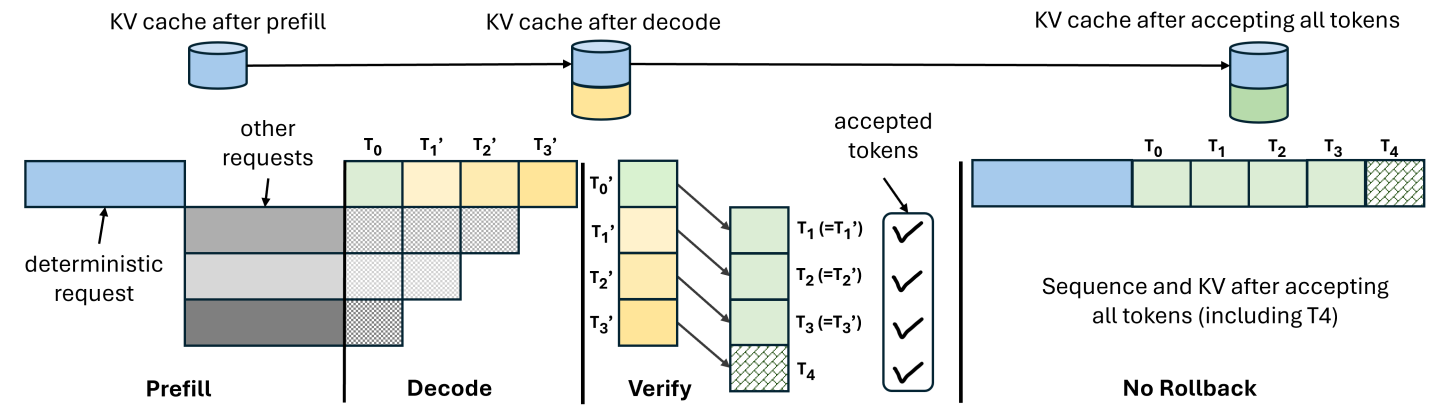
The image is a technical diagram illustrating a multi-stage process for managing Key-Value (KV) cache in a language model system, likely depicting a form of speculative decoding or verification. The process flows from left to right through three main phases: **Prefill**, **Decode**, and **Verify**, culminating in a **No Rollback** state where all tokens are accepted. The diagram uses color-coded blocks, arrows, and cylinder icons to represent data flow, token sequences, and cache states.
### Components/Axes
The diagram is segmented into four primary regions from left to right:
1. **Prefill Region (Left):**
* **Label:** "Prefill" at the bottom.
* **Components:**
* A light blue rectangle labeled "deterministic request" with an arrow pointing to it.
* A stack of three grey rectangles labeled "other requests" with an arrow pointing to them.
* A cylinder icon at the top labeled "KV cache after prefill".
2. **Decode Region (Center-Left):**
* **Label:** "Decode" at the bottom.
* **Components:**
* A horizontal sequence of four colored blocks representing tokens: `T₀` (light green), `T₁'` (light yellow), `T₂'` (light yellow), `T₃'` (light yellow).
* Below this, a grid showing the interaction of the "deterministic request" (blue) and "other requests" (grey) with the token sequence. The grid cells are filled with patterns: solid color, cross-hatching, and dots.
* A cylinder icon at the top labeled "KV cache after decode", which is partially filled with blue (top) and yellow (bottom).
3. **Verify Region (Center-Right):**
* **Label:** "Verify" at the bottom.
* **Components:**
* A vertical column of four token blocks: `T₀'` (light green), `T₁'` (light yellow), `T₂'` (light yellow), `T₃'` (light yellow).
* Arrows point from this column to a second vertical column showing the verification result:
* `T₁ (=T₁')` (light green)
* `T₂ (=T₂')` (light green)
* `T₃ (=T₃')` (light green)
* `T₄` (cross-hatched pattern)
* To the right, a box labeled "accepted tokens" contains four checkmarks (✓).
4. **No Rollback Region (Right):**
* **Label:** "No Rollback" at the bottom.
* **Components:**
* A final horizontal sequence of five token blocks: `T₀` (light blue), `T₁` (light green), `T₂` (light green), `T₃` (light green), `T₄` (cross-hatched pattern).
* A cylinder icon at the top labeled "KV cache after accepting all tokens", which is partially filled with blue (top) and green (bottom).
* Descriptive text: "Sequence and KV after accepting all tokens (including T4)".
### Detailed Analysis
The process depicts a verification mechanism for a sequence of generated tokens (`T₀'` to `T₃'`).
* **Initial State (Prefill):** The system processes a "deterministic request" and "other requests". The KV cache is initialized ("KV cache after prefill").
* **Speculative Generation (Decode):** A sequence of four tokens (`T₀'`, `T₁'`, `T₂'`, `T₃'`) is generated. The KV cache is updated with a mix of blue and yellow data, corresponding to the different request types.
* **Verification Step (Verify):** The generated tokens are verified against a target model or process.
* The first token `T₀'` is not shown in the verification output column, implying it may be a prompt token or is handled separately.
* Tokens `T₁'`, `T₂'`, and `T₃'` are verified and accepted as `T₁`, `T₂`, and `T₃` (indicated by `=T₁'`, etc.), and their color changes from yellow to green.
* A new token, `T₄` (cross-hatched), is generated or validated as part of this step.
* The "accepted tokens" box with four checkmarks confirms the acceptance of the sequence.
* **Final State (No Rollback):** The entire sequence, including the newly verified `T₄`, is accepted. The final token sequence is `T₀`, `T₁`, `T₂`, `T₃`, `T₄`. The KV cache is updated to a final state containing blue and green data.
### Key Observations
1. **Color Coding:** Colors are used consistently to denote state or origin:
* **Light Blue:** Associated with the "deterministic request" and the initial token `T₀`.
* **Light Yellow:** Represents speculative or draft tokens (`T₁'`, `T₂'`, `T₃'`) during the Decode phase.
* **Light Green:** Represents verified/accepted tokens (`T₁`, `T₂`, `T₃`) and the initial `T₀'` in the Verify column.
* **Cross-hatch Pattern:** Used for the newly generated/accepted token `T₄`.
* **Grey:** Represents "other requests".
2. **Process Flow:** The arrows clearly show a linear progression: Prefill → Decode → Verify → No Rollback. The Verify stage acts as a gate, transforming yellow speculative tokens into green accepted ones and appending a new token.
3. **Cache Evolution:** The cylinder icons visually track the KV cache state. It starts empty/blue, gains yellow data after decode, and ends with blue and green data after acceptance, indicating the cache is updated with the final, verified sequence.
4. **"No Rollback" Implication:** The final label emphasizes that the entire sequence, including the extra token `T₄`, is accepted without needing to discard and regenerate, suggesting an efficient verification process.
### Interpretation
This diagram illustrates a **speculative decoding** or **draft-and-verify** workflow for autoregressive language models. The core idea is to generate a draft sequence of tokens (`T₀'`-`T₃'`) quickly (perhaps with a smaller, faster model) and then verify them in parallel or with a larger, more accurate model.
* **Efficiency Gain:** The "No Rollback" outcome is the ideal scenario. It means all draft tokens were correct, and an additional token (`T₄`) was generated during verification, resulting in a net gain of tokens per step. This is more efficient than standard autoregressive generation, which produces one token per step.
* **Role of Requests:** The "deterministic request" and "other requests" likely represent different computational paths or model components involved in the draft generation phase. Their interaction in the Decode grid suggests a complex scheduling or memory access pattern.
* **Cache Management:** The KV cache is a critical resource. The diagram shows it being progressively built and then finalized with the accepted tokens, highlighting the importance of cache consistency in this process.
* **Underlying Mechanism:** The verification arrows (`T₁'` → `T₁ (=T₁')`) imply a comparison operation. The system checks if the draft token matches the token that the main model would generate given the context. The acceptance of `T₄` suggests the verification process can also produce new valid tokens beyond the draft length.
In essence, the diagram depicts an optimization technique that trades increased computational complexity during the verification phase for a higher token generation throughput, avoiding costly rollbacks when the draft is accurate.
DECODING INTELLIGENCE...