## Scatter Plot Matrix: Error vs. Causal Effect under Different Scenarios
### Overview
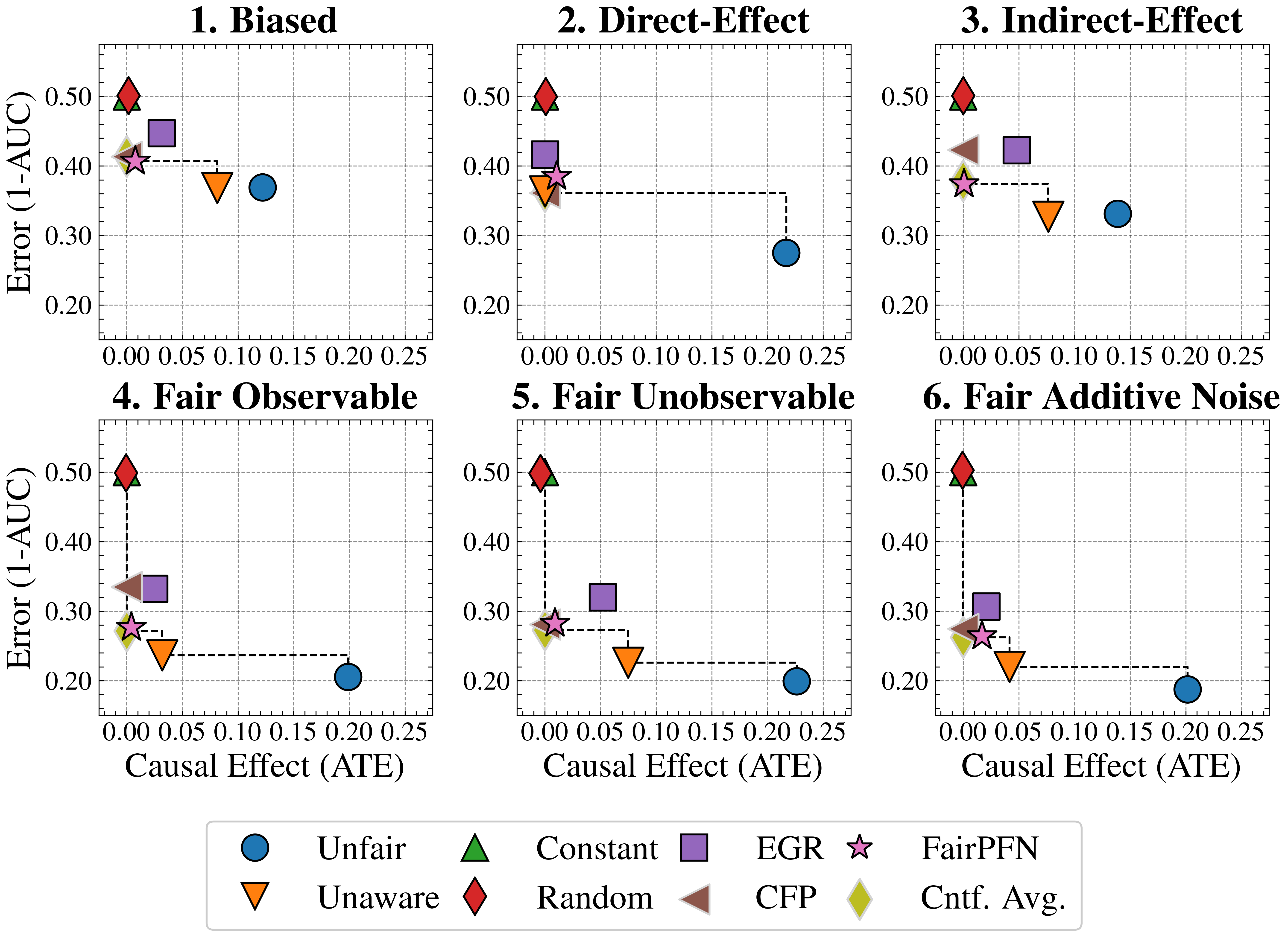
The image presents a 2x3 matrix of scatter plots, each depicting the relationship between "Error (1-AUC)" on the y-axis and "Causal Effect (ATE)" on the x-axis. Each plot represents a different scenario: "Biased," "Direct-Effect," "Indirect-Effect," "Fair Observable," "Fair Unobservable," and "Fair Additive Noise." Different colored shapes represent different algorithms or methods, as indicated by the legend at the bottom. The plots show how the error and causal effect vary for each method under different conditions.
### Components/Axes
* **X-axis (Horizontal):** "Causal Effect (ATE)". The scale ranges from 0.00 to 0.25, with tick marks at intervals of 0.05.
* **Y-axis (Vertical):** "Error (1-AUC)". The scale ranges from 0.20 to 0.50, with tick marks at intervals of 0.10.
* **Plot Titles:**
* Plot 1 (Top-Left): "1. Biased"
* Plot 2 (Top-Middle): "2. Direct-Effect"
* Plot 3 (Top-Right): "3. Indirect-Effect"
* Plot 4 (Bottom-Left): "4. Fair Observable"
* Plot 5 (Bottom-Middle): "5. Fair Unobservable"
* Plot 6 (Bottom-Right): "6. Fair Additive Noise"
* **Legend (Bottom):**
* Blue Circle: "Unfair"
* Orange Down-pointing Triangle: "Unaware"
* Green Up-pointing Triangle: "Constant"
* Brown Left-pointing Triangle: "Random"
* Purple Square: "EGR"
* Light-Pink Star: "FairPFN"
* Olive-Green Diamond: "Cntf. Avg."
### Detailed Analysis
Each plot contains the same set of data series, represented by different shapes and colors, but their positions vary across the plots. A dashed black line connects some of the data points, specifically the "Unfair" (blue circle) data point to the cluster of points on the left side of each plot.
**Plot 1: Biased**
* Unfair (Blue Circle): Causal Effect ≈ 0.12, Error ≈ 0.37
* Unaware (Orange Down-pointing Triangle): Causal Effect ≈ 0.08, Error ≈ 0.36
* Constant (Green Up-pointing Triangle): Causal Effect ≈ 0.00, Error ≈ 0.50
* Random (Brown Left-pointing Triangle): Causal Effect ≈ 0.00, Error ≈ 0.42
* EGR (Purple Square): Causal Effect ≈ 0.04, Error ≈ 0.43
* FairPFN (Light-Pink Star): Causal Effect ≈ 0.00, Error ≈ 0.41
* Cntf. Avg. (Olive-Green Diamond): Causal Effect ≈ 0.00, Error ≈ 0.41
**Plot 2: Direct-Effect**
* Unfair (Blue Circle): Causal Effect ≈ 0.22, Error ≈ 0.29
* Unaware (Orange Down-pointing Triangle): Causal Effect ≈ 0.00, Error ≈ 0.37
* Constant (Green Up-pointing Triangle): Causal Effect ≈ 0.00, Error ≈ 0.50
* Random (Brown Left-pointing Triangle): Not present in this plot.
* EGR (Purple Square): Causal Effect ≈ 0.00, Error ≈ 0.41
* FairPFN (Light-Pink Star): Causal Effect ≈ 0.00, Error ≈ 0.38
* Cntf. Avg. (Olive-Green Diamond): Not present in this plot.
**Plot 3: Indirect-Effect**
* Unfair (Blue Circle): Causal Effect ≈ 0.14, Error ≈ 0.33
* Unaware (Orange Down-pointing Triangle): Causal Effect ≈ 0.07, Error ≈ 0.32
* Constant (Green Up-pointing Triangle): Causal Effect ≈ 0.00, Error ≈ 0.50
* Random (Brown Left-pointing Triangle): Causal Effect ≈ 0.00, Error ≈ 0.42
* EGR (Purple Square): Causal Effect ≈ 0.04, Error ≈ 0.42
* FairPFN (Light-Pink Star): Causal Effect ≈ 0.00, Error ≈ 0.38
* Cntf. Avg. (Olive-Green Diamond): Causal Effect ≈ 0.00, Error ≈ 0.40
**Plot 4: Fair Observable**
* Unfair (Blue Circle): Causal Effect ≈ 0.20, Error ≈ 0.21
* Unaware (Orange Down-pointing Triangle): Causal Effect ≈ 0.04, Error ≈ 0.25
* Constant (Green Up-pointing Triangle): Causal Effect ≈ 0.00, Error ≈ 0.50
* Random (Brown Left-pointing Triangle): Causal Effect ≈ 0.00, Error ≈ 0.32
* EGR (Purple Square): Causal Effect ≈ 0.02, Error ≈ 0.34
* FairPFN (Light-Pink Star): Causal Effect ≈ 0.00, Error ≈ 0.29
* Cntf. Avg. (Olive-Green Diamond): Causal Effect ≈ 0.00, Error ≈ 0.28
**Plot 5: Fair Unobservable**
* Unfair (Blue Circle): Causal Effect ≈ 0.20, Error ≈ 0.21
* Unaware (Orange Down-pointing Triangle): Causal Effect ≈ 0.06, Error ≈ 0.23
* Constant (Green Up-pointing Triangle): Causal Effect ≈ 0.00, Error ≈ 0.50
* Random (Brown Left-pointing Triangle): Not present in this plot.
* EGR (Purple Square): Causal Effect ≈ 0.04, Error ≈ 0.32
* FairPFN (Light-Pink Star): Causal Effect ≈ 0.00, Error ≈ 0.29
* Cntf. Avg. (Olive-Green Diamond): Causal Effect ≈ 0.00, Error ≈ 0.28
**Plot 6: Fair Additive Noise**
* Unfair (Blue Circle): Causal Effect ≈ 0.20, Error ≈ 0.20
* Unaware (Orange Down-pointing Triangle): Causal Effect ≈ 0.06, Error ≈ 0.23
* Constant (Green Up-pointing Triangle): Causal Effect ≈ 0.00, Error ≈ 0.50
* Random (Brown Left-pointing Triangle): Not present in this plot.
* EGR (Purple Square): Causal Effect ≈ 0.04, Error ≈ 0.31
* FairPFN (Light-Pink Star): Causal Effect ≈ 0.00, Error ≈ 0.27
* Cntf. Avg. (Olive-Green Diamond): Causal Effect ≈ 0.00, Error ≈ 0.27
### Key Observations
* The "Constant" method (green triangle) consistently has the highest error (around 0.50) and the lowest causal effect (around 0.00) across all scenarios.
* The "Unfair" method (blue circle) generally has a higher causal effect but a lower error compared to other methods, except for "Biased" and "Indirect-Effect" scenarios.
* The "Unaware", "FairPFN", and "Cntf. Avg." methods tend to cluster together with low causal effect and relatively low error.
* The dashed lines highlight the change in performance of the "Unfair" method across different scenarios.
### Interpretation
The plots illustrate how different methods perform in terms of error and causal effect under various fairness scenarios. The "Constant" method appears to be the least effective, consistently exhibiting high error and low causal effect. The "Unfair" method demonstrates a trade-off, achieving higher causal effect at the expense of higher error in some scenarios. The "Fair Observable," "Fair Unobservable," and "Fair Additive Noise" scenarios seem to improve the performance of the "Unfair" method, resulting in lower error and higher causal effect. The clustering of "Unaware," "FairPFN," and "Cntf. Avg." suggests that these methods might have similar characteristics or be influenced by similar factors. The dashed lines connecting the "Unfair" data points visually emphasize the impact of different scenarios on the method's performance.