# Technical Document Extraction: Perplexity vs. Context Chart
## 1. Component Isolation
* **Header:** None present.
* **Main Chart Area:** A line graph plotted on a Cartesian coordinate system with a light-gray dashed grid.
* **Footer/Axes:** Contains the X-axis label "Context" and the Y-axis label "Perplexity".
## 2. Axis Identification and Markers
* **Y-Axis (Vertical):**
* **Label:** Perplexity
* **Range:** 10 to 30
* **Major Tick Marks:** 10, 15, 20, 25, 30
* **Orientation:** Text is rotated 90 degrees counter-clockwise.
* **X-Axis (Horizontal):**
* **Label:** Context
* **Range:** 0 to approximately 4500+
* **Major Tick Marks:** 0, 1000, 2000, 3000, 4000
* **Minor Tick Marks:** Present at intervals of 500 (unlabeled).
## 3. Data Series Analysis
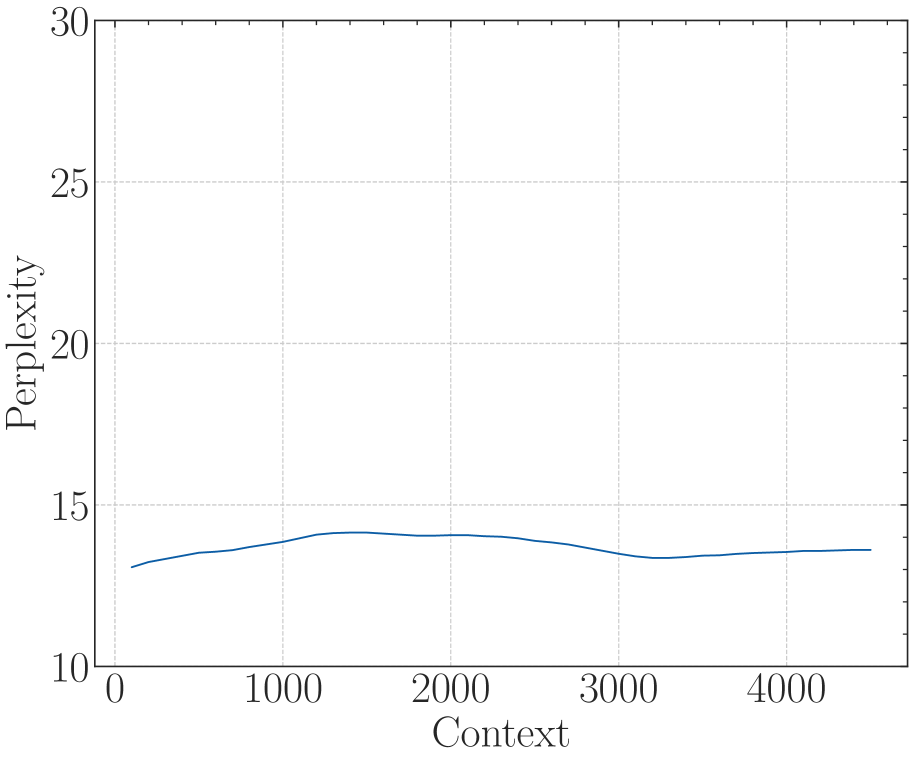
The chart contains a single data series represented by a solid dark blue line.
### Trend Verification
* **Initial Phase (0 - 1500 Context):** The line shows a steady upward slope, starting slightly above 13 and peaking near 14.2.
* **Middle Phase (1500 - 3200 Context):** The line exhibits a gradual decline, dipping back toward the 13.5 mark.
* **Final Phase (3200 - 4500 Context):** The line stabilizes and shows a very slight upward recovery, ending just below the 14 mark.
* **Overall Stability:** The data remains remarkably stable within a narrow band between 13 and 14.5 perplexity across the entire context window.
### Extracted Data Points (Approximate)
Based on the visual alignment with the grid:
| Context (X) | Perplexity (Y) |
| :--- | :--- |
| 100 | ~13.1 |
| 500 | ~13.5 |
| 1000 | ~13.8 |
| 1500 | ~14.2 (Peak) |
| 2000 | ~14.1 |
| 2500 | ~13.9 |
| 3200 | ~13.4 (Local Minimum) |
| 4000 | ~13.6 |
| 4500 | ~13.7 |
## 4. Visual Style and Metadata
* **Grid:** Light gray dashed lines for both major and minor increments.
* **Font:** Serif typeface used for all labels and numbers.
* **Legend:** No legend is present, as there is only one data series.
* **Language:** English.
## 5. Summary of Information
This technical chart illustrates the relationship between "Context" and "Perplexity." In the field of natural language processing, this typically represents how a model's predictive performance (Perplexity) changes as the input sequence length (Context) increases. The data indicates that the model maintains a consistent perplexity level (between 13 and 14.5) regardless of context length up to 4500 units, suggesting high stability and sustained performance over long sequences.