## Diagram: Latent Token Integration in Chain-of-Thought (CoT) Processing
### Overview
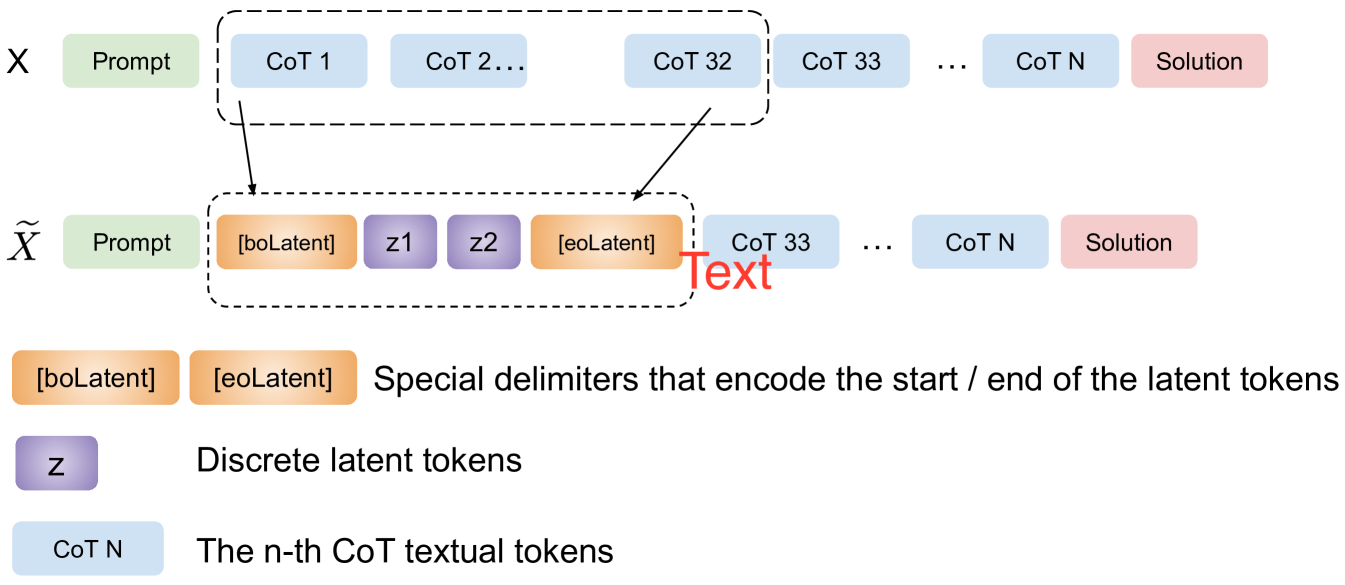
The diagram illustrates a two-stage process for generating solutions using latent tokens within a Chain-of-Thought (CoT) framework. It contrasts the original input sequence (X) with a modified version (X̃) that incorporates latent variables. The process involves sequential CoT steps, latent token insertion, and solution generation.
### Components/Axes
1. **Sections**:
- **X (Original Input)**: Contains prompt → CoT 1 → CoT 2 → ... → CoT 32 → CoT 33 → ... → CoT N → Solution
- **X̃ (Modified Input)**: Contains prompt → [boLatent] → z1 → z2 → [eoLatent] → CoT 33 → ... → CoT N → Solution
2. **Legend**:
- **Orange**: `[boLatent]` (beginning of latent tokens) and `[eoLatent]` (end of latent tokens)
- **Purple**: `z1`, `z2` (discrete latent tokens)
- **Blue**: `CoT N` (n-th CoT textual tokens)
3. **Key Elements**:
- **Textual Tokens**: Labeled as "Text" in red, spanning from `[boLatent]` to `[eoLatent]`
- **Delimiters**: `[boLatent]` and `[eoLatent]` mark the start/end of latent token sequences
- **Solution**: Final output in pink, identical in both X and X̃
### Detailed Analysis
1. **Original Process (X)**:
- Linear sequence from prompt to solution via CoT steps 1–N
- No latent tokens inserted
2. **Modified Process (X̃)**:
- Insertion of latent tokens between prompt and CoT 33:
- `[boLatent]` (orange) marks latent sequence start
- `z1`, `z2` (purple) represent discrete latent variables
- `[eoLatent]` (orange) marks latent sequence end
- CoT steps 33–N and solution remain unchanged
3. **Spatial Grounding**:
- **Top Section (X)**: Horizontal flow from left (prompt) to right (solution)
- **Bottom Section (X̃)**: Parallel flow with latent token insertion between prompt and CoT 33
- **Legend**: Positioned below the diagram, color-coded for clarity
### Key Observations
1. **Latent Token Placement**:
- Latent tokens (`z1`, `z2`) are inserted *after* the prompt but *before* CoT 33 in X̃
- `[boLatent]` and `[eoLatent]` act as syntactic boundaries for latent sequences
2. **CoT Continuity**:
- CoT steps 1–32 are omitted in X̃, suggesting they are replaced or bypassed by latent processing
- CoT 33–N and solution remain identical in both X and X̃
3. **Color Consistency**:
- All `[boLatent]` and `[eoLatent]` elements match the orange legend
- All `z` tokens match the purple legend
- All `CoT N` elements match the blue legend
### Interpretation
This diagram demonstrates a hybrid CoT approach where:
1. **Latent Variables** (`z1`, `z2`) are injected into the processing pipeline to potentially enhance solution quality or efficiency
2. **Delimiter Tokens** (`[boLatent]`, `[eoLatent]`) enable the model to explicitly demarcate latent token regions
3. **Partial Replacement** of early CoT steps (1–32) with latent processing suggests a focus on optimizing later stages of reasoning
4. The preservation of CoT 33–N and solution indicates that latent integration occurs *before* the final reasoning phases
The architecture implies a model that combines symbolic reasoning (CoT) with latent variable manipulation, possibly for tasks requiring both structured reasoning and latent knowledge representation.