# Technical Document Extraction
## Title
- **Text**: "C / Workshops / Findings"
- **Placement**: Top of the image
## Legend
- **Location**: Top right of the image
- **Color-Label Mapping**:
- **Dark Teal**: "A* / A (Flagship)"
- **Medium Teal**: "B (Strong)"
- **Light Teal**: "C / Workshops / Findings"
## Data Points
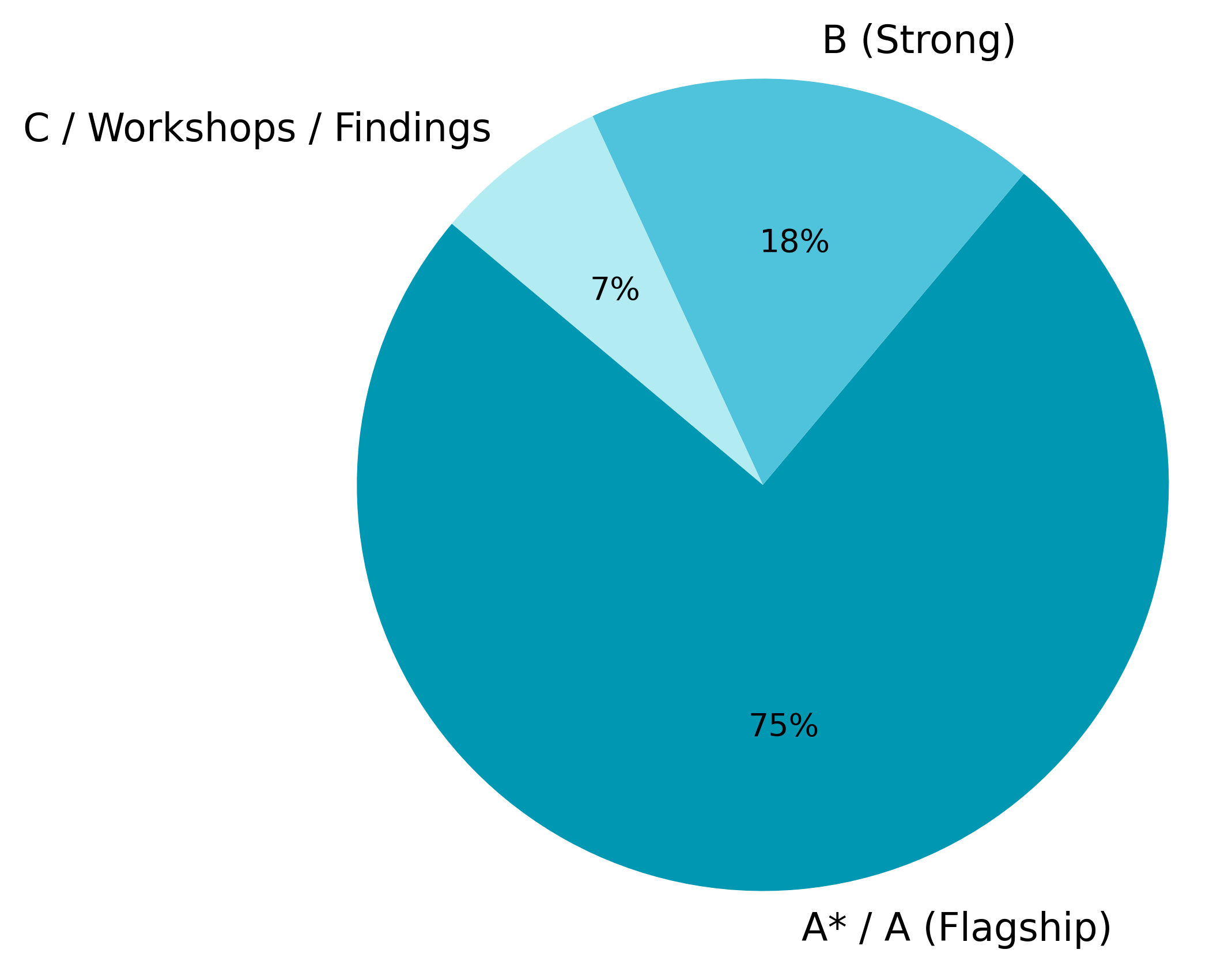
1. **Segment 1**:
- **Label**: "A* / A (Flagship)"
- **Percentage**: 75%
- **Color**: Dark Teal
- **Trend**: Dominates the chart, occupying the majority of the pie.
2. **Segment 2**:
- **Label**: "B (Strong)"
- **Percentage**: 18%
- **Color**: Medium Teal
- **Trend**: Second-largest segment, smaller than "A* / A" but larger than "C / Workshops / Findings".
3. **Segment 3**:
- **Label**: "C / Workshops / Findings"
- **Percentage**: 7%
- **Color**: Light Teal
- **Trend**: Smallest segment, occupying the least portion of the pie.
## Spatial Grounding
- **Legend Placement**: Top right of the image.
- **Color Consistency Check**:
- "A* / A (Flagship)" (Dark Teal) matches the largest segment.
- "B (Strong)" (Medium Teal) matches the second-largest segment.
- "C / Workshops / Findings" (Light Teal) matches the smallest segment.
## Trend Verification
- **Visual Analysis**:
- "A* / A (Flagship)" (75%) is the largest segment, visually dominating the chart.
- "B (Strong)" (18%) is the second-largest, with a moderate size.
- "C / Workshops / Findings" (7%) is the smallest, occupying a minimal portion.
- **Numerical Confirmation**:
- 75% + 18% + 7% = 100%, confirming data integrity.
## Component Isolation
1. **Header**:
- **Text**: "C / Workshops / Findings" (title).
2. **Main Chart**:
- **Structure**: Pie chart with three segments.
- **Labels**: Embedded within each segment.
3. **Footer**:
- **No explicit footer** in the image.
## Notes
- **Language**: All text is in English.
- **Data Completeness**: All labels, percentages, and colors are explicitly provided in the image.
- **No Missing Information**: No axis titles, axis markers, or additional text blocks are present.