## Diagram: Knowledge Graph Reasoning
### Overview
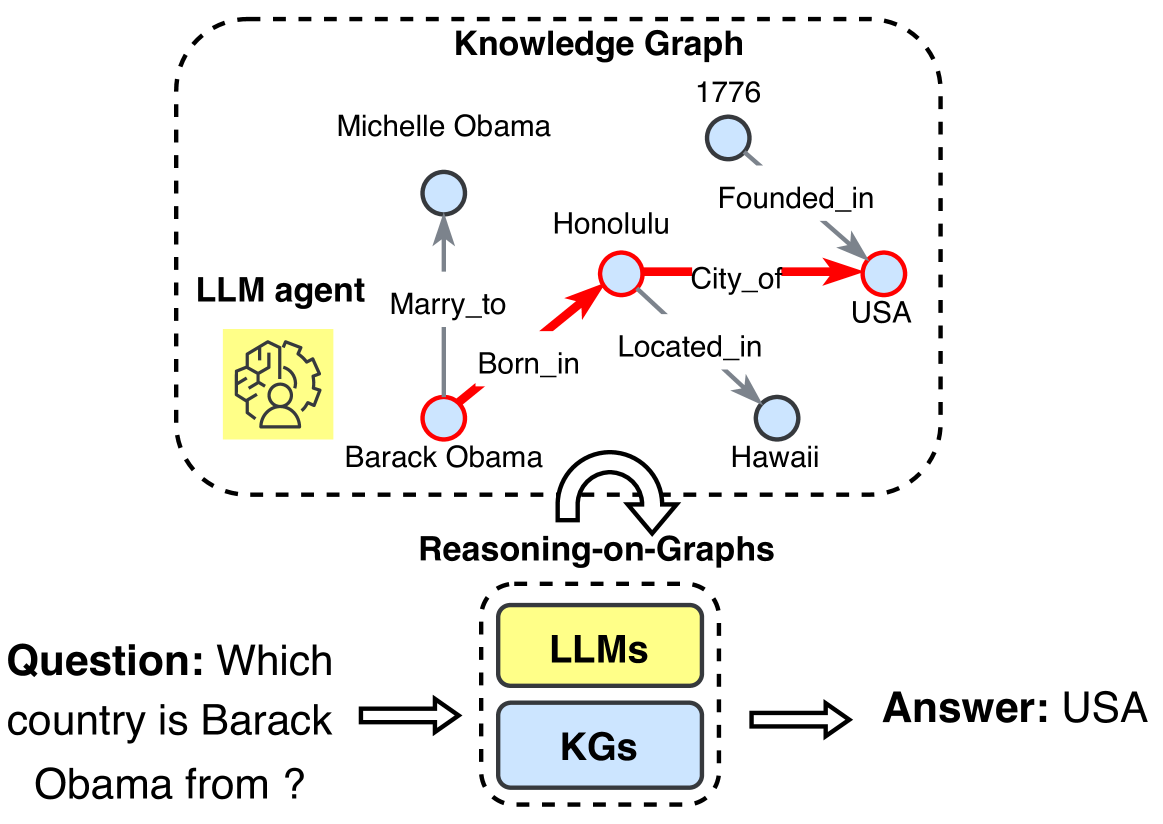
The image illustrates how a Language Learning Model (LLM) agent uses a knowledge graph to answer a question about Barack Obama's country of origin. The diagram shows the flow of information from the question, through the LLM and knowledge graph, to the final answer.
### Components/Axes
* **Knowledge Graph:** A network of interconnected entities and relationships, enclosed in a dashed rounded rectangle.
* **Nodes:** Represented as circles, containing entities like "Michelle Obama", "1776", "Honolulu", "USA", "Hawaii", and "Barack Obama".
* **Edges:** Represented as arrows, indicating relationships between entities, such as "Marry_to", "Founded_in", "City_of", "Located_in", and "Born_in". Red arrows appear to indicate the path of reasoning.
* **LLM Agent:** Represented by a yellow square containing a gear and person icon, located on the left side of the Knowledge Graph.
* **Reasoning-on-Graphs:** A process involving LLMs and Knowledge Graphs (KGs), depicted below the Knowledge Graph.
* **LLMs:** Represented by a yellow rounded rectangle.
* **KGs:** Represented by a blue rounded rectangle.
* **Question:** "Which country is Barack Obama from?" located on the bottom left.
* **Answer:** "USA" located on the bottom right.
* **Arrows:** Indicate the flow of information: Question -> Reasoning-on-Graphs -> Answer.
### Detailed Analysis
* **Knowledge Graph Details:**
* Michelle Obama "Marry_to" Barack Obama (gray arrow)
* Barack Obama "Born_in" Honolulu (red arrow)
* Honolulu "City_of" USA (red arrow)
* Honolulu "Located_in" Hawaii (gray arrow)
* USA "Founded_in" 1776 (gray arrow)
* **Reasoning Flow:**
1. The question "Which country is Barack Obama from?" is posed.
2. The LLM agent utilizes the knowledge graph to find the answer.
3. The knowledge graph contains the information that Barack Obama was "Born_in" Honolulu, and Honolulu is a "City_of" USA.
4. The LLM agent infers that Barack Obama is from the USA.
5. The answer "USA" is provided.
### Key Observations
* The diagram highlights the use of a knowledge graph to answer a question.
* The red arrows indicate the path of reasoning used to arrive at the answer.
* The LLM agent acts as an interface between the question and the knowledge graph.
### Interpretation
The diagram demonstrates how LLMs can leverage knowledge graphs to perform reasoning and answer questions. The knowledge graph provides structured information about entities and their relationships, which the LLM can use to infer answers to complex questions. In this specific example, the LLM uses the knowledge graph to determine that Barack Obama is from the USA by tracing the relationships between Barack Obama, Honolulu, and the USA. This illustrates the power of combining LLMs with knowledge graphs for question answering and other knowledge-intensive tasks.