## Knowledge Graph Diagram: Entity Relationships and Reasoning Flow
### Overview
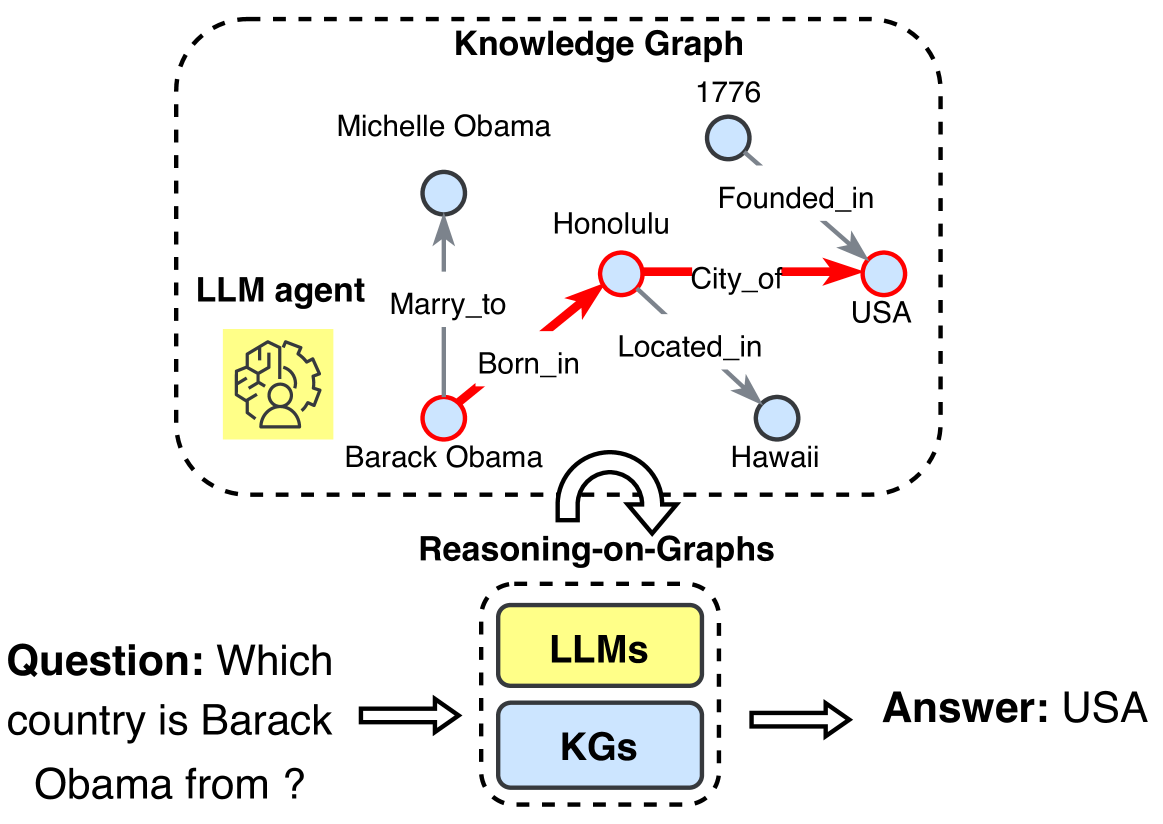
The diagram illustrates a knowledge graph (KG) structure with interconnected entities and relationships, alongside an LLM (Large Language Model) agent's reasoning process to answer a factual question. The graph connects people, locations, and historical data through labeled edges, demonstrating how semantic relationships enable knowledge retrieval.
### Components/Axes
1. **Knowledge Graph (KG) Elements**:
- **Nodes**:
- `Michelle Obama`, `Barack Obama`, `Honolulu`, `Hawaii`, `USA`, `1776`
- **Edges**:
- `Marry_to` (Michelle Obama → Barack Obama)
- `Born_in` (Barack Obama → Honolulu)
- `City_of` (Honolulu → USA)
- `Located_in` (Honolulu → Hawaii)
- `Founded_in` (USA → 1776)
- **LLM Agent**: Represented by a brain-with-person icon, labeled "LLM agent."
2. **Reasoning-on-Graphs Section**:
- **Input**: Question: "Which country is Barack Obama from?"
- **Process**:
- LLM (yellow box) → KG (blue box) → Answer: "USA"
- **Flow**: Arrows indicate the LLM queries the KG, which traverses edges to derive the answer.
### Detailed Analysis
- **Entity Relationships**:
- `Michelle Obama` is connected to `Barack Obama` via `Marry_to`.
- `Barack Obama` is linked to `Honolulu` via `Born_in`.
- `Honolulu` is associated with `USA` via `City_of` and `Hawaii` via `Located_in`.
- `USA` is connected to `1776` via `Founded_in`.
- **Question-Answer Flow**:
1. The LLM agent receives the question and queries the KG.
2. The KG traverses the `Born_in` edge from `Barack Obama` to `Honolulu`.
3. From `Honolulu`, it follows the `City_of` edge to `USA`.
4. The final answer "USA" is returned.
### Key Observations
- **Structural Logic**: The graph enforces semantic consistency (e.g., `City_of` links cities to countries).
- **Temporal Context**: `1776` is explicitly tied to `USA` as its founding year.
- **Redundancy Check**: `Honolulu` has two edges (`City_of` → `USA`, `Located_in` → `Hawaii`), ensuring cross-validation of geographic relationships.
### Interpretation
This diagram demonstrates how knowledge graphs enable LLMs to answer complex questions by leveraging structured relationships. The correct answer ("USA") is derived by following the `Born_in` → `City_of` path, highlighting the importance of edge labels in defining semantic paths. The inclusion of `1776` adds historical context, showing how KGs can integrate temporal data. The LLM-KG interaction model emphasizes the synergy between generative AI and structured knowledge systems for factual reasoning.