## Chart: Theorems Proved vs. Wall-Clock Time
### Overview
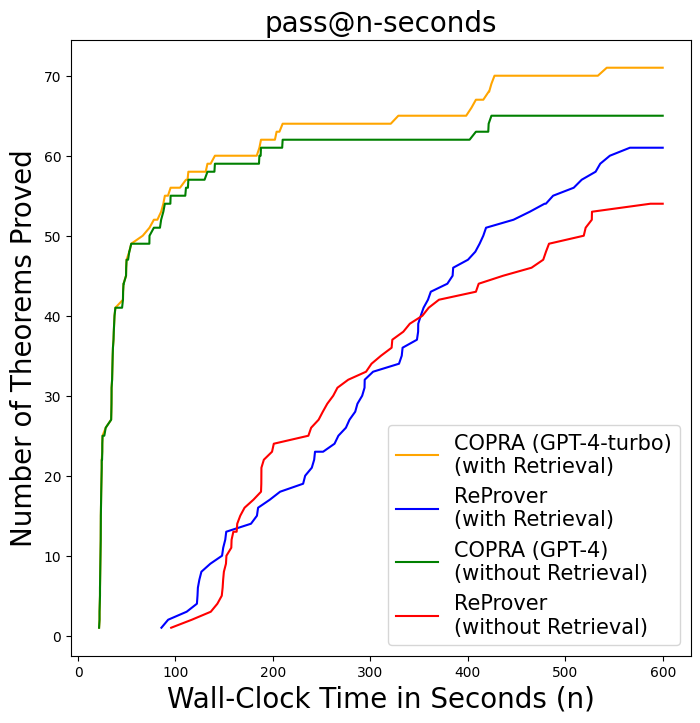
The image is a line chart comparing the number of theorems proved by different systems (COPRA and ReProver) using different configurations (with and without retrieval) over a period of wall-clock time in seconds. The chart displays four data series, each representing a different system configuration.
### Components/Axes
* **Title:** pass@n-seconds
* **X-axis:** Wall-Clock Time in Seconds (n)
* Scale: 0 to 600, with tick marks at intervals of 100.
* **Y-axis:** Number of Theorems Proved
* Scale: 0 to 70, with tick marks at intervals of 10.
* **Legend:** Located in the center-right of the chart.
* **Gold:** COPRA (GPT-4-turbo) (with Retrieval)
* **Dark Blue:** ReProver (with Retrieval)
* **Green:** COPRA (GPT-4) (without Retrieval)
* **Red:** ReProver (without Retrieval)
### Detailed Analysis
* **COPRA (GPT-4-turbo) (with Retrieval) - Gold Line:**
* Trend: The line generally slopes upward, indicating an increase in the number of theorems proved as time increases. The line plateaus around 65 theorems proved after approximately 300 seconds.
* Data Points:
* At approximately 100 seconds, around 50 theorems proved.
* At approximately 200 seconds, around 60 theorems proved.
* At approximately 300 seconds, around 65 theorems proved.
* At approximately 600 seconds, around 65 theorems proved.
* **ReProver (with Retrieval) - Dark Blue Line:**
* Trend: The line slopes upward, indicating an increase in the number of theorems proved as time increases.
* Data Points:
* At approximately 100 seconds, around 2 theorems proved.
* At approximately 200 seconds, around 20 theorems proved.
* At approximately 300 seconds, around 35 theorems proved.
* At approximately 400 seconds, around 43 theorems proved.
* At approximately 500 seconds, around 54 theorems proved.
* At approximately 600 seconds, around 61 theorems proved.
* **COPRA (GPT-4) (without Retrieval) - Green Line:**
* Trend: The line increases rapidly initially, then plateaus around 65 theorems proved after approximately 200 seconds.
* Data Points:
* At approximately 50 seconds, around 48 theorems proved.
* At approximately 100 seconds, around 58 theorems proved.
* At approximately 200 seconds, around 62 theorems proved.
* At approximately 600 seconds, around 65 theorems proved.
* **ReProver (without Retrieval) - Red Line:**
* Trend: The line slopes upward, indicating an increase in the number of theorems proved as time increases.
* Data Points:
* At approximately 100 seconds, around 2 theorems proved.
* At approximately 200 seconds, around 5 theorems proved.
* At approximately 300 seconds, around 25 theorems proved.
* At approximately 400 seconds, around 43 theorems proved.
* At approximately 500 seconds, around 50 theorems proved.
* At approximately 600 seconds, around 54 theorems proved.
### Key Observations
* COPRA (GPT-4) without retrieval (green line) proves theorems much faster initially than the other configurations, reaching a plateau early on.
* COPRA (GPT-4-turbo) with retrieval (gold line) performs similarly to COPRA (GPT-4) without retrieval (green line), but plateaus slightly earlier.
* ReProver, both with and without retrieval (blue and red lines), proves theorems at a slower rate compared to COPRA.
* The "with Retrieval" configurations for both COPRA and ReProver generally outperform their "without Retrieval" counterparts, although the difference is more pronounced for ReProver.
### Interpretation
The chart demonstrates the performance of different theorem proving systems (COPRA and ReProver) under varying conditions (with and without retrieval). The data suggests that:
* COPRA, especially when using GPT-4 (with or without retrieval), is more efficient at proving theorems within the given time frame compared to ReProver.
* The use of retrieval mechanisms generally improves the performance of both systems, particularly for ReProver.
* The rapid initial increase in theorems proved by COPRA (GPT-4) without retrieval suggests that it quickly finds a set of provable theorems and then plateaus, possibly indicating a limitation in its ability to explore more complex theorems without retrieval assistance.
* The slower but more consistent increase in theorems proved by ReProver suggests a different approach to theorem proving, potentially one that explores a broader range of theorems but at a slower pace.