\n
## Line Chart: pass@n-seconds
### Overview
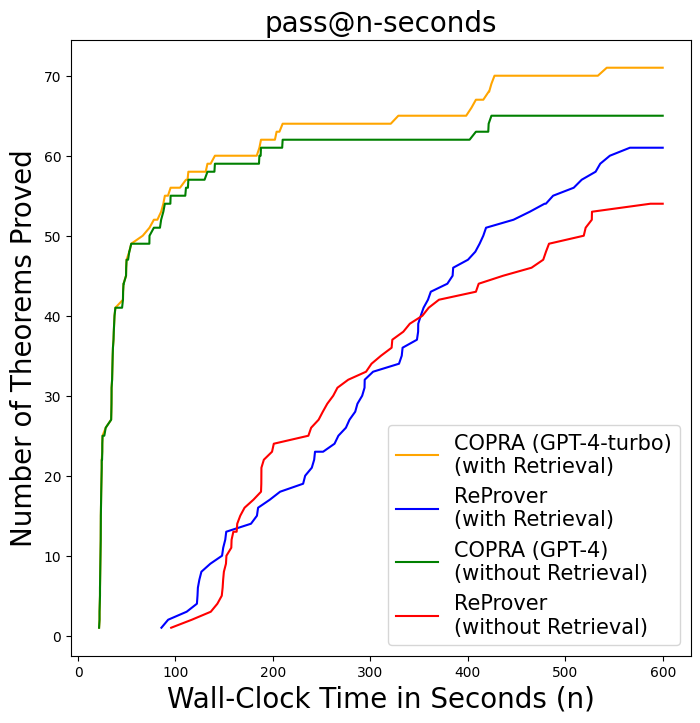
The image is a line chart titled "pass@n-seconds" that compares the performance of four different automated theorem-proving systems over time. The chart plots the cumulative number of theorems proved against the wall-clock time in seconds. It demonstrates how quickly each system can solve problems, with a focus on the impact of a "Retrieval" mechanism.
### Components/Axes
* **Chart Title:** `pass@n-seconds` (Top center)
* **Y-Axis:** Label is `Number of Theorems Proved`. Scale runs from 0 to 70 in increments of 10.
* **X-Axis:** Label is `Wall-Clock Time in Seconds (n)`. Scale runs from 0 to 600 in increments of 100.
* **Legend:** Located in the bottom-right quadrant of the chart area. It contains four entries, each with a colored line sample and a text label:
1. **Yellow Line:** `COPRA (GPT-4-turbo) (with Retrieval)`
2. **Blue Line:** `ReProver (with Retrieval)`
3. **Green Line:** `COPRA (GPT-4) (without Retrieval)`
4. **Red Line:** `ReProver (without Retrieval)`
### Detailed Analysis
The chart displays four data series, each representing a different system configuration. The trend for each is a non-decreasing step function, as the cumulative count of proved theorems can only increase or stay flat.
1. **COPRA (GPT-4-turbo) with Retrieval (Yellow Line):**
* **Trend:** Shows the fastest initial growth and maintains the highest performance throughout. It has a very steep ascent in the first ~50 seconds, then continues to climb in smaller steps, plateauing near the top.
* **Key Data Points (Approximate):**
* At n=50s: ~50 theorems proved.
* At n=100s: ~55 theorems proved.
* At n=300s: ~64 theorems proved.
* At n=600s: ~71 theorems proved (highest final value).
2. **COPRA (GPT-4) without Retrieval (Green Line):**
* **Trend:** Follows a very similar trajectory to its "with Retrieval" counterpart (yellow), but consistently lags slightly behind. It also has a steep initial rise.
* **Key Data Points (Approximate):**
* At n=50s: ~49 theorems proved.
* At n=100s: ~53 theorems proved.
* At n=300s: ~62 theorems proved.
* At n=600s: ~65 theorems proved.
3. **ReProver with Retrieval (Blue Line):**
* **Trend:** Begins proving theorems later than the COPRA systems (starting around n=100s). It shows a steady, roughly linear increase over time, with a moderate slope.
* **Key Data Points (Approximate):**
* At n=100s: ~5 theorems proved.
* At n=200s: ~18 theorems proved.
* At n=300s: ~35 theorems proved.
* At n=600s: ~61 theorems proved.
4. **ReProver without Retrieval (Red Line):**
* **Trend:** Also begins around n=100s. Its growth is the slowest of the four, with a shallower slope compared to the blue line (ReProver with Retrieval).
* **Key Data Points (Approximate):**
* At n=100s: ~2 theorems proved.
* At n=200s: ~14 theorems proved.
* At n=300s: ~33 theorems proved.
* At n=600s: ~54 theorems proved.
### Key Observations
* **Performance Hierarchy:** The final ranking at 600 seconds is: 1) COPRA (GPT-4-turbo, with Retrieval), 2) COPRA (GPT-4, without Retrieval), 3) ReProver (with Retrieval), 4) ReProver (without Retrieval).
* **Impact of Retrieval:** For both COPRA and ReProver, the "with Retrieval" variant outperforms the "without Retrieval" variant. The performance gap is more pronounced for ReProver (blue vs. red lines) than for COPRA (yellow vs. green lines).
* **Initial Speed:** The COPRA systems (yellow, green) demonstrate a significant advantage in the early phase (0-100 seconds), solving many theorems very quickly. The ReProver systems (blue, red) have a delayed start.
* **Growth Patterns:** COPRA systems show a "fast start, then plateau" pattern. ReProver systems show a "slow start, then steady climb" pattern.
### Interpretation
This chart evaluates the efficiency of different AI-driven theorem-proving agents. The data suggests that:
1. **Model Foundation Matters:** Systems built on GPT-4-turbo (COPRA) have a substantial initial speed and overall capacity advantage over the ReProver architecture in this benchmark.
2. **Retrieval is Beneficial:** Augmenting a prover with a retrieval mechanism (likely for accessing relevant lemmas or past proofs) consistently improves performance, allowing it to prove more theorems within the same time budget. This effect is critical for ReProver to become competitive.
3. **Time-Accuracy Trade-off:** If the goal is to solve as many problems as possible under a strict time limit (e.g., <100 seconds), COPRA is the clear choice. If given a longer time budget (>300 seconds), the gap narrows, and ReProver with Retrieval becomes a viable contender, eventually surpassing COPRA without Retrieval.
4. **Underlying Capability:** The steep initial climb of COPRA implies it may be better at recognizing and solving "easy" theorems almost immediately, while ReProver requires a warm-up period, possibly for building an internal context or search tree. The steady climb of ReProver suggests a more systematic, perhaps deeper, search process that pays off over time.