# Technical Document Extraction: Heatmap Analysis
## Image Description
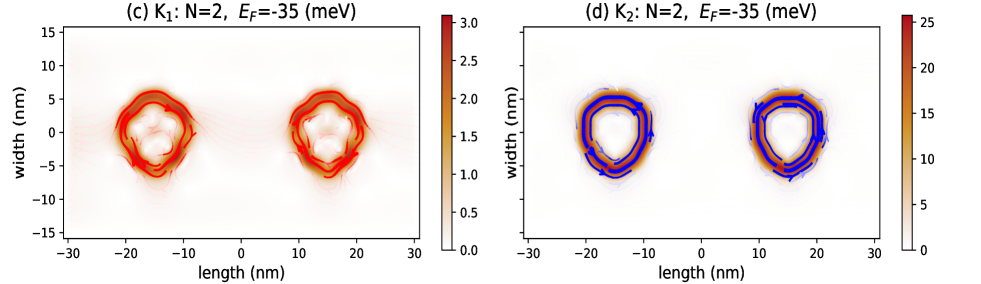
The image contains two side-by-side heatmaps labeled **(c)** and **(d)**, representing spatial intensity distributions under identical parameters:
- **N=2** (likely a quantum number or system parameter)
- **E_F=-35 meV** (Fermi energy)
### Key Components
1. **Axes**
- **X-axis**: `length (nm)` ranging from **-30 nm to 30 nm**
- **Y-axis**: `width (nm)` ranging from **-15 nm to 15 nm**
2. **Color Scales**
- **(c)**: Red-to-white gradient, intensity range **0.0 to 3.0** (unitless)
- **(d)**: Blue-to-red gradient, intensity range **0.0 to 25.0** (unitless)
3. **Structural Features**
- **Heatmap (c)**:
- Symmetrical **dipole-like lobes** centered at (±10 nm, 0 nm)
- Central void (low-intensity region) with radiating intensity peaks
- Smooth gradient transition from red (high intensity) to white (low intensity)
- **Heatmap (d)**:
- **Annular ring structure** with concentric intensity variations
- Central void surrounded by alternating high/low intensity rings
- Blue (low intensity) transitions to red (high intensity) at outer edges
4. **Legend Cross-Reference**
- **(c)** Colorbar: Red = 3.0, White = 0.0
- **(d)** Colorbar: Blue = 0.0, Red = 25.0
## Observations
- **Similarities**:
- Both heatmaps exhibit **central voids** and **symmetrical intensity distributions** about the origin.
- Identical system parameters (**N=2**, **E_F=-35 meV**) suggest comparable physical conditions.
- **Differences**:
- **(c)** shows **dipolar symmetry** with localized intensity maxima at ±10 nm.
- **(d)** exhibits **rotational symmetry** with distributed intensity in annular patterns.
- **(d)** has a **10× higher intensity range** (25 vs. 3.0), indicating stronger spatial variations.
## Technical Notes
- The heatmaps likely represent **quantum mechanical probability densities** or **electronic band structures** for a system with two nodes (N=2).
- The negative Fermi energy (E_F=-35 meV) implies a **valence-band-dominated** system.
- Structural differences between (c) and (d) may reflect variations in **spin-orbit coupling**, **magnetic field orientation**, or **interaction strength**.